

This is the Textbook Assignment: Chapter 3, “Direct Current” from the Module 1 — Introduction to Matter, Energy, and Direct Current in Navy Electricity and Electronics Training Series (NEETS) . If you are looking for a reviewer in Electronics Engineering this will definitely help. I can assure you that this will be a great help in reviewing the book in preparation for your Board Exam. Make sure to familiarize each and every questions to increase the chance of passing the ECE Board Exam.
Start Practice Exam Test Questions
Choose the letter of the best answer in each questions.
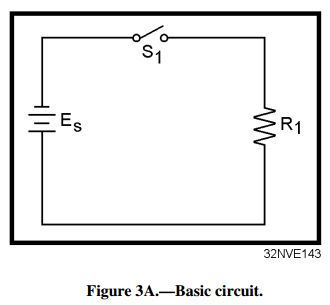
Figure 3A.—Basic circuit.
IN ANSWERING QUESTIONS 1 THROUGH 3, REFER TO FIGURE 3A.
1. What parts of the circuit represent the (a) source and (b) load?
- A. (a) Es (b) S1
- B. (a) Es (b) R1
- C. (a) S1 (b) R1
- D. (a) S1 (b) Es
2. Which of the following terms describes the circuit condition?
- A. Partially shorted
- B. Partially open
- C. Shorted
- D. Open
3. Which of the following terms describes the figure 3A?
- A. Parts layout
- B. Exploded view
- C. Wiring diagram
- D. Schematic diagram
4. If circuit voltage is held constant, circuit current will react in what manner as the resistance (a) increases, and (b) decreases?
- A. (a) Increase (b) decrease
- B. (a) Increase (b) increase
- C. (a) Decrease (b) decrease
- D. (a) Decrease (b) increase
5. If circuit resistance is held constant, circuit current will react in what manner as the voltage (a) increases, and (b) decreases?
- A. (a) Increase (b) decrease
- B. (a) Increase (b) increase
- C. (a) Decrease (b) decrease
- D. (a) Decrease (b) increase
3-6. According to Ohm’s law, what formula should be used to calculate circuit voltage if resistance and current value are known?
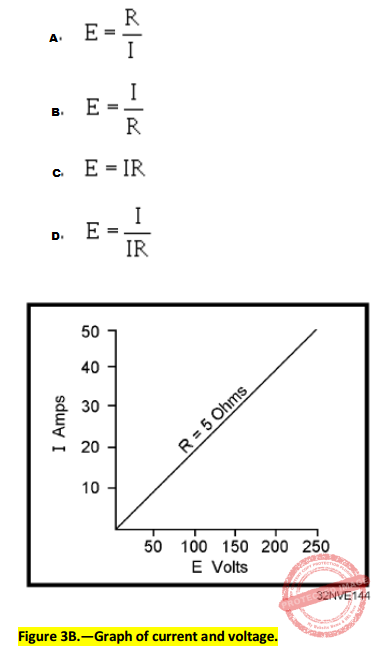
Figure 3B.—Graph of current and voltage.
IN ANSWERING QUESTIONS 7 AND 8, REFER TO FIGURE 3B.
7. If the current is 15 amperes, what is the value of the voltage?
- A. 50 V
- B. 75 V
- C. 100 V
- D. 150 V
8. If the voltage is 200 volts, what is the value of the current?
- A. 10 A
- B. 20 A
- C. 30 A
- D. 40 A
9. Which of the following terms applies to the rate at which an electrical force causes motion?
- A. Power
- B. Energy
- C. Inertia
- D. Each of the above
10. Which of the following circuit quantities can be varied ONLY by varying one of the other circuit quantities?
- A. Voltage
- B. Current
- C. Resistance
- D. Each of the above
11. Which of the following is a correct formula for determining power in an electrical circuit?
- A. P = EI
- B. P = I2R
- C. P = E2/R
- D. Each of the above
12. What is the current in a circuit with 15 ohms of resistance that uses 135 watts of power?
- A. 10 A
- B. 15 A
- C. 3 A
- D. 9 A
13. What is the total power used by a 15-ohm resistor with 4 amps of current?
- A. 60 W
- B. 240 W
- C. 360 W
- D. 900 W
14. What type of resistor should be used in question 3-13?
- A. Carbon
- B. Wirewound
- C. Precision
- D. Composition
15. How much total energy is converted by a 1-horsepower motor in 10 hours?
- A. 7.46 kWh
- B. 8.32 kWh
- C. 8.59 kWh
- D. 9.32 kWh
16. If the energy used by the motor in question 3-15 is 9.5 kWh, what is the efficiency of the motor?
- A. 0.981
- B. 0.904
- C. 0.876
- D. 0.785
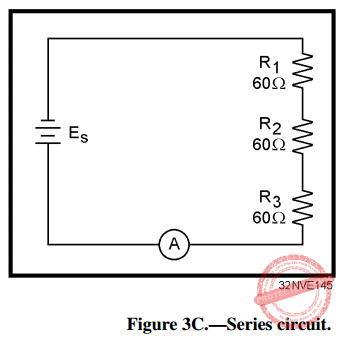
Figure 3C.—Series circuit.
IN ANSWERING QUESTIONS 17 THROUGH 23, REFER TO FIGURE 3C.
17. What is the total circuit resistance (R)?
- A. 20 Ω
- B. 60 Ω
- C. 180 Ω
- D. 240 Ω
18. If the circuit current is 3 amps, what is the source voltage (Es)?
- A. 60 V
- B. 180 V
- C. 540 V
- D. 720 V
19. What is the total voltage dropped by each resistor in question 18?
- A. 20 V
- B. 60 V
- C. 180 V
- D. 540 V
20. If the current decreases to 2 amps, what is the total voltage drop across each resistor?
- A. 120 V
- B. 230 V
- C. 310 V
- D. 400 V
21. What would have to be done to the circuit to cause the current to decrease to 2 amps?
- A. The source voltage would have to be increased
- B. The source voltage would have to be decreased
- C. The resistance of R1 would have to be decreased
- D. One of the resistors would have to be removed from the circuit
22. If the circuit current is 2 amps, what is the total power used by each resistor?
- A. 240 W
- B. 460 W
- C. 620 W
- D. 800 W
23. What is the total power used in the circuit if Es = 360 V?
- A. 720 W
- B. 1380 W
- C. 1860 W
- D. 2400 W
24. When Kirchhoff’s voltage law is used to assign polarities to the voltage drop across a resistor, which of the following references is used to indicate the end of the resistor that the current enters?
- A. Ground
- B. Neutral
- C. Negative
- D. Positive
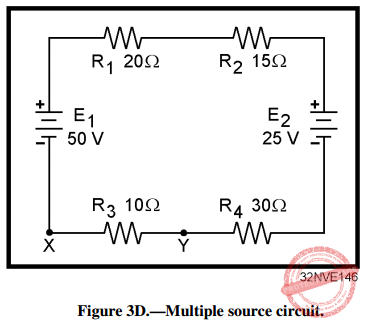
Figure 3D.—Multiple source circuit.
IN ANSWERING QUESTIONS 25 AND 26, REFER TO FIGURE 3D.
25. What is the effective source voltage?
- A. 15 V
- B. 25 V
- C. 50 V
- D. 75 V
26. What is the total amount and direction of current through R3?
- A. 1.0 A from Y to X
- B. 1.0 A from X to Y
- C. 0.33 A from Y to X
- D. 0.33 A from X to Y
27. Which of the following terms applies to a circuit in which there is NO complete path for current?
- A. Open
- B. Short
- C. Closed
- D. Grounded
28. A circuit in which the resistance is almost zero ohms is referred to by which of the following terms?
- A. Open
- B. Short
- C. Closed
- D. Broken
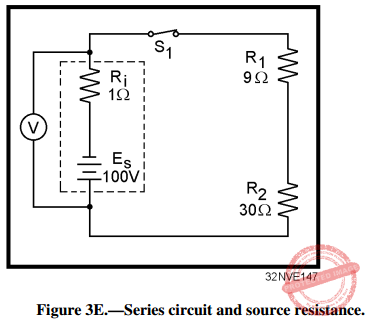
Figure 3E.—Series circuit and source resistance.
IN ANSWERING QUESTIONS 29 THROUGH 32, REFER TO FIGURE 3E.
29. If R2 has a short circuit, what will most likely happen to the circuit?
- A. R1 will be destroyed
- B. Es will increase
- C. V will indicate O volts
- D. S1 will automatically open
30. What is the total voltage drop across Ri when the switch is closed?
- A. 2.5 V
- B. 6.5 V
- C. 97.5 V
- D. 100.0 V
31. What will the meter indicate with (a) S1 open, and (b) S1 closed?
- A. (a) 100 V (b) 100 V
- B. (a) 97.5 V (b) 100 V
- C. (a) 100 V (b) 97.5 V
- D. (a) 97.5 V (b) 97.5 V
32. To achieve maximum power transfer in the circuit, which of the following conditions must be met?
- A. Ri = RL
- B. Is = IL
- C. Es = EL
- D. Ks = KL
33. Maximum power is transferred from a source to a load when the value of the load resistance is of what value when compared to the source resistance?
- A. Equal
- B. Twice
- C. One-half
- D. Several times
34. When maximum power is transferred from a source to a load, what is the efficiency of power transfer?
- A. 5%
- B. 25%
- C. 50%
- D. 95%
35. A circuit consists of three resistors connected in parallel. R1= 30 ohms, R2= 15 ohms, and R3= 10 ohms. If the current through R2= 4 amperes, what is the total source voltage?
- A. 20 V
- B. 60 V
- C. 120 V
- D. 220 V
36. What is the relationship of total current to the current through a component in (a) a series circuit, and (b) a parallel circuit?
- A. (a) Divides (b) divides
- B. (a) Divides (b) equals
- C. (a) Equals (b) equals
- D. (a) Equals (b) divides
37. If a current has a negative polarity when Kirchhoff’s current law is applied, which of the following, statements is true of the current?
- A. It is from a battery
- B. It is from a generator
- C. It is entering a junction
- D. It is leaving a junction
38. Three equal resistors are connected in parallel and each resistor has an ohmic value of 300 ohms. What is the equivalent resistance of the circuit?
- A. 100 Ω
- B. 150 Ω
- C. 600 Ω
- D. 900 Ω
39. Three resistors with ohmic values of 120 ohms, 60 ohms, and 40 ohms are connected in parallel. What is the equivalent resistance of the circuit?
- A. 10 Ω
- B. 20 Ω
- C. 30 Ω
- D. 40 Ω
40. Two resistors with ohmic values of 90 ohms and 45 ohms are connected in parallel. What is the equivalent resistance of the circuit?
- A. 10 Ω
- B. 20 Ω
- C. 30 Ω
- D. 40 Ω
41. Which of the following terms describes a single resistor that represents a complex circuit?
- A. Equal resistor
- B. Phantom resistor
- C. Schematic resistor
- D. Equivalent resistor
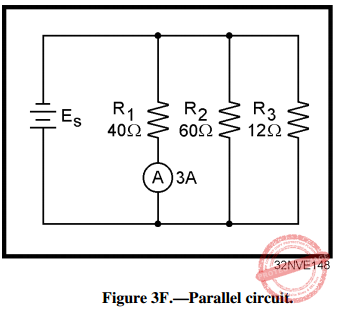
Figure 3F.—Parallel circuit.
IN ANSWERING QUESTIONS 42 THROUGH 46, REFER TO FIGURE 3F.
42. What is the value of Es?
- A. 336 V
- B. 300 V
- C. 240 V
- D. 120 V
43. What is the value of current through R2?
- A. 1 A
- B. 2 A
- C. 3 A
- D. 4 A
44. What is the approximate value of total resistance?
- A. 8 Ω
- B. 37 Ω
- C. 112 Ω
- D. 257 Ω
45. What is the value of total power?
- A. 1.2 kW
- B. 1.5 kW
- C. 1.8 kW
- D. 2.0 kW
46. What is the total power consumed by R3?
- A. 108 W
- B. 240 W
- C. 360 W
- D. 1200 W
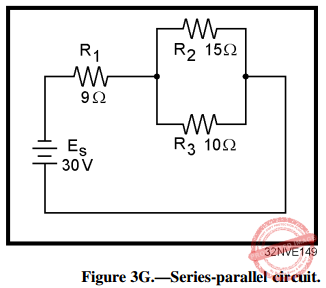
Figure 3G.—Series-parallel circuit.
IN ANSWERING QUESTIONS 47 THROUGH 49, REFER TO FIGURE 3G.
47. What is the value of the total resistance?
- A. 3.6 Ω
- B. 15 Ω
- C. 34 Ω
- D. 40 Ω
48. What is the total power used in the circuit?
- A. 22.5 W
- B. 26.5 W
- C. 60.0 W
- D. 250.0 W
49. What is the total voltage drop across R3?
- A. 8 V
- B. 12 V
- C. 18 V
- D. 30 V
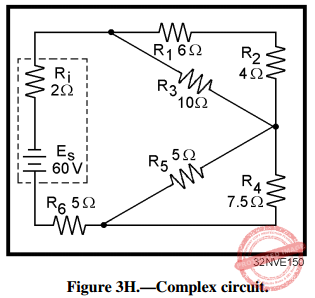
Figure 3H.—Complex circuit.
IN ANSWERING QUESTIONS 50 AND 51, REFER TO FIGURE 3H.
50. What is the value of total resistance?
- A. 5 Ω
- B. 8 Ω
- C. 13 Ω
- D. 15 Ω
51. If an equivalent resistor is used to represent the network of R1, R2, R3, R4, R5, and R6, what is the total voltage drop across this resistor?
- A. 8 V
- B. 26 V
- C. 52 V
- D. 60 V
52. If an open occurs in a series portion of a circuit, what is the effect on (a) total resistance, and (b) total current?
- A. (a) Decreases to zero (b) Becomes infinite
- B. (a) Decreases to zero (b) Decreases to zero
- C. (a) Becomes infinite (b) Becomes infinite
- D. (a) Becomes infinite (b) Decreases to zero
53. If an open occurs in a parallel branch of a circuit, what is the effect on (a) total resistance, and (b) total current?
- A. (a) Increases (b) decreases
- B. (a) Increases (b) increases
- C. (a) Decreases (b) decreases
- D. (a) Decreases (b) increases
54. If a short circuit occurs in a series portion of a circuit, what is the effect on (a) total resistance, and (b) total current?
- A. (a) Increases (b) decreases
- B. (a) Increases (b) increases
- C. (a) Decreases (b) decreases
- D. (a) Decreases (b) increases
55. If a short circuit occurs in a parallel branch of a circuit, what is the effect in (a) total resistance, and (b) total current?
- A. (a) Increases (b) decreases
- B. (a) Increases (b) increases
- C. (a) Decreases (b) decreases
- D. (a) Decreases (b) increases
56. If one branch of a parallel network shorts, what portion of the circuit current, if any, will flow through the remaining branches?
- A. An amount determined by the combined resistance of the remaining branches
- B. All
- C. One-half
- D. None
57. Which of the following circuit quantities need NOT be known before designing a voltage divider?
- A. The current of the source
- B. The voltage of the source
- C. The current requirement of the load
- D. The voltage requirement of the load
THE FOLLOWING INFORMATION IS TO BE USED IN ANSWERING QUESTIONS 58 THROUGH 60: A VOLTAGE DIVIDER IS REQUIRED TO SUPPLY A SINGLE LOAD WITH +150 VOLTS AND 300 MILLIAMPS OF CURRENT. THE SOURCE VOLTAGE IS 250 VOLTS. (HINT: DRAW THE CIRCUIT.)
58. What should be the value of the bleeder current?
- A. 3 A
- B. 300 mA
- C. 30 mA
- D. 3 mA
59. What should be the ohmic value of the bleeder resistor?
- A. 50
- B. 500
- C. 5 kΩ
- D. 50 kΩ
60. What is the value of total current?
- A. 303 mA
- B. 330 mA
- C. 600 mA
- D. 3300 mA
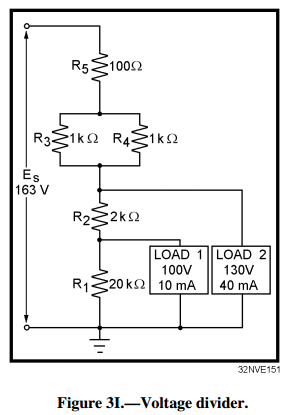
Figure 3I.—Voltage divider.
IN ANSWERING QUESTIONS 61 THROUGH 66, REFER TO FIGURE 3I.
61. Why must the value of R1 be calculated first?
- A. For convenience
- B. The current through R2 depends on the value of R1
- C. The voltage drop across R1 depends on the value of load 1
- D. In any circuit, values for resistors labeled R1 are calculated first
62. How is the current through R2 calculated?
- A. By adding IR1 and the current requirement of load 1
- B. By adding the current requirements of load 1 and load 2
- C. By subtracting the current requirement of load 1 from the current requirement of load 2
- D. By subtracting the current requirement of load 2 from the current requirement of load 1
63. How is the voltage drop across R2 calculated?
- A. By adding the voltage requirements of load 1 and load 2
- B. By subtracting the voltage drops across R5 and R3 from the source voltage
- C. By subtracting the voltage requirement of load 1 from the voltage requirement of load 2
- D. By subtracting the voltage requirements of load 1 and load 2 from the source voltage
64. What is the minimum wattage rating required for R5?
- A. 1 W
- B. 2 W
- C. 1/2 W
- D. 1/4 W
65. What is the total power supplied by the source?
- A. 3.765 W
- B. 7.965 W
- C. 8.209 W
- D. 8.965 W
66. What is the purpose of using the series-parallel network consisting of R3, R4, and R5 in place of a single resistor?
- A. It provides the desired resistance with resistor values that are easily obtainable
- B. It provides the close tolerance required for the circuit
- C. It is more reliable than the use of a single resistor
- D. It costs less by using three resistors of lower wattage rating than a single, large power resistor
67. A single voltage divider provides both negative and positive voltages from a single source voltage through the use of a
- A. ground between two of the dividing resistors
- B. ground to the positive terminal of the source
- C. ground to the negative terminal of the source
- D. ground to the input of all loads requiring a negative voltage
68. Which of the following voltages are considered dangerous?
- A. Voltages above 115 volts only
- B. Voltages above 230 volts only
- C. Voltages above 450 volts only
- D. All voltages
69. If you discover a possible malfunction in an electric circuit, which of the following actions should be taken?
- A. Attempt repairs yourself
- B. Report the malfunction to a qualified technician
- C. Ignore the malfunction unless you were assigned to repair it
- D. Secure the circuit immediately by removing power at the nearest switch
70. If a person has stopped breathing and there is NO detectable heartbeat, who should perform CPR?
- A. Medical personnel only
- B. The first person on the scene
- C. Emergency Medical Technicians only
- D. Trained, qualified personnel only
Check your work.
Download File in PDF
Related Content




P inoyBIX educates thousands of reviewers and students a day in preparation for their board examinations. Also provides professionals with materials for their lectures and practice exams. Help me go forward with the same spirit.
“Will you subscribe today via YOUTUBE?”
TIRED OF ADS?
- Become Premium Member and experienced complete ads-free content browsing.
- Full Content Access to Premium Solutions Exclusive for Premium members
- Access to PINOYBIX FREEBIES folder
- Download Reviewers and Learning Materials Free
- Download Content: You can see download/print button at the bottom of each post.
PINOYBIX FREEBIES FOR PREMIUM MEMBERSHIP:
- CIVIL ENGINEERING REVIEWER
- CIVIL SERVICE EXAM REVIEWER
- CRIMINOLOGY REVIEWER
- ELECTRONICS ENGINEERING REVIEWER (ECE/ECT)
- ELECTRICAL ENGINEERING & RME REVIEWER
- FIRE OFFICER EXAMINATION REVIEWER
- LET REVIEWER
- MASTER PLUMBER REVIEWER
- MECHANICAL ENGINEERING REVIEWER
- NAPOLCOM REVIEWER
- Additional upload reviewers and learning materials are also FREE
FOR A LIMITED TIME
If you subscribe for PREMIUM today!
You will receive an additional 1 month of Premium Membership FREE.
For Bronze Membership an additional 2 months of Premium Membership FREE.
For Silver Membership an additional 3 months of Premium Membership FREE.
For Gold Membership an additional 5 months of Premium Membership FREE.
Join the PinoyBIX community.