
This is the Textbook Assignment: Chapter 1, “Turning to Electricity” from the Module 1 — Introduction to Matter, Energy, and Direct Current in Navy Electricity and Electronics Training Series (NEETS) . If you are looking for a reviewer in Electronics Engineering this will definitely help. I can assure you that this will be a great help in reviewing the book in preparation for your Board Exam. Make sure to familiarize each and every questions to increase the chance of passing the ECE Board Exam.
Start Practice Exam Test Questions
Choose the letter of the best answer in each questions.
1. Matter can be found in which of the following forms?
- A. Solid
- B. Liquid
- C. Gaseous
- D. Each of the above
2. A substance that CANNOT be reduced to a simpler substance by chemical means is called a/an
- A. element
- B. mixture
- C. compound
- D. solution
3. A molecule is the smallest possible particle that retains the characteristic of which of the following substances?
- A. An element
- B. A mixture
- C. A compound
- D. A solution
4. An atom is the smallest possible particle that retains the characteristic of which of the following substances?
- A. An element
- B. A mixture
- C. A compound
- D. A solution
5. What subatomic particle has a negative charge and a small mass?
- A. Proton
- B. Electron
- C. Positron
- D. Neutron
6. What subatomic particle has a positive charge and a large mass?
- A. Proton
- B. Electron
- C. Positron
- D. Neutron
7. What subatomic particle has no charge?
- A. Proton
- B. Electron
- C. Positron
- D. Neutron
8. When light is represented as a tiny packet of energy, what are these packets of energy called?
- A. Angstroms
- B. Photons
- C. Wavelengths
- D. Frequencies
9. If light energy collides with an orbiting electron, what happens to the electron?
- A. The electron will move around the same orbit faster
- B. The electron will jump to an orbit further from the nucleus
- C. The electron will jump to an orbit closer to the nucleus
- D. The electron will merge with the nucleus
10. After the action described in question 9 occurs, the electron will return to the condition it had before being acted upon by the light. When the electron returns to this condition, which of the following actions occurs?
- A. The nucleus becomes lighter
- B. The atom becomes an ion
- C. Light energy is emitted
- D. The valence of the atom changes
11. The number of electrons in the outermost shell of an atom determines which of the following characteristics of the atom?
- A. Valence
- B. Atomic weight
- C. Atomic number
- D. Number of shells
12. When an atom gains or loses an electron, which of the following terms applies?
- A. Unbalanced
- B. Lightened
- C. Neutral
- D. Ionized
13. What is the main difference between conductors, semiconductors, and insulators?
- A. The temperature differences
- B. The physical state of their mass
- C. The number of free electrons
- D. The designations of the outer shells
14. A substance with an excess of electrons is considered to be in what electrical state?
- A. Neutral
- B. Positive
- C. Negative
- D. Discharged
15. Which of following actions describes the easiest way to accumulate a static electric charge?
- A. Friction between two conductors
- B. Friction between two insulators
- C. Pressure between two conductors
- D. Pressure between two insulators
16. An atom that contains 6 protons and 5 electrons has what electrical charge?
- A. Positive
- B. Negative
- C. Neutral
- D. Intermediate
17. How do "like" and "unlike" charges react to one another?
- A. Unlike charges repel each other, like charges repel each other
- B. Unlike charges attract each other, like charges attract each other
- C. Unlike charges repel each other, like charges attract each other
- D. Unlike charges attract each other, like charges repel each other
18. What is/are the term(s) applied to the space between and around charged bodies in which their influence is felt?
- A. Electric field of force
- B. Electrostatic field
- C. Dielectric field
- D. Each of the above
19. Electrostatic lines of force are drawn in which of the following manners?
- A. Entering negative charge, entering positive charge
- B. Entering negative charge, leaving positive charge
- C. Leaving negative charge, leaving positive charge
- D. Leaving negative charge, entering positive charge
20. Which of the following devices use magnetism?
- A. Batteries
- B. Light bulbs
- C. High-fidelity speakers
- D. Each of the above
21. Magnetic materials have which of the following qualities?
- A. They are attracted by magnets
- B. They can be magnetized
- C. Both A and B above
- D. They are electrical insulators
22. Ferromagnetic materials have which of the following qualities?
- A. They are all alloys
- B. They all contain nickel
- C. They make very weak magnets
- D. They are relatively easy to magnetize
23. A material with low reluctance and high permeability such as iron or soft steel is used to make what type of magnet?
- A. Temporary
- B. Permanent
- C. Residual
- D. Natural
24. The ability of a material to retain magnetism is called
- A. permeability
- B. retentivity
- C. reluctance
- D. ionization
25. The law of magnetic poles states which of the following relationships?
- A. Like poles attract, unlike poles attract
- B. Like poles attract, unlike poles repel
- C. Like poles repel, unlike poles repel
- D. Like poles repel, unlike poles attract
26. The north indicating pole of a compass needle is attracted to which of the following poles of the earth?
- A. The geographic north pole
- B. The magnetic north pole
- C. The geographic south pole
- D. The magnetic south pole
27. Weber’s theory of magnetism assumes that magnetic material is composed of
- A. tiny molecular magnets
- B. domains of magnetic influence
- C. large blocks of material acting as magnets
- D. atoms with electrons spinning different directions
28. According to the domain theory, if an atom with 26 electrons has 20 electrons spinning counterclock-wise, the atom is considered to be
- A. charged
- B. insulated
- C. neutralized
- D. magnetized
29. If a glass plate is placed over a magnet and iron filings are sprinkled over the glass, a pattern will be visible. What does this pattern indicate?
- A. The magnetic field
- B. The electrostatic field
- C. The piezoelectric effect
- D. The chemical reaction of the magnet and the filings
30. An imaginary line used to illustrate a magnetic effect is known as a/an
- A. magnetic pole
- B. force field pole
- C. magnetic line of force
- D. electrostatic line of force
31. Which of the following is NOT a property of magnetic lines of force?
- A. They form closed loops around the magnet
- B. They leave the magnetic material at right angles to the surface
- C. They cross each other at right angles
- D. They leave the north pole and enter the south pole of the magnet
32. A magnetic shield or screen used to protect a delicate instrument should be made of which of the following materials?
- A. Plastic
- B. Copper
- C. Soft iron
- D. Aluminum
33. Bar magnets should be stored in which of the following manners?
- A. Separately
- B. In pairs at 90 degree angles
- C. In pairs with north poles together
- D. In pairs with a north pole and a south pole together
34. What is the term applied to the ability to do work?
- A. Power
- B. Energy
- C. Voltage
- D. Current
35. An object that is in motion has what type of energy?
- A. Kinetic
- B. Magnetic
- C. Newtonian
- D. Potential
36. A book sitting on a shelf has what kind of energy?
- A. Kinetic
- B. Potential
- C. Newtonian
- D. Magnetic
37. Which of the following term(s) apply(ies) to the difference of potential between two bodies?
- A. Voltage
- B. Electromotive force
- C. Both A and B above
- D. Current
38. Which of the following terms is equal to "2.1 kV?"
- A. 210 V
- B. 2100 V
- C. 21,000 V
- D. 2.1 x 10⁶ V
39. 250 µV is equal to which of the following terms?
- A. 0.25 mV
- B. 0.00025 V
- C. 250 x 10-6 V
- D. All of the above
40. What is the general term that describes a device which supplies a voltage?
- A. A voltage source
- B. A voltage supply
- C. A voltage generator
- D. A voltage producer
41. In addition to friction, magnetism, and chemical action, which of the following methods can be used to produce a voltage?
- A. Pressure
- B. Heat
- C. Light
- D. Each of the above
IN ANSWERING QUESTIONS 42 THROUGH 46, MATCH THE VOLTAGE PRODUCING METHOD LISTED IN COLUMN B TO THE DEVICE LISTED IN COLUMN A.
COLUMN A
42. Radio receiver’s oscillator
43. Thermocouple
44. Automobile battery
45. Automobile generator
46. Flashlight cell
COLUMN B
- A. Heat
- B. Pressure
- C. Magnetism
- D. Chemical action
47. Current in an electric circuit is caused by which of the following actions?
- A. Electrons moving from negative to positive
- B. Electrons moving from positive to negative
- C. Protons moving from negative to positive
- D. Protons moving from positive to negative
48. When directed drift takes place, at what speed does the effect take place?
- A. 100,000 miles per hour
- B. 186,000 miles per second
- C. 300,000 meters per hour
- D. 500,000 meters per second
49. If the voltage in a circuit increases, what happens to the current?
- A. Current increases
- B. Current decreases
- C. Current remains the same
- D. Current fluctuates rapidly
50. Which of the following values is equal to 100mA?
- A. 1.0 ampere
- B. 10.0 amperes
- C. 0.10 ampere
- D. 0.01 ampere
51. What symbol is used to represent the ohm?
- A. A
- B. O
- C. µ
- D. Ω
52. If low weight is the major factor, which of the following materials should be used as a conductor?
- A. Aluminum
- B. Copper
- C. Silver
- D. Gold
53. What material is MOST widely used as a conductor in electrical equipment?
- A. Aluminum
- B. Copper
- C. Silver
- D. Gold
54. Resistance of a conductor will increase with which of the following changes to the cross-sectional area and length of the conductor?
- A. Cross-sectional area is increased, length is increased
- B. Cross-sectional area is increased, length is decreased
- C. Cross-sectional area is decreased, length is increased
- D. Cross-sectional area is decreased, length is decreased
55. A material whose resistance decreases as the temperature increases has what temperature coefficient?
- A. Positive
- B. Negative
- C. Zero
- D. Neutral
56. A material whose resistance remains constant as the temperature increases has what temperature coefficient?
- A. Positive
- B. Negative
- C. Zero
- D. Neutral
57. Which of the following units is NOT a unit of conductance?
- A. Siemens
- B. S
- C. G
- D. Ohm
58. Resistance bears which, if any, of the following relationships to conductance?
- A. A direct relationship
- B. A reciprocal relationship
- C. An inverse square relationship
- D. None
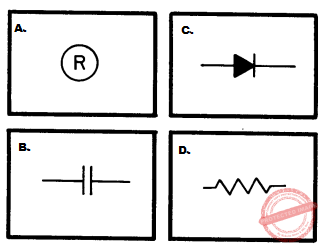
59. Which of the following schematic symbols is used to represent a resistor?
60. How is the ability of a resistor to dissipate heat indicated?
- A. By the wattage rating
- B. By the voltage rating
- C. By the resistance rating
- D. By the tolerance
61. Carbon resistors have which of the following disadvantages?
- A. A high cost factor
- B. An extremely large physical size
- C. The resistance value changes with age
- D. A limited range of resistance values
62. Which of the following types of resistors will overcome the disadvantages of a carbon resistor?
- A. Rheostat
- B. Potentiometer
- C. Molded composition
- D. Wirewound resistor
63. What is the total number of connections on
(a) a rheostat and (b) a potentiometer?
- A. (a) Two (b) two
- B. (a) Two (b) three
- C. (a) Three (b) two
- D. (a) Three (b) three
64. Which, if any, of the following types of variable resistors is used to control a large amount of current?
- A. Rheostat
- B. Potentiometer
- C. Wirewound potentiometer
- D. None of the above
65. A carbon resistor is color-coded orange, orange, orange. What is the resistance value of this resistor?
- A. 2.2 kΩ
- B. 3.3 kΩ
- C. 33.0 kΩ
- D. 440.0 kΩ
66. What are the allowable limits of ohmic value in a resistor color coded blue, green, yellow, gold?
- A. 682.5 kΩ to 617.5 kΩ
- B. 715.0 kΩ to 585.0 kΩ
- C. 7.98 MΩ to 7.22 MΩ
- D. 8.36 MΩ to 6.84 MΩ
67. Of the following, which color of the fifth band on a resistor indicates the LEAST chance of failure?
- A. Red
- B. Brown
- C. Yellow
- D. Orange
IN ANSWERING QUESTIONS 68 THROUGH 70, REFER TO FIGURE 1A.
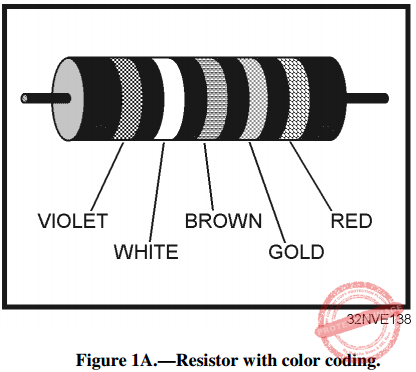
Figure 1A.—Resistor with color coding.
68. What is the ohmic value of the resistor?
- A. 8 Ω
- B. 79 Ω
- C. 790 Ω
- D. 800 Ω
69. What is the specified tolerance of the resistor?
- A. 1%
- B. 5%
- C. 10%
- D. 20%
70. What is the specified reliability of the resistor?
- A. 1.0%
- B. 0.1%
- C. 0.01%
- D. 0.001%
Check your work.
Download File in PDF
Related Content

P inoyBIX educates thousands of reviewers and students a day in preparation for their board examinations. Also provides professionals with materials for their lectures and practice exams. Help me go forward with the same spirit.
“Will you subscribe today via YOUTUBE?”
TIRED OF ADS?
- Become Premium Member and experienced complete ads-free content browsing.
- Full Content Access to Premium Solutions Exclusive for Premium members
- Access to PINOYBIX FREEBIES folder
- Download Reviewers and Learning Materials Free
- Download Content: You can see download/print button at the bottom of each post.
PINOYBIX FREEBIES FOR PREMIUM MEMBERSHIP:
- CIVIL ENGINEERING REVIEWER
- CIVIL SERVICE EXAM REVIEWER
- CRIMINOLOGY REVIEWER
- ELECTRONICS ENGINEERING REVIEWER (ECE/ECT)
- ELECTRICAL ENGINEERING & RME REVIEWER
- FIRE OFFICER EXAMINATION REVIEWER
- LET REVIEWER
- MASTER PLUMBER REVIEWER
- MECHANICAL ENGINEERING REVIEWER
- NAPOLCOM REVIEWER
- Additional upload reviewers and learning materials are also FREE
FOR A LIMITED TIME
If you subscribe for PREMIUM today!
You will receive an additional 1 month of Premium Membership FREE.
For Bronze Membership an additional 2 months of Premium Membership FREE.
For Silver Membership an additional 3 months of Premium Membership FREE.
For Gold Membership an additional 5 months of Premium Membership FREE.
Join the PinoyBIX community.