
This is the Multiple Choice Questions in Oscillators from the book Electronic Devices – Electron Flow Version and Conventional Current Version 8th Edition by Thomas L. Floyd. If you are looking for a reviewer in Electronics Engineering this will definitely help. I can assure you that this will be a great help in reviewing the book in preparation for your Board Exam. Make sure to familiarize each and every questions to increase the chance of passing the ECE Board Exam.
If you are looking for the Self-test in Floyd’s Electronic Devices proceed to
Practice Exam Test Questions
Choose the letter of the best answer in each questions.
1. In order to start up, a feedback oscillator requires
A. negative feedback less than 1.
B. positive feedback greater than 1.
C. unity feedback equal to 1.
D. no feedback.
Answer: Option B
Solution:
2. What is the total phase shift requirement, around the feedback loop, for a phase-shift oscillator?
A. 90°
B. 180°
C. 270°
D. 360°
Answer: Option D
Solution:
3. What is the relationship between the series and parallel resonant frequencies of a quartz crystal?
A. They are equal.
B. Parallel resonant frequency is approximately 1 kHz higher than series resonant frequency.
C. Series resonant frequency is approximately 1 kHz higher than parallel resonant frequency.
D. none of the above
Answer: Option B
Solution:
4. At series resonance, the impedance of a crystal is
A. minimum.
B. maximum.
C. equal.
D. zero.
Answer: Option A
Solution:
5. At parallel resonance, the impedance of a crystal is
A. minimum.
B. maximum.
C. equal.
D. zero.
Answer: Option B
Solution:
6. What is the minimum frequency at which a crystal will oscillate?
A. seventh harmonic
B. third harmonic
C. fundamental
D. second harmonic
Answer: Option C
Solution:
7. Refer to Figure 16-1(a). This circuit is known as
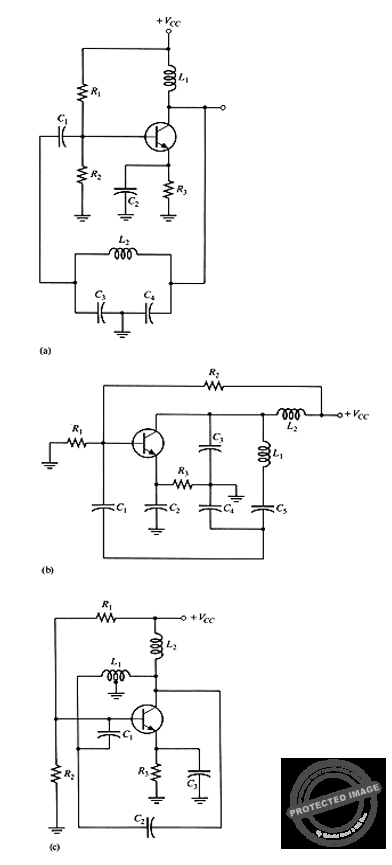
Figure 16-1
A. a Clapp oscillator.
B. an Armstrong oscillator.
C. a Colpitts oscillator.
D. a Hartley oscillator.
Answer: Option C
Solution:
8. Refer to Figure 16-1(b). This circuit is known as
A. a Clapp oscillator.
B. an Armstrong oscillator.
C. a Colpitts oscillator.
D. a Hartley oscillator.
Answer: Option A
Solution:
9. Refer to Figure 16-1(c). This circuit is known as
A. a Clapp oscillator.
B. an Armstrong oscillator.
C. a Colpitts oscillator.
D. a Hartley oscillator.
Answer: Option D
Solution:
10. Refer to Figure 16-1(b). The resonant frequency is controlled by
A. C3 and L1.
B. C2, C4, C5, and L1.
C. C3, C4, C5, and L1.
D. C3, C4, C5, and L2.
Answer: Option C
Solution:
11. Calculate the fr of a lead-lag network if R1 = R2 = 6.8 kΩ, and C1 = C2 = 0.05 µF.
A. 468 Hz
B. 4.68 kHz
C. 46.8 kHz
D. 468 kHz
Answer: Option A
Solution:
12. Refer to Figure 16-2. Calculate the resonant frequency.

Figure 16-2
A. 1.126 kHz
B. 6.17 kHz
C. 23.9 MHz
D. 14.1 MHz
Answer: Option B
Solution:
13. Refer to Figure 16-3. Determine the resonant frequency.
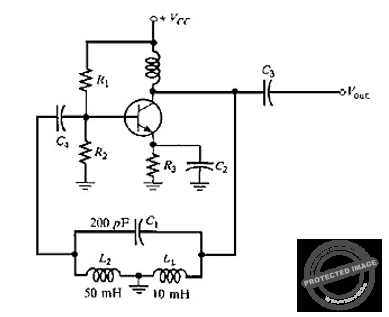
Figure 16-3
A. 123.4 kHz
B. 61.7 kHz
C. 45.94 kHz
D. 23.1 kHz
Answer: Option C
Solution:
14. Refer to Figure 16-3. If C1 increases in value, the resonant frequency will
A. increase.
B. decrease.
C. remain the same.
D. none of the above
Answer: Option B
Solution:
15. A certain oscillator has a tap on the inductor in the tank circuit. This oscillator is probably
A. a Colpitts oscillator.
B. a Clapp oscillator.
C. a crystal oscillator.
D. a Hartley oscillator.
Answer: Option D
Solution:
16. An op-amp integrator has a square-wave input. The output should be
A. a sine wave.
B. a triangle wave.
C. a square wave.
D. pure dc.
Answer: Option B
Solution:
17. Refer to Figure 16-4. This circuit is
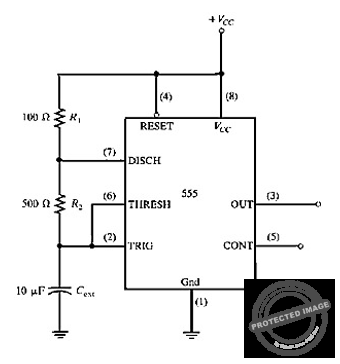
Figure 16-4
A. a sine-wave oscillator.
B. a monostable multivibrator.
C. an astable multivibrator.
D. a VCO.
Answer: Option C
Solution:
18. Refer to Figure 16-4. Determine the frequency of oscillation, if any.
A. 131 Hz
B. 262 Hz
C. 2.62 kHz
D. none
Answer: Option A
Solution:
19. Refer to Figure 16-4. What is the duty cycle, if any?
A. 16.3%
B. 54.5%
C. 86.9%
D. none
Answer: Option B
Solution:
20. Refer to Figure 16-4. Assuming it is configured as an oscillator and if you desired to reduce the duty to less than 50%, the following circuit change would need to be made.
A. Reduce the size of R1.
B. Reduce the size of R2.
C. Increase the size of R1.
D. Connect a diode in parallel with R1.
Answer: Option D
Solution:
21. A circuit that can change the frequency of oscillation with an application of a dc voltage is sometimes called
A. a voltage-controlled oscillator.
B. a crystal oscillator.
C. a Hartley oscillator.
D. an astable multivibrator.
Answer: Option A
Solution:
22. Sinusoidal oscillators operate with _____ feedback.
A. positive
B. negative
c. either of the two
D. neither of the two
Answer: Option A
Solution:
23. One condition for positive feedback is that the phase shift around the feedback loop must be _____°.
A. 0
B. 90
C. 180
D. 45
Answer: Option A
Solution:
24. The start-up gain of an oscillator must be _____ one.
A. equal to
B. less than
C. greater than
D. none of the above
Answer: Option C
Solution:
25. For frequencies up to 1 MHz, the _____ is the most widely used type of sinusoidal RC oscillator.
A. Wien-bridge
B. phase-shift
C. twin-T
D. none of the above
Answer: Option A
Solution:
26. The lead-lag circuit in the Wien-bridge oscillator has a resonant frequency at which the attenuation is
A. 1/2.
B. 1/4.
C. 1/3.
D. 1/5.
Answer: Option C
Solution:
27. The attenuation of the three-section RC feedback phase-shift oscillator is
A. 1/9.
B. 1/30.
C. 1/3.
D. 1/29.
Answer: Option D
Solution:
28. The twin-T oscillator produces a _____ response.
A. low-pass
B. high-pass
C. band-pass
D. band-stop
Answer: Option D
Solution:
29. The feedback signal in a(n) _____ oscillator is derived from a capacitive voltage divider in the LC circuit.
A. Hartley
B. Armstrong
C. Colpitts
D. none of the above
Answer: Option C
Solution:
30. The feedback signal in a(n) _____ oscillator is derived from an inductive voltage divider in the LC circuit.
A. Hartley
B. Armstrong
C. Colpitts
D. none of the above
Answer: Option A
Solution:
TRUE/FALSE
1. Oscillators operate on negative feedback.
A. True
B. False
Answer: Option B
Solution:
2. The start-up gain of an oscillator must be greater than 1.
A. True
B. False
Answer: Option A
Solution:
3. The feedback signal in a Hartley oscillator is derived from an inductive voltage in the tank circuit.
A. True
B. False
Answer: Option A
Solution:
4. Crystal oscillators are inherently unstable.
A. True
B. False
Answer: Option B
Solution:
5. The frequency in a VCO can be varied with a DC voltage.
A. True
B. False
Answer: Option A
Solution:
6. LC feedback elements are normally used in oscillators for frequencies greater than 1 MHz.
A. True
B. False
Answer: Option A
Solution:
7. The positive feedback voltage in an oscillator has no net phase shift.
A. True
B. False
Answer: Option A
Solution:
8. For a Wien-bridge oscillator, resonance occurs when Vout/Vin = 1.
A. True
B. False
Answer: Option B
Solution:
9. The feedback network in a Colpitts oscillator contains two series capacitors and a parallel inductor.
A. True
B. False
Answer: Option A
Solution:
10. In the astable mode, a 555 timer is connected as a free-running relaxation oscillator.
A. True
B. False
Answer: Option A
Solution:
Check your work.
Complete List of Chapter MCQs in Floyd’s Electronic Devices
Related Content



P inoyBIX educates thousands of reviewers and students a day in preparation for their board examinations. Also provides professionals with materials for their lectures and practice exams. Help me go forward with the same spirit.
“Will you subscribe today via YOUTUBE?”
TIRED OF ADS?
- Become Premium Member and experienced complete ads-free content browsing.
- Full Content Access to Premium Solutions Exclusive for Premium members
- Access to PINOYBIX FREEBIES folder
- Download Reviewers and Learning Materials Free
- Download Content: You can see download/print button at the bottom of each post.
PINOYBIX FREEBIES FOR PREMIUM MEMBERSHIP:
- CIVIL ENGINEERING REVIEWER
- CIVIL SERVICE EXAM REVIEWER
- CRIMINOLOGY REVIEWER
- ELECTRONICS ENGINEERING REVIEWER (ECE/ECT)
- ELECTRICAL ENGINEERING & RME REVIEWER
- FIRE OFFICER EXAMINATION REVIEWER
- LET REVIEWER
- MASTER PLUMBER REVIEWER
- MECHANICAL ENGINEERING REVIEWER
- NAPOLCOM REVIEWER
- Additional upload reviewers and learning materials are also FREE
FOR A LIMITED TIME
If you subscribe for PREMIUM today!
You will receive an additional 1 month of Premium Membership FREE.
For Bronze Membership an additional 2 months of Premium Membership FREE.
For Silver Membership an additional 3 months of Premium Membership FREE.
For Gold Membership an additional 5 months of Premium Membership FREE.
Join the PinoyBIX community.