
Are you overwhelmed by the vast number of engineering terms you need to master before your board exam? You’re not alone. Every Filipino engineering student knows the pressure of memorizing countless technical definitions while trying to understand complex concepts. Conductor-related topics are particularly challenging because they appear across multiple subjects and constitute a significant portion of the board exam questions.
This comprehensive guide was created specifically for Filipino engineering students struggling with conductors terminology. As a former board exam taker myself, I understand the anxiety of facing questions about concepts you’ve studied but can’t quite recall during that crucial moment. That’s why I’ve compiled over 101 essential conductor-related terms, organized into logical sections to make your review process more efficient and less stressful.
Whether you’re studying late at night after a long day of review classes or trying to fit in quick study sessions between family responsibilities, this guide will serve as your reliable companion. Each definition has been carefully crafted to be concise yet complete, focusing on the exact terminology and concepts that frequently appear in Philippine board exams. No more wasting precious time searching through multiple references or deciphering complex explanations.
Let’s turn your conductor terminology concerns into confidence as you prepare for one of the most important examinations of your professional life.
Fundamental Conductor Concepts
1. Conductor: A material that allows the flow of electrical current or heat energy with minimal resistance, typically characterized by free electrons in its atomic structure.
2. Electrical Conductivity: The measure of a material’s ability to conduct electrical current, expressed in Siemens per meter (S/m).
3. Thermal Conductivity: A material’s ability to conduct heat, measured in watts per meter-kelvin (W/m·K).
4. Free Electron: An electron in the outermost shell of an atom that can move freely within the material, enabling electrical conduction.
5. Valence Band: The highest energy band in a material that is completely filled with electrons at absolute zero temperature.
6. Conduction Band: The energy band above the valence band where electrons can move freely, contributing to electrical conductivity.
7. Energy Gap: The energy difference between the valence band and conduction band, determining whether a material behaves as a conductor, semiconductor, or insulator.
8. Electron Mobility: The ability of electrons to move through a conductor when subjected to an electric field, measured in square meters per volt-second (m²/V·s).
9. Resistivity: The electrical resistance of a unit cube of material, reciprocal of conductivity, measured in ohm-meters (Ω·m).
10. Charge Carrier: Particles (typically electrons) that carry electrical charge through a conductor.
11. Drude Model: A classical model describing electron transport in conductors, treating electrons as a gas of free particles moving within a fixed array of ions.
12. Mean Free Path: The average distance traveled by a charge carrier between collisions in a conductor.
Types of Conductors
13. Metallic Conductor: A conductor made of metal elements characterized by high electrical and thermal conductivity.
14. Electrolytic Conductor: A solution or molten substance that conducts electricity through ion movement rather than electron flow.
15. Ionic Conductor: A material that conducts electricity through the movement of ions, common in batteries and fuel cells.
16. Superconductor: A material exhibiting zero electrical resistance when cooled below a critical temperature.
17. Semiconductor: A material with conductivity between a conductor and an insulator, whose conductivity can be controlled by doping or external fields.
18. Photoconductor: A material whose electrical conductivity increases when exposed to electromagnetic radiation.
19. Organic Conductor: A carbon-based material that can conduct electricity, including conductive polymers and carbon nanostructures.
20. High-Temperature Superconductor (HTS): A superconductor that functions at temperatures above the boiling point of liquid nitrogen (77K).
21. Low-Temperature Superconductor (LTS): A superconductor requiring cooling to near absolute zero to function, typically using liquid helium.
22. Solid Conductor: A continuous wire or bar used to conduct electricity in electrical systems.
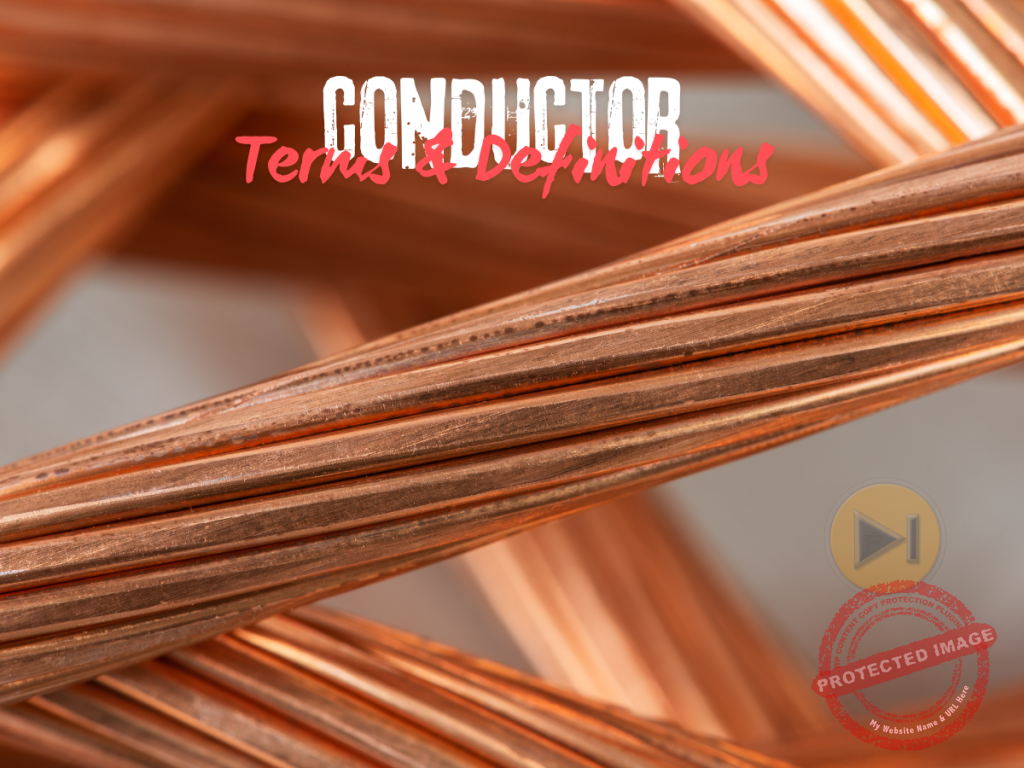
23. Stranded Conductor: A conductor composed of multiple smaller wires twisted together, providing greater flexibility than solid conductors.
24. Hollow Conductor: A conductor with an empty center, often used in high-frequency applications to reduce skin effect.
Conductor Properties and Behaviors
25. Resistivity Temperature Coefficient: The rate at which a conductor’s resistivity changes with temperature, typically positive for metals.
26. Skin Effect: The tendency of alternating current to concentrate near the surface of a conductor, effectively reducing its cross-sectional area at high frequencies.
27. Proximity Effect: An electromagnetic phenomenon where current distribution in a conductor is influenced by nearby conductors carrying alternating current.
28. Hall Effect: The production of a voltage difference across a conductor when placed in a magnetic field perpendicular to the current flow.
29. Wiedemann-Franz Law: A physical law stating that the ratio of thermal conductivity to electrical conductivity is proportional to temperature for most metals.
30. Joule Heating: Heat generated when an electric current passes through a conductor due to electrical resistance, proportional to the square of the current.
31. Annealing: A heat treatment process that reduces the electrical resistance of metal conductors by relieving internal stresses.
32. Work Hardening: The strengthening of a conductor through plastic deformation, which typically increases resistance.
33. Stress Relief: The process of reducing internal stresses in a conductor to improve its electrical and mechanical properties.
34. Flexibility: A measure of a conductor’s ability to bend without breaking, important for applications requiring movement or vibration resistance.
35. Tensile Strength: The maximum stress a conductor can withstand while being stretched before breaking.
36. Malleability: The property of a conductor that allows it to be hammered or pressed into thin sheets without breaking.
37. Ductility: The ability of a conductor to be drawn into thin wires without breaking, critical for wire manufacturing.
38. Fatigue Resistance: A conductor’s ability to withstand repeated mechanical stress cycles without failing.
Conductor Materials
39. Copper Conductor: A widely used conductor due to its excellent electrical conductivity, thermal properties, and moderate cost.
40. Aluminum Conductor: A lightweight conductor with about 61% the conductivity of copper, commonly used in power transmission lines.
41. Silver Conductor: The most conductive metal, typically used in specialized applications due to its high cost.
42. Gold Conductor: A highly conductive metal resistant to oxidation, used in critical applications and electronic connectors.
43. Iron Conductor: A magnetic conductor with moderate conductivity, used in electromagnetic applications.
44. Nichrome: An alloy of nickel and chromium with high resistance, commonly used in heating elements.
45. Constantan: A copper-nickel alloy with nearly constant resistance across a wide temperature range, used in thermocouples.
46. Carbon Conductor: A non-metallic conductor used in electrodes, brushes for electric motors, and various electronic applications.
47. Graphene: A two-dimensional form of carbon with extremely high electrical conductivity and unique electronic properties.
48. Carbon Nanotubes: Cylindrical carbon structures with exceptional electrical and mechanical properties.
49. Mercury: A liquid metal conductor used in specialized applications such as electrical switches and rectifiers.
50. Brass: An alloy of copper and zinc used as a conductor in applications requiring good corrosion resistance.
51. Bronze: An alloy primarily of copper and tin used in electrical applications requiring high strength and corrosion resistance.
Conductor Specifications and Ratings
52. Ampacity: The maximum current a conductor can carry continuously without exceeding its temperature rating.
53. Current Density: The amount of electric current per unit cross-sectional area of a conductor, typically measured in amperes per square millimeter (A/mm²).
54. Temperature Rating: The maximum temperature a conductor can withstand continuously without degradation of its properties.
55. Voltage Rating: The maximum voltage a conductor insulation system can withstand without electrical breakdown.
56. American Wire Gauge (AWG): A standardized wire diameter system used in North America to specify conductor sizes.
57. Circular Mil: A unit of area equal to the area of a circle with a diameter of one mil (0.001 inch), used for specifying conductor cross-sections.
58. International Electrotechnical Commission (IEC) Standard: International standards defining conductor specifications and testing methods.
59. Insulation Class: A classification system for electrical insulation materials based on their maximum operating temperature.
60. Conductor Fill: The percentage of a conduit’s cross-sectional area occupied by conductors, limited by electrical codes.
61. Derating Factor: A factor applied to reduce the ampacity of a conductor due to environmental conditions or installation methods.
Conductor Insulation and Protection
62. Insulation: Material surrounding a conductor to prevent electrical current leakage and protect against environmental factors.
63. Dielectric Strength: The maximum electric field an insulating material can withstand without breaking down, measured in volts per meter.
64. Polyvinyl Chloride (PVC) Insulation: A common thermoplastic polymer insulation material used for low and medium-voltage applications.
65. Cross-Linked Polyethylene (XLPE): A thermoset insulation material with excellent electrical properties used for medium and high voltage cables.
66. Ethylene Propylene Rubber (EPR): A flexible, durable insulation material with good electrical properties used in power cables.
67. Teflon (PTFE) Insulation: A high-performance insulation with excellent thermal stability and dielectric properties, used in high-temperature applications.
68. Mineral Insulation: Insulation consisting of magnesium oxide powder, used in fire-resistant cables.
69. Cable Jacket: The outermost layer of a cable that provides physical protection for the insulated conductors within.
70. Armor: A metal layer, typically aluminum or steel, used to protect cables from mechanical damage.
71. Shield: A conductive layer surrounding the insulation of a conductor to control the electric field distribution and provide a ground return path.
72. Semi-conductive Layer: A material with intermediate conductivity used in high-voltage cables to control electric field distribution at the interface between conductor and insulation.
Conductor Applications in Electrical Systems
73. Transmission Line Conductor: A conductor used to transmit electrical power over long distances, typically at high voltages.
74. Distribution Conductor: A conductor used in the electrical distribution network to deliver power to end-users.
75. Busbar: A rigid conductor, typically in the form of a bar, used to collect and distribute large amounts of current.
76. Grounding Conductor: A conductor providing a low-impedance path to earth for fault currents, important for electrical safety.
77. Neutral Conductor: The conductor connected to the neutral point of a system that carries the unbalanced current in a polyphase system.
78. Phase Conductor: A current-carrying conductor in an AC system that maintains a phase relationship with other conductors.
79. Service Drop: The overhead conductors extending from the utility pole to a building’s service entrance.
80. Service Entrance Conductor: The conductors between the service equipment and the point of connection to the service drop or lateral.
81. Feeder Conductor: A conductor that carries power from the service equipment to the branch circuit panelboards.
82. Branch Circuit Conductor: A conductor extending beyond the final overcurrent device protecting the circuit.
83. Bonding Jumper: A reliable conductor ensuring electrical continuity between metal parts required to be electrically connected.
84. Equipment Grounding Conductor: A conductor connecting non-current-carrying metal parts of equipment to the system grounded conductor or ground.
Specialized Conductor Types
85. All-Aluminum Conductor (AAC): A conductor made entirely of aluminum strands, used primarily in overhead transmission lines.
86. Aluminum Conductor Steel Reinforced (ACSR): A composite conductor with aluminum strands surrounding a steel core, providing additional mechanical strength.
87. Aluminum Conductor Aluminum Alloy Reinforced (ACAR): A conductor with aluminum strands surrounding a core of aluminum alloy, offering a balance between conductivity and strength.
88. Aluminum-Clad Steel Conductor: A bimetallic conductor with a steel core and aluminum outer layer, combining strength with conductivity.
89. Copper-Clad Aluminum: A bimetallic conductor with an aluminum core and copper cladding, offering some benefits of both metals.
90. Litz Wire: A conductor composed of many thin strands, individually insulated and twisted together to minimize skin effect at high frequencies.
91. Magnetic Wire: A solid conductor with thin insulation, typically used in transformers, motors, and inductors.
92. Tinned Copper: Copper conductor coated with tin to improve solderability and resist corrosion.
93. Silver-Plated Copper: Copper conductor with a silver coating to improve conductivity and oxidation resistance.
94. High-Frequency Conductor: Specialized conductors designed to minimize losses at high frequencies, often using silver plating or special geometries.
95. Overhead Ground Wire (OPGW): A type of conductor used on high-voltage transmission lines that combines the functions of grounding and fiber optic communications.
Testing and Maintenance of Conductors
96. Insulation Resistance Test: A test measuring the resistance between a conductor and ground to verify insulation integrity.
97. Continuity Test: A test verifying the electrical continuity of a conductor throughout its length.
98. High-Potential (Hi-Pot) Test: A voltage test applied between conductors or between conductors and ground to verify insulation strength.
99. Time Domain Reflectometry (TDR): A technique for locating faults in conductors by measuring the reflection of electrical pulses.
100. Megger Test: A specific type of insulation resistance test using a megohmmeter to measure high resistance values.
101. Loop Impedance Test: A test measuring the impedance of the complete circuit path, including the conductor and return path.
102. Corona Discharge: A luminous electrical discharge due to ionization of air surrounding a conductor at high voltage, indicating potential insulation problems.
103. Thermographic Inspection: A non-contact method using infrared imaging to detect abnormal heating in conductors.
104. Partial Discharge Test: A test detecting small electrical discharges within insulation, indicating potential insulation deterioration.
105. Conductor Creep: The permanent elongation of a conductor over time due to mechanical loading, particularly in overhead lines.
Emerging Conductor Technologies
106. High-Temperature Low-Sag (HTLS) Conductor: Advanced overhead conductors capable of operating at higher temperatures with reduced thermal expansion.
107. Carbon Fiber Composite Core Conductor: A conductor using carbon fiber composite material for the core, providing high strength with low weight.
108. Quantum Conductor: Theoretical conductors utilizing quantum effects to achieve unprecedented conductivity characteristics.
109. Topological Insulator: A material that behaves as an insulator in its interior but conducts electricity on its surface, potentially leading to new types of conductors.
110. Metamaterial Conductor: Engineered materials with properties not found in naturally occurring conductors, designed for specific electrical applications.
111. Two-Dimensional Conductor: Ultra-thin conductors with a thickness of a few atoms, exhibiting unique electrical properties due to quantum confinement.
112. Spintronic Conductor: Conductors utilizing electron spin for signal transmission, potentially enabling more efficient electrical systems.
As your board exam date approaches, remember that mastering these 101+ conductor-related terms isn’t just about memorization—it’s about building a foundation of knowledge that will serve you throughout your engineering career. Every engineer who has successfully passed the board exam has stood where you are now, feeling the weight of responsibility and perhaps some anxiety about the challenge ahead.
The journey to becoming a licensed Filipino engineer is demanding, but entirely achievable with the right preparation. This guide has armed you with precisely defined terminology covering everything from basic conductor concepts to emerging technologies, giving you an edge when facing those challenging board exam questions.
Keep this guide close during your review sessions. Return to it often, test yourself regularly, and use it to strengthen your understanding of interconnected engineering concepts. When exam day arrives, you’ll walk in with the confidence that comes from thorough preparation and deep understanding.
Remember that your hard work now paves the way for a fulfilling career that will contribute to our nation’s development. The electrical systems you’ll design, maintain, and improve as a licensed engineer will power homes, businesses, and critical infrastructure across the Philippines.
Take a deep breath, trust in your preparation, and know that with resources like this comprehensive terminology guide, you’re already on the path to success. Mabuhay ang Pilipinong inhinyero!
Related Content

P inoyBIX educates thousands of reviewers and students a day in preparation for their board examinations. Also provides professionals with materials for their lectures and practice exams. Help me go forward with the same spirit.
“Will you subscribe today via YOUTUBE?”
TIRED OF ADS?
- Become Premium Member and experienced complete ads-free content browsing.
- Full Content Access to Premium Solutions Exclusive for Premium members
- Access to PINOYBIX FREEBIES folder
- Download Reviewers and Learning Materials Free
- Download Content: You can see download/print button at the bottom of each post.
PINOYBIX FREEBIES FOR PREMIUM MEMBERSHIP:
- CIVIL ENGINEERING REVIEWER
- CIVIL SERVICE EXAM REVIEWER
- CRIMINOLOGY REVIEWER
- ELECTRONICS ENGINEERING REVIEWER (ECE/ECT)
- ELECTRICAL ENGINEERING & RME REVIEWER
- FIRE OFFICER EXAMINATION REVIEWER
- LET REVIEWER
- MASTER PLUMBER REVIEWER
- MECHANICAL ENGINEERING REVIEWER
- NAPOLCOM REVIEWER
- Additional upload reviewers and learning materials are also FREE
FOR A LIMITED TIME
If you subscribe for PREMIUM today!
You will receive an additional 1 month of Premium Membership FREE.
For Bronze Membership an additional 2 months of Premium Membership FREE.
For Silver Membership an additional 3 months of Premium Membership FREE.
For Gold Membership an additional 5 months of Premium Membership FREE.
Join the PinoyBIX community.