
INTRODUCTION
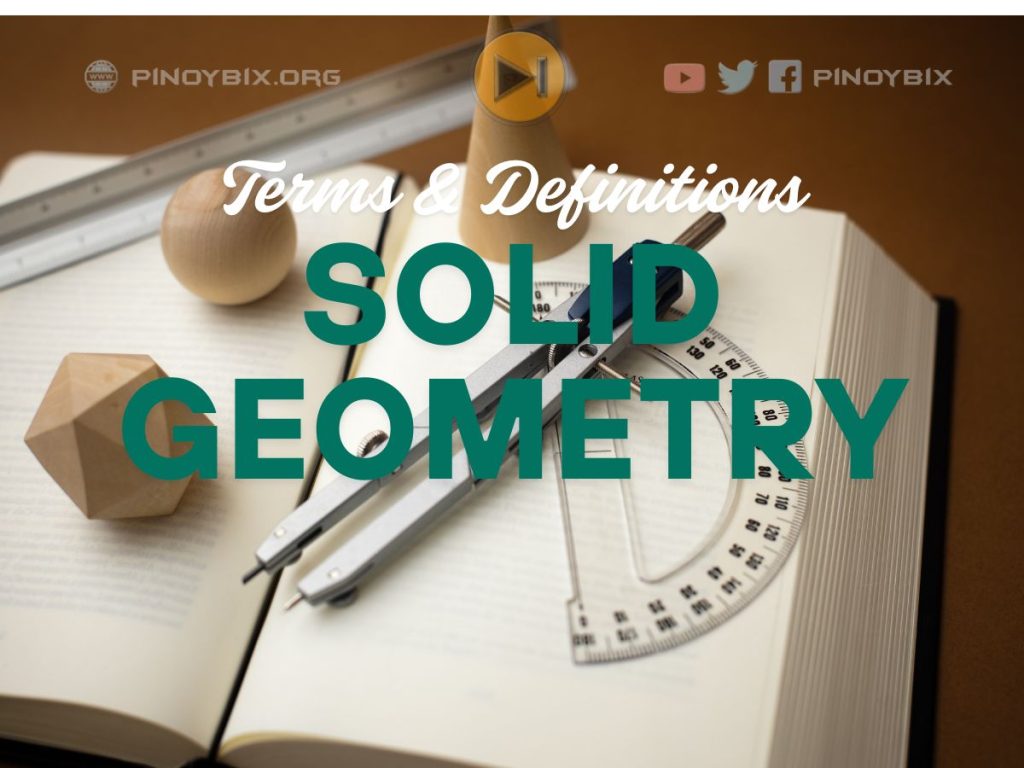
Solid Geometry is one of those subjects that engineering reviewees often underestimate. After spending so much time on algebra, trigonometry, and analytic geometry, many reviewees treat solid geometry as a light topic and a quick refresh before moving on. That is a mistake. The Mathematics board exam regularly includes problems on volumes, surface areas, and the properties of three-dimensional figures, and a weak grasp of the vocabulary behind those problems almost always leads to computational errors or misread questions.
The challenge with Solid Geometry is not that the formulas are complicated. Most of them are straightforward once you know what you are dealing with. The real challenge is knowing the terminology well enough to identify what kind of solid is being described in a problem, what its parts are called, and what relationships exist between those parts. Terms like frustum, prismatoid, spherical zone, and directrix carry very specific meanings in the context of board exam problems. If you do not know those meanings cold, you will lose time and points.
This list covers 151 terms and definitions in Solid Geometry, alphabetically sorted and written specifically for engineering reviewees preparing for the PRC licensure examination. The definitions are precise but accessible. They are written to help you build a working vocabulary. It is the kind you can apply quickly under exam conditions, not just recall in a quiet study session.
Use this list as a reference throughout your review. Read through it once for orientation, then return to specific terms as you work through practice problems. The combination of conceptual clarity and repeated exposure is what makes the vocabulary stick when it matters most especially on exam day.
The 151 Solid Geometry Terms and Definitions
1. Altitude of a Cone
The perpendicular distance from the apex of a cone to the plane of its base. It is the height of the cone and is used directly in computing both the volume and the lateral surface area.
2. Altitude of a Cylinder
The perpendicular distance between the two bases of a cylinder. For a right circular cylinder, the altitude equals the length of any element on the lateral surface.
3. Altitude of a Frustum
The perpendicular distance between the two parallel bases of a frustum. It is used in the volume formula for both a frustum of a cone and a frustum of a pyramid.
4. Altitude of a Prism
The perpendicular distance between the two base planes of a prism. For a right prism, the altitude equals the length of any lateral edge.
5. Altitude of a Pyramid
The perpendicular distance from the apex of a pyramid to the plane of its base. This is the true height of the pyramid and is essential for volume computation.
6. Altitude of a Spherical Segment
The perpendicular distance between the two parallel planes that bound a spherical segment. Also called the height of the segment, it is used in computing the volume and surface area of the segment.
7. Antiprism
A polyhedron with two parallel polygonal bases connected not by parallelogram lateral faces but by a band of triangles. The bases are rotated relative to each other. The simplest antiprism is the octahedron.
8. Apex
The point at the top of a cone or pyramid, where all lateral faces or the lateral surface converge. Also called the vertex of the solid. The apex is equidistant from all base vertices in a regular pyramid.
9. Apothem of a Prism
The apothem of the regular polygonal base of a right prism. It is the perpendicular distance from the center of the base to the midpoint of any base edge, and it is used in computing the lateral surface area.
10. Apothem of a Pyramid
The slant height of a face of a regular pyramid measured from the apex to the midpoint of a base edge. Also called the apothem of the pyramid, it is used in computing lateral surface area.
11. Archimedean Solid
A convex polyhedron with two or more types of regular polygon faces, and with the same arrangement of polygons at each vertex. There are exactly thirteen Archimedean solids. They differ from Platonic solids in having more than one type of face polygon.
12. Axis of a Cone
The straight line connecting the apex of a cone to the center of its circular base. For a right circular cone, the axis is perpendicular to the base.
13. Axis of a Cylinder
The straight line connecting the centers of the two circular bases of a cylinder. For a right circular cylinder, the axis is perpendicular to both bases.
14. Axis of a Solid of Revolution
The fixed line about which a plane figure is rotated to generate a solid of revolution. The shape and dimensions of the resulting solid depend entirely on the position of the figure relative to this axis.
15. Base of a Cone
The circular face of a cone. It is a flat, bounded region enclosed by the directrix. The base lies in a plane perpendicular to the axis for a right circular cone.
16. Base of a Cylinder
Either of the two congruent, parallel circular faces of a cylinder. Both bases lie in parallel planes and are connected by the lateral surface.
17. Base of a Prism
Either of the two congruent, parallel polygonal faces of a prism. The two bases are connected by the lateral faces, which are parallelograms.
18. Base of a Pyramid
The polygonal face of a pyramid that lies opposite the apex. All lateral faces of the pyramid share one edge with the base and meet at the apex.
19. Bicylinder
A solid formed by the intersection of two cylinders of equal radius whose axes are perpendicular to each other. Also called a Steinmetz solid, it is a classic example of a solid whose volume can be computed without calculus.
20. Bipyramid
A solid formed by joining two congruent pyramids at their bases. The result has a polygonal equator and two apices at opposite ends. A triangular bipyramid has six triangular faces and five vertices.
21. Capsule
A solid formed by capping a cylinder with two hemispheres at each end. Its total length is the sum of the cylinder height and the diameter of the two caps. Volume equals the sum of the cylinder volume and the full sphere volume.
22. Cavalieri’s Principle
A principle stating that if two solids have equal altitudes and if every cross section parallel to the base at the same height has equal area, then the two solids have equal volumes. It is used to derive volume formulas for oblique solids.
23. Center of a Sphere
The fixed interior point that is equidistant from every point on the surface of a sphere. All radii of a sphere are equal and originate from this center.
24. Center of Gravity of a Solid
The point at which the total weight of a solid may be considered to be concentrated for the purpose of analyzing equilibrium and moments. For uniform solids, it coincides with the geometric centroid.
25. Centroid of a Solid
The geometric center of a three-dimensional solid, defined as the point whose coordinates are the averages of the coordinates of all points in the solid. For solids with uniform density, the centroid and the center of gravity are the same point.
26. Circumscribed Sphere
A sphere that passes through all vertices of a polyhedron. Also called the circumsphere, it exists for all regular polyhedra and some other symmetric solids.
27. Cone
A solid bounded by a circular base and a lateral surface that tapers smoothly from the base to a single point called the apex. The most common type in board exam problems is the right circular cone.
28. Congruent Solids
Two solids that are identical in shape and size. All corresponding dimensions are equal, and one solid can be superimposed exactly onto the other through rigid motions such as translations, rotations, and reflections.
29. Conical Surface
The surface generated by a straight line, called the generator or element, that passes through a fixed point called the apex and moves along a fixed curve called the directrix. A cone is a portion of a conical surface.
30. Convex Polyhedron
A polyhedron in which any line segment connecting two points on its surface lies entirely within or on the solid. All regular polyhedra are convex, and most solids encountered in board exam problems are convex.
31. Cross Section
The plane figure formed by cutting a solid with a plane. The shape and area of the cross section depend on the orientation of the cutting plane relative to the solid. Cross sections parallel to the base of a prism or cylinder are congruent to the base.
32. Cube
A regular hexahedron bounded by six congruent square faces, twelve equal edges, and eight vertices. All edges are equal in length, all faces are perpendicular to adjacent faces, and all angles are right angles.
33. Cuboctahedron
An Archimedean solid with eight triangular faces and six square faces, fourteen faces in total. It has twelve vertices and twenty-four edges. It is the convex hull of the midpoints of a cube’s edges.
34. Cuboid
A rectangular parallelepiped in which all faces are rectangles. Also called a rectangular solid or box, its volume is the product of its three dimensions: length, width, and height.
35. Cylinder
A solid bounded by a lateral surface and two congruent, parallel circular bases. The most common type in engineering problems is the right circular cylinder, where the axis is perpendicular to the bases.
36. Cylindrical Shell
A solid formed by the region between two coaxial cylinders of different radii but the same height. Its volume equals the product of the average circumference, the height, and the thickness of the shell.
37. Cylindrical Surface
The surface generated by a straight line, called the element or generator, that moves parallel to a fixed line and along a fixed curve called the directrix. A cylinder is bounded by two parallel planes cutting the cylindrical surface.
38. Diagonal of a Polyhedron
A line segment connecting two vertices of a polyhedron that are not on the same face. For a rectangular parallelepiped with dimensions l, w, and h, the space diagonal has length equal to the square root of the sum of the squares of the three dimensions.
39. Diameter of a Sphere
A chord of a sphere that passes through the center. The diameter is twice the radius and is the longest chord of the sphere.
40. Dihedral Angle
The angle between two half planes that share a common edge, called the edge of the dihedral angle. It is measured by the plane angle formed by two rays, one in each half plane, both perpendicular to the edge at the same point.
41. Directrix of a Cone
The fixed curve along which the generator of a conical surface moves. For a right circular cone, the directrix is a circle, and the generator is a straight line passing through the apex.
42. Directrix of a Cylinder
The fixed curve along which the element or generator of a cylindrical surface moves. For a right circular cylinder, the directrix is a circle in the plane of one of the bases.
43. Dodecahedron
A polyhedron with twelve faces. The regular dodecahedron, one of the five Platonic solids, has twelve congruent regular pentagonal faces, thirty edges, and twenty vertices.
44. Duality of Polyhedra
A geometric relationship between pairs of polyhedra in which the vertices of one correspond to the faces of the other. The cube and octahedron are duals of each other, as are the dodecahedron and icosahedron. The tetrahedron is self-dual.
45. Edge of a Polyhedron
A line segment formed by the intersection of two adjacent faces of a polyhedron. Edges define the skeletal structure of the solid and are used in Euler’s formula relating vertices, edges, and faces.
46. Element of a Cone
Any straight line segment on the lateral surface of a cone connecting the apex to a point on the circular base. For a right circular cone, all elements are equal in length and are called slant heights.
47. Element of a Cylinder
Any straight line segment on the lateral surface of a cylinder that is parallel to the axis and connects corresponding points on the two bases. For a right circular cylinder, all elements are equal in length to the altitude.
48. Ellipsoid
A solid bounded by a surface in which every cross section is an ellipse or a circle. It is generated by rotating an ellipse about one of its axes. When all three axes are equal, the ellipsoid becomes a sphere.
49. Euler’s Formula for Polyhedra
The relationship V minus E plus F equals 2, where V is the number of vertices, E is the number of edges, and F is the number of faces of any convex polyhedron. This formula is a fundamental identity in solid geometry.
50. Face of a Polyhedron
Any of the flat polygonal surfaces that bound a polyhedron. Adjacent faces share an edge. The number and shape of faces define the type of polyhedron.
51. Frustum of a Cone
The portion of a cone between the base and a cutting plane parallel to the base. It has two circular bases of different radii and a slant height connecting the two base circles along the lateral surface.
52. Frustum of a Pyramid
The portion of a pyramid between the base and a cutting plane parallel to the base. It has two polygonal bases that are similar and parallel, connected by trapezoidal lateral faces.
53. Geodesic Dome
A structure approximating a sphere using a network of triangular elements arranged along great circles. In solid geometry, the geodesic sphere is a polyhedron formed by subdividing the faces of an icosahedron and projecting the new vertices onto a sphere.
54. Generator of a Surface
A moving line that traces out a surface as it moves according to a defined rule. For cones, the generator passes through the apex; for cylinders, it remains parallel to the axis.
55. Great Circle
A circle on the surface of a sphere whose plane passes through the center of the sphere. It is the largest possible circle that can be drawn on a sphere, and its radius equals the radius of the sphere.
56. Hemisphere
Exactly half of a sphere, cut by a plane through the center. It has one flat circular base and one curved surface. The volume of a hemisphere is half the volume of the full sphere.
57. Hexahedron
A polyhedron with six faces. The most common hexahedron in board exam problems is the cube, which is also a regular hexahedron. A general hexahedron can have faces of various shapes.
58. Icosahedron
A polyhedron with twenty faces. The regular icosahedron, one of the five Platonic solids, has twenty congruent equilateral triangular faces, thirty edges, and twelve vertices.
59. Inscribed Sphere
A sphere that is tangent to every face of a polyhedron from the inside. Also called the insphere, it touches each face at exactly one point. Its radius is called the inradius of the polyhedron.
60. Isogonal Solid
A solid in which all vertices are equivalent and every vertex has the same arrangement of faces around it. All Platonic solids and Archimedean solids are isogonal.
61. Lateral Area
The total area of the lateral surface of a solid, excluding the area of the bases. For a right circular cylinder, the lateral area equals the product of the circumference of the base and the altitude.
62. Lateral Edge of a Prism
Any edge of a prism that is not part of either base. Lateral edges connect corresponding vertices of the two bases. In a right prism, lateral edges are perpendicular to the bases.
63. Lateral Edge of a Pyramid
Any edge connecting the apex of a pyramid to a vertex of the base. All lateral edges of a regular pyramid are equal in length.
64. Lateral Face of a Prism
Any face of a prism that is not a base. Each lateral face is a parallelogram bounded by two lateral edges and one edge from each base.
65. Lateral Face of a Pyramid
Any triangular face of a pyramid that connects the apex to one edge of the base. A pyramid with an n-sided base has n lateral faces.
66. Lateral Surface of a Cone
The curved surface of a cone that connects the circular base to the apex. It is generated by rotating one element of the cone about the axis and has an area equal to pi times the radius times the slant height.
67. Lateral Surface of a Cylinder
The curved surface of a cylinder connecting the two bases. When unrolled, it forms a rectangle whose width equals the circumference of the base and whose height equals the altitude of the cylinder.
68. Lune
A portion of the surface of a sphere bounded by two great semicircles meeting at two antipodal points. The area of a lune depends on the angle between the two great semicircles.
69. Meridian
A great circle of a sphere that passes through the poles. In spherical geometry, meridians are used to define lines of longitude and to measure angular distances on the sphere.
70. Napkin Ring
A solid formed by removing a cylindrical core from the center of a sphere. Remarkably, the volume of a napkin ring depends only on its height and not on the radius of the original sphere.
This content is for Premium Member. Tired of ads?
Subscribe To Unlock The Content! and Remove Ads.
151. Zonohedron
A convex polyhedron in which every face is a polygon with point symmetry, meaning it looks the same when rotated 180 degrees about its center. Parallelepipeds and rhombohedra are simple examples. Zonohedra are generated by sets of line segments called zones.
CONCLUSION
Solid Geometry may not have the algebraic complexity of Differential Equations or the abstract depth of Advanced Mathematics, but it demands something that reviewees often overlook: spatial intuition backed by precise vocabulary. The terms in this list cover every major category you will encounter on the mathematics board exam from the basic solids like prisms, cylinders, and cones, to composite solids, solids of revolution, and the surface geometry of the sphere. Knowing these terms is not just academic. It is the foundation for interpreting problems correctly and choosing the right formula without hesitation.
Pay close attention to the volume formulas for the cone, pyramid, frustum, sphere, and spherical segments. These appear consistently across multiple engineering disciplines on the board exam, from civil and geodetic engineering to mechanical and electrical engineering mathematics. The prismatoid formula deserves special attention because it unifies many of these volume computations into one elegant expression. If you can apply that formula quickly and accurately, you have a significant advantage in the exam room.
Also spend time on the sphere-related terms. Spherical zones, spherical caps, spherical sectors, and spherical segments are a consistently tested group, and confusing one with another is a common source of errors. Treat each definition as a precise technical specification, not a vague description. The difference between a zone and a segment, or between a sector and a cap, is not just vocabulary as well as it determines which formula applies and which dimensions you use in the computation.
For practice problems on all these topics, head over to our Solid Geometry Problems and Solutions section here on PinoyBix. Hundreds of solved exam-type questions, complete with step-by-step solutions, organized by topic so you can drill exactly what you need to work on.
Related Content

P inoyBIX educates thousands of reviewers and students a day in preparation for their board examinations. Also provides professionals with materials for their lectures and practice exams. Help me go forward with the same spirit.
“Will you subscribe today via YOUTUBE?”
TIRED OF ADS?
- Become Premium Member and experienced complete ads-free content browsing.
- Full Content Access to Premium Solutions Exclusive for Premium members
- Access to PINOYBIX FREEBIES folder
- Download Reviewers and Learning Materials Free
- Download Content: You can see download/print button at the bottom of each post.
PINOYBIX FREEBIES FOR PREMIUM MEMBERSHIP:
- CIVIL ENGINEERING REVIEWER
- CIVIL SERVICE EXAM REVIEWER
- CRIMINOLOGY REVIEWER
- ELECTRONICS ENGINEERING REVIEWER (ECE/ECT)
- ELECTRICAL ENGINEERING & RME REVIEWER
- FIRE OFFICER EXAMINATION REVIEWER
- LET REVIEWER
- MASTER PLUMBER REVIEWER
- MECHANICAL ENGINEERING REVIEWER
- NAPOLCOM REVIEWER
- Additional upload reviewers and learning materials are also FREE
FOR A LIMITED TIME
If you subscribe for PREMIUM today!
You will receive an additional 1 month of Premium Membership FREE.
For Bronze Membership an additional 2 months of Premium Membership FREE.
For Silver Membership an additional 3 months of Premium Membership FREE.
For Gold Membership an additional 5 months of Premium Membership FREE.
Join the PinoyBIX community.