
This is the Multiple Choice Questions in The Operational Amplifier from the book Electronic Devices – Electron Flow Version and Conventional Current Version 8th Edition by Thomas L. Floyd. If you are looking for a reviewer in Electronics Engineering this will definitely help. I can assure you that this will be a great help in reviewing the book in preparation for your Board Exam. Make sure to familiarize each and every questions to increase the chance of passing the ECE Board Exam.
If you are looking for the Self-test in Floyd’s Electronic Devices proceed to
Practice Exam Test Questions
Choose the letter of the best answer in each questions.
1. Refer to Figure 12-1(a). This amplifier is known as

Figure 12-1
A. an inverting amplifier.
B. a non-inverting amplifier.
C. a voltage-follower.
D. a common-source amplifier.
Answer: Option C
Solution:
2. Refer to Figure 12-1(b). This amplifier is known as
A. an inverting amplifier.
B. a non-inverting amplifier.
C. a voltage-follower.
D. a common-source amplifier.
Answer: Option B
Solution:
3. Refer to Figure 12-1(c). This amplifier is known as
A. an inverting amplifier.
B. a non-inverting amplifier.
C. a voltage-follower.
D. a common-source amplifier.
Answer: Option A
Solution:
4. Refer to Figure 12-1(a). A dc voltage of –1.2 V is applied. VCC = ±12 V. What is the output voltage?
A. 1.2 V
B. –1.2 V
C. 0 V
D. 12 V
Answer: Option B
Solution:
5. Refer to Figure 12-1(b). The voltage gain of this amplifier is
A. 100.
B. 5.
C. 20.
D. 21.
Answer: Option D
Solution:
6. Refer to Figure 12-1(c). If an input signal of –0.5 V were applied, determine the output voltage.
A. –5 V
B. 5 V
C. 10 V
D. –10 V
Answer: Option B
Solution:
7. Refer to Figure 12-1(c). The input impedance of this circuit is
A. 500 kΩ.
B. 10 kΩ.
C. 50 kΩ.
D. 5 kΩ.
Answer: Option C
Solution:
8. Refer to Figure 12-1(c). You need an amplifier with an input impedance of 12 kΩ. You must not change the amplifier voltage gain. The new value of Ri would be _____ and the new value of Rf would be _____.
A. 10 kΩ, 100 kΩ
B. 13.3 kΩ, 120 kΩ
C. 12 kΩ, 108 kΩ
D. 12 kΩ, 120 kΩ
Answer: Option D
Solution:
9. Refer to Figure 12-1(b). A dc input signal of –50 mV is applied. You would measure _____ from the inverting input to ground. `
A. 50 mV
B. 1.05 V
C. –1.05 V
D. –50 mV
Answer: Option D
Solution:
10. It takes an op-amp 22 µs to change its output from –15 V to +15 V. Determine the slew rate.
A. 1.36 V/µs
B. 0.68 V/µs
C. –0.68 V/µs
D. cannot determine
Answer: Option A
Solution:
11. Refer to Figure 12-2. The purpose of R1 and R2 is

Figure 12-2
A. for bias current compensation.
B. for input offset voltage compensation.
C. to set input impedance.
D. to set input impedance and voltage gain.
Answer: Option D
Solution:
12. Refer to Figure 12-2. The purpose of R4 is
A. for bias current compensation.
B. for input offset voltage compensation.
C. to set input impedance.
D. to set input impedance and voltage gain.
Answer: Option B
Solution:
13. Refer to Figure 12-2. The purpose of R3 is
A. for bias current compensation.
B. for input offset voltage compensation.
C. to set input impedance.
D. to set input impedance and voltage gain.
Answer: Option A
Solution:
14. Refer to Figure 12-2. If the value of R1 decreases, the voltage gain will _____ and the input impedance will _____.
A. increase, increase
B. increase, decrease
C. decrease, decrease
D. decrease, increase
Answer: Option B
Solution:
15. A voltage-follower amplifier comes to you for service. You find the voltage gain to be 5.5 and the input impedance 22 kΩ. The probable fault in this amplifier, if any, is
A. the gain is too low for this type of amplifier.
B. the input impedance is too high for this amplifier.
C. nothing is wrong. The trouble must be somewhere else.
D. none of these.
Answer: Option D
Solution:
16. An op-amp has an open-loop gain of 100,000 and a cutoff frequency of 40 Hz. Find the open-loop gain at a frequency of 30 Hz.
A. 800
B. 8,000
C. 80,000
D. 100,000
Answer: Option D
Solution:
17. An op-amp has an open-loop gain of 75,000 and a cutoff frequency of 100 Hz. At 1 kHz the open-loop gain is down by
A. 10 dB.
B. 6 dB.
C. 20 dB.
D. 3 dB.
Answer: Option C
Solution:
18. An RC network has R = 47 kΩ and C = 0.22 µF. What is the cutoff frequency?
A. 154 Hz
B. 1540 Hz
C. 1.54 Hz
D. 15.4 Hz
Answer: Option D
Solution:
19. An RC network has R = 500 kΩ and C = 10 pF. Find the value of fc.
A. 31831 Hz
B. 31.831 kHz
C. 0.031831 MHz
D. all of the above
Answer: Option D
Solution:
20. A certain op-amp has an open-loop voltage gain of 150,000. What is this gain expressed in dB?
A. 51.7 dB
B. 103.5 dB
C. 150,000 dB
D. 5.18 dB
Answer: Option B
Solution:
21. The midrange open-loop gain of an op-amp is 135 dB. With negative feedback this gain is reduced to 72 dB. The closed-loop gain is
A. 135 dB.
B. 72 dB.
C. 207 dB.
D. 63 dB.
Answer: Option B
Solution:
22. Refer to Figure 12-3(a). Find the midrange gain of this amplifier.

Figure 12-3
A. 26.7
B. –26.7
C. 27.7
D. –27.7
Answer: Option B
Solution:
23. Refer to Figure 12-3(b). Find the midrange gain of this op-amp amplifier.
A. 10
B. 11
C. –10
D. –11
Answer: Option B
Solution:
24. Refer to Figure 12-3(c). The midrange voltage gain of this amplifier is
A. 0.5.
B. 27.7.
C. –11.
D. 1.
Answer: Option D
Solution:
25. Refer to Figure 12-3(a). The op-amp has a unity-gain bandwidth of 3 MHz. Determine the BW of the circuit.
A. 3 MHz
B. 30 kHz
C. 112.4 kHz
D. infinite in width
Answer: Option C
Solution:
26. Refer to Figure 12-3(b). The op-amp has a unity-gain bandwidth of 1.7 MHz. Find the bandwidth of the circuit.
A. 155 MHz
B. 155 kHz
C. 155 Hz
D. 15.5 Hz
Answer: Option B
Solution:
27. Refer to Figure 12-3(c). The unity-gain bandwidth of this op-amp is 10.4 kHz. What is the bandwidth of the circuit?
A. 10.4 kHz
B. 15.5 kHz
C. 3 MHz
D. 16.7 kHz
Answer: Option A
Solution:
28. Refer to Figure 12-4(a). Determine the bandwidth
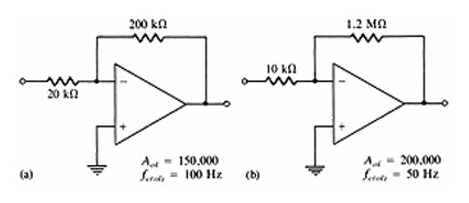
Figure 12-4
A. 1 MHz
B. 1.5 MHz
C. 1 kHz
D. 1.5 kHz
Answer: Option B
Solution:
29. Refer to Figure 12-4(b). Calculate the bandwidth.
A. 8.33 MHz
B. 833 kHz
C. 83.3 kHz
D. 8.33 kHz
Answer: Option C
Solution:
30. Negative feedback added to an op-amp _____ the bandwidth and _____ the gain.
A. increases, increases
B. increases, decreases
C. decreases, decreases
D. decreases, increases
Answer: Option B
Solution:
31. A practical op-amp has very _____ input impedance, very _____ output impedance, very _____ open-loop voltage gain, and a _____ bandwidth.
A. high, low, high, wide
B. high, high, low, narrow
C. low, high, high, wide
D. low, low, low, wide
Answer: Option A
Solution:
32. The input offset voltage drift is a parameter directly related to VOS and _____.
A. ID
B. power dissipation
C. temperature
D. phase shift
Answer: Option C
Solution:
33. The maximum rate of change of the output voltage in response to a step input voltage is the _____ of an op-amp.
A. time constant
B. maximum frequency
C. slew rate
D. static discharge
Answer: Option C
Solution:
34. A(n) _____ amplifier configuration has a higher input impedance and a lower output impedance than the op-amp itself.
A. non-inverting
B. inverting
C. voltage-follower
D. none of the above
Answer: Option A
Solution:
35. A(n) _____ amplifier configuration has an input impedance approximately equal to the input resistor Ri and an output impedance approximately equal to the output impedance of the op-amp itself.
A. non-inverting
B. inverting
C. voltage-follower
D. none of the above
Answer: Option B
Solution:
36. The _____ amplifier configuration has the highest input impedance and the lowest output impedance of the three basic op-amp configurations.
A. non-inverting
B. inverting
C. voltage-follower
D. none of the above
Answer: Option C
Solution:
37. Open-loop voltage gain of an op-amp can range up to _____.
A. 10,000
B. 50,000
C. 100,000
D. 200,000
Answer: Option D
Solution:
38. The ______ is the voltage gain of an op-amp with external feedback.
A. Aol
B. Acl
C. Av
D. none of the above
Answer: Option B
Solution:
39. A three-stage op-amp can have a maximum phase lag of _____°.
A. –180
B. –90
C. –270
D. none of the above
Answer: Option C
Solution:
TRUE/FALSE
1. A good op-amp has low voltage gain, low output impedance, and high input impedance.
A. True
B. False
Answer: Option B
Solution:
2. The common-mode rejection ratio (CMRR) is a measure of an op-amp’s ability to reject common-mode input signals.
A. True
B. False
Answer: Option A
Solution:
3. An inverting amplifier has an input impedance equal to the feedback resistor Rf.
A. True
B. False
Answer: Option B
Solution:
4. A non-inverting amplifier has a higher input impedance and a lower output impedance than the op-amp itself (without feedback).
A. True
B. False
Answer: Option A
Solution:
5. All practical op-amps have input bias currents and voltages that produce output error voltages.
A. True
B. False
Answer: Option A
Solution:
6. Open-loop gain of an op-amp is the voltage gain without feedback.
A. True
B. False
Answer: Option A
Solution:
7. Closed-loop gain is the gain with negative feedback.
A. True
B. False
Answer: Option A
Solution:
8. Open-loop gain is always smaller than closed-loop gain.
A. True
B. False
Answer: Option B
Solution:
9. Negative feedback decreases the bandwidth and increases the voltage gain.
A. True
B. False
Answer: Option B
Solution:
10. When the open-loop gain of an op-amp is reduced by negative feedback, the bandwidth is increased.
A. True
B. False
Answer: Option A
Solution:
Check your work.
Complete List of Chapter MCQ in Floyd’s Electronic Devices
Related Content


P inoyBIX educates thousands of reviewers and students a day in preparation for their board examinations. Also provides professionals with materials for their lectures and practice exams. Help me go forward with the same spirit.
“Will you subscribe today via YOUTUBE?”
TIRED OF ADS?
- Become Premium Member and experienced complete ads-free content browsing.
- Full Content Access to Premium Solutions Exclusive for Premium members
- Access to PINOYBIX FREEBIES folder
- Download Reviewers and Learning Materials Free
- Download Content: You can see download/print button at the bottom of each post.
PINOYBIX FREEBIES FOR PREMIUM MEMBERSHIP:
- CIVIL ENGINEERING REVIEWER
- CIVIL SERVICE EXAM REVIEWER
- CRIMINOLOGY REVIEWER
- ELECTRONICS ENGINEERING REVIEWER (ECE/ECT)
- ELECTRICAL ENGINEERING & RME REVIEWER
- FIRE OFFICER EXAMINATION REVIEWER
- LET REVIEWER
- MASTER PLUMBER REVIEWER
- MECHANICAL ENGINEERING REVIEWER
- NAPOLCOM REVIEWER
- Additional upload reviewers and learning materials are also FREE
FOR A LIMITED TIME
If you subscribe for PREMIUM today!
You will receive an additional 1 month of Premium Membership FREE.
For Bronze Membership an additional 2 months of Premium Membership FREE.
For Silver Membership an additional 3 months of Premium Membership FREE.
For Gold Membership an additional 5 months of Premium Membership FREE.
Join the PinoyBIX community.