
This is the Multiple Choice Questions in Other Two-Terminal Devices from the book Electronic Devices and Circuit Theory 10th Edition by Robert L. Boylestad. If you are looking for a reviewer in Electronics Engineering this will definitely help. I can assure you that this will be a great help in reviewing the book in preparation for your Board Exam. Make sure to familiarize each and every questions to increase the chance of passing the ECE Board Exam.
Online Questions and Answers Topic Outline
- MCQ in Introduction to Other Two-Terminal Devices | MCQ in Schottky Barrier (Hot-Carrier) Diodes | MCQ in Varactor (Varicap0 Diodes | MCQ in Power Diodes | MCQ in Tunnel Diodes | MCQ in Photodiodes | MCQ in Photoconductive Cells | MCQ in IR Emitters | MCQ in Liquid-Crystal Displays (LCD) | MCQ in Solar Cells | MCQ in Thermistors
Practice Exam Test Questions
Choose the letter of the best answer in each questions.
1. Which of the following is (are) diodes?
A. Schottky
B. Varactor
C. Tunnel
D. All of the above
Answer: Option D
Solution:
2. Which of the following metals is (are) used in the fabrication of Schottky diodes?
A. Molybdenum
B. Platinum
C. Tungsten
D. All of the above
Answer: Option D
Solution:
3. What are the typical ranges of reverse-bias current levels IS for low-power and high-power Schottky diodes at room temperature?
A. Picoamperes, nanoamperes
B. Nanoamperes, microamperes
C. Microamperes, milliamperes
D. Milliamperes, amperes
Answer: Option C
Solution:
4. What is the voltage drop across Schottky diodes?
A. 0 V to 0.2 V
B. 0.7 V to 0.8 V
C. 0.8 V to 1.0 V
D. 1.0 V to 1.5 V
Answer: Option A
Solution:
5. What metal(s) is(are) used in the construction of Schottky diodes?
A. Molybdenum
B. Platinum
C. Tungsten
D. Silicon
E. Any of the above
Answer: Option E
Solution:
6. For a 50-A unit, the PIV of the Schottky is about _____ compared to 150 V for the p-n junction variety.
A. 25
B 50
C. 75
D. 100
Answer: Option B
Solution:
7. Schottky diodes are very effective at frequencies approaching ______.
A. 20 GHz
B. 10 MHz
C. 100 MHz
D. 1 MHz
Answer: Option A
Solution:
8. This is an approximate equivalent circuit for the ______ diode.
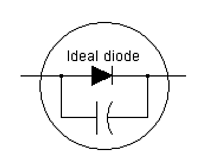
A. Schottky
B. varicap
C. tunnel
Answer: Option A
Solution:
9. What is the range of the varying capacitor CT in varactor diodes?
A. 0 pF to 5 pF
B. 2 pF to 100 µF
C. 2 µF to 100 µF
D. 2 pF to 100 pF
Answer: Option D
Solution:
10. Which of the following areas is (are) applications of varactor diodes?
A. FM modulators
B. Automatic-frequency control devices
C. Adjustable bandpass filters
D. All of the above
11. The tuning diode is a ______-dependent, variable ______.
A. voltage, resistor
B. current, capacitor
C. voltage, capacitor
D. current, inductor
Answer: Option C
Solution:
12. This is an equivalent circuit for the ______ diode.
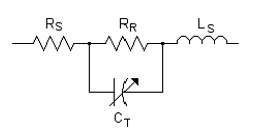
A. Schottky
B. varicap
C. tunnel
D. any of the above
Answer: Option B
Solution:
13. The varicap diode has a transition capacitance sensitive to the applied reverse-bias potential that is a maximum at zero volts and decreases ______ with increasing reverse-bias potentials.
A. logarithmically
B. parabolically
C. exponentially
D. all of the above
Answer: Option C
Solution:
14. The majority of power diodes are constructed using ______.
A. molybdenum
B. platinum
C. tungsten
D. silicon
Answer: Option D
Solution:
15. The current capability of power diodes can be increased by placing two or more in series.
A. True
B. False
Answer: Option B
Solution:
16. The PIV rating of power diodes can be increased by stacking the diodes in series.
A. True
B. False
Answer: Option A
Solution:
17. Which of the following diodes has a negative-resistance region?
A. Schottky
B. Varactor
C. Tunnel
D. Power
Answer: Option C
Solution:
18. Which of the following semiconductor materials is (are) used in the manufacturing of tunnel diodes?
A. Germanium
B. Gallium
C. Both germanium and gallium arsenide
D. Silicon
Answer: Option C
Solution:
19. What is the ratio IP / IV for gallium arsenide?
A. 1:1
B. 5:1
C. 10:1
D. 20:1
Answer: Option D
Solution:
20. What is the limit of peak current IP in tunnel diodes?
A. A few microamperes to several hundred amperes
B. A few microamperes to several amperes
C. A few microamperes to several milliamperes
D. A few microamperes to several hundred microamperes
Answer: Option A
Solution:
21. What is the maximum peak voltage for tunnel diodes?
A. 50 mV
B. 100 mV
C. 250 mV
D. 600 mV
Answer: Option D
Solution:
22. In which region is the operating point stable in tunnel diodes?
A. Negative-resistance
B. Positive-resistance
C. Both negative- and positive-resistance
D. Neither negative- nor positive-resistance
Answer: Option B
Solution:
23. Which of the following diodes is limited to the reverse-bias region in its region of operation?
A. Schottky
B. Tunnel
C. Photodiode
D. Rectifier
Answer: Option C
Solution:
24. What is the response time of cadmium sulfide (CdS) in photoconductive cells?
A. 100 ms
B. 50 ms
C. 25 ms
D. 10 ms
Answer: Option A
Solution:
25. Which of the following areas is (are) an application of infrared-emitting diodes?
A. Intrusion alarms
B. Shaft encoders
C. Paper-tape readers
D. All of the above
Answer: Option D
Solution:
26. What is the maximum temperature limit for liquid-crystal displays (LCDs)?
A. 10°C
B. 30°C
C. 60°C
D. 100°C
Answer: Option C
Solution:
27. What is the response time of light-emitting diodes (LEDs)?
A. Less than 100 ns
B. 50 ms
C. 100 ms to 300 ms
D. 400 ms
Answer: Option A
Solution:
28. What is the response time of LCDs?
A. Less than 100 ns
B. 50 ms
C. 100 ms to 300 ms
D. 400 ms
Answer: Option C
Solution:
29. What is the power density received from the sun at sea level?
A. 10 mW/cm2
B. 100 mW/cm2
C. 500 mW/cm2
D. 1 W/cm2
Answer: Option B
Solution:
30. Which of the following semiconductor materials is (are) used for manufacturing solar cells?
A. Gallium arsenide
B. Indium arsenide
C. Cadmium sulfide
D. All of the above
Answer: Option D
Solution:
31. What type of temperature coefficient do thermistors have?
A. Positive
B. Negative
C. Either positive or negative
D. None of the above
Answer: Option C
Solution:
32. Which of the following materials is (are) used in the manufacturing of thermistors?
A. Ge
B. Si
C. A mixture of oxides of cobalt, nickel, strontium, or manganese
D. All of the above
Answer: Option D
Solution:
33. What is the resistance of thermistors at room temperature (20°C)?
A. 5 kΩ
B. 1 kΩ
C. 100 Ω
D. 1 Ω
Answer: Option A
Solution:
34. What is the resistance of thermistors at boiling temperature (100°C)?
A. 5 kΩ
B. 1 kΩ
C. 100 Ω
D. 1 Ω
Answer: Option C
Solution:
35. What is the typical level of change in resistance per degree change in temperature?
A. 1% to 2%
B. 3% to 5%
C. 7% to 10%
D. 10% to 25%
Answer: Option B
Solution:
FILL-IN-THE-BLANKS
1. Schottky diodes have ______.
A. quick response time
B. a lower noise figure
C. both quick response time and a lower noise figure
D. None of the above
Answer: Option C
Solution:
2. Schottky diode construction results in a ______ uniform junction region and a ______ level of ruggedness.
A. more, high
B. less, high
C. more, low
D. less, low
Answer: Option A
Solution:
3. In both n-type and p-type silicon materials, the ______ is the majority carrier in a Schottky diode.
A. hole
B. electron
C. proton
C. neutron
Answer: Option B
Solution:
4. The barrier at the junction for a Schottky diode is ______ that of the p-n junction device in both the forward- and reverse-bias regions.
A. the same as
B. more than
C. less than
D. None of the above
Answer: Option C
Solution:
5. A Schottky diode has ______ level of current at the same applied bias compared to that of the p-n junction at both the forward- and reverse-bias regions.
A. a lower
B. a higher
C. the same
D. None of the above
Answer: Option B
Solution:
6. The PIV of Schottky diodes is usually ______ that of a comparable p-n junction unit.
A. 1/2
B. 1/3
C. 1/4
D. 1/5
Answer: Option B
Solution:
7. Varactor diodes are ______.
A. semiconductor devices
B. voltage-dependent
C. variable capacitors
D. All of the above
Answer: Option D
Solution:
8. In varactor diodes, as the reverse-bias potential increases, the width of the depletion region ______, which in turn ______ the transition capacitance.
A. increases, increases
B. decreases, reduces
C. increases, reduces
D. decreases, increases
Answer: Option C
Solution:
9. The normal range of reverse-bias voltage VR for varactor diodes is limited to about ______.
A. 15 V
B. 20 V
C. 25 V
D. 40 V
Answer: Option B
Solution:
10. In the reverse-bias region of varactor diodes, the resistance RR in parallel with the varying capacitor is ______ and the series resistance RS is ______.
A. very large, very small
B. very large, very large
C. very small, very large
D. very small, very small
Answer: Option A
Solution:
11. The majority of power diodes are constructed using silicon because of its higher ______ rating(s).
A. current
B. temperature
C. PIV
D. All of the above
Answer: Option D
Solution:
12. The current capability of power diodes can be increased by placing two or more of the diodes in ______, and the PIV rating can be increased by stacking the diodes in ______.
A. parallel, parallel
B. series, parallel
C. parallel, series
D. series, series
Answer: Option C
Solution:
13. In the negative-resistance region of tunnel diodes, as the terminal voltage increases, the diode current ______.
A. remains the same
B. decreases
C. increases
D. is undefined
Answer: Option B
Solution:
14. The p-n junction of a tunnel diode is doped at a level from ______ to ______ times that of a typical semiconductor diode.
A. one, several
B. several, ten
C. more than ten, several hundred
D. one hundred, several thousand
Answer: Option D
Solution:
15. The negative-resistance region of tunnel diodes can be used in the design of ______.
A. oscillators
B. switching networks
C. pulse generators
D. All of the above
Answer: Option D
Solution:
16. The wavelength is usually measured in ______.
A. angstrom units
B. micrometers
C. both angstrom units and micrometers
D. None of the above
Answer: Option C
Solution:
17. In photodiodes, an increase in light intensity _______ the reverse current.
A. increases
B. decreases
C. maintains
D. None of the above
Answer: Option A
Solution:
18. Ge has a ______ dark current and a ______ level of reverse current than silicon.
A. higher, lower
B. higher, higher
C. lower, higher
D. lower, lower
Answer: Option B
Solution:
19. The response time for cadmium selenide (CdSe) is ______.
A. 100 ms
B. 50 ms
C. 25 ms
D. 10 ms
Answer: Option D
Solution:
20. A decrease in illumination ______ the resistance Rλ of a photoconductive cell.
A. decreases
B. increases
C. maintains
D. None of the above
Answer: Option B
Solution:
21. LCDs have ______ power requirement than (as) LEDs.
A. a lower
B. a higher
C. the same
D. None of the above
Answer: Option A
Solution:
22. LCDs are characteristically ______ LEDs.
A. the same speed as
B. much slower than
C. faster than
D. much faster than
Answer: Option B
Solution:
23. ______ is (are) the most widely used material(s) for solar cells.
A. Selenium
B. Silicon
C. Both selenium and silicon
D. Cadmium sulfide
Answer: Option C
Solution:
24. In general, silicon ______.
A. has a higher conversion efficiency
B. has greater stability
C. is less subject to fatigue
D. All of the above
Answer: Option D
Solution:
25. Typical levels of efficiency for solar cells range from ______ to ______.
A. 10%, 40%
B. 40%, 50%
C. 50%, 75%
D. 75%, 100%
Answer: Option A
Solution:
Check your work.
Complete List of Chapter Quiz in Electronic Devices and Circuit Theory
Related Content




P inoyBIX educates thousands of reviewers and students a day in preparation for their board examinations. Also provides professionals with materials for their lectures and practice exams. Help me go forward with the same spirit.
“Will you subscribe today via YOUTUBE?”
TIRED OF ADS?
- Become Premium Member and experienced complete ads-free content browsing.
- Full Content Access to Premium Solutions Exclusive for Premium members
- Access to PINOYBIX FREEBIES folder
- Download Reviewers and Learning Materials Free
- Download Content: You can see download/print button at the bottom of each post.
PINOYBIX FREEBIES FOR PREMIUM MEMBERSHIP:
- CIVIL ENGINEERING REVIEWER
- CIVIL SERVICE EXAM REVIEWER
- CRIMINOLOGY REVIEWER
- ELECTRONICS ENGINEERING REVIEWER (ECE/ECT)
- ELECTRICAL ENGINEERING & RME REVIEWER
- FIRE OFFICER EXAMINATION REVIEWER
- LET REVIEWER
- MASTER PLUMBER REVIEWER
- MECHANICAL ENGINEERING REVIEWER
- NAPOLCOM REVIEWER
- Additional upload reviewers and learning materials are also FREE
FOR A LIMITED TIME
If you subscribe for PREMIUM today!
You will receive an additional 1 month of Premium Membership FREE.
For Bronze Membership an additional 2 months of Premium Membership FREE.
For Silver Membership an additional 3 months of Premium Membership FREE.
For Gold Membership an additional 5 months of Premium Membership FREE.
Join the PinoyBIX community.