
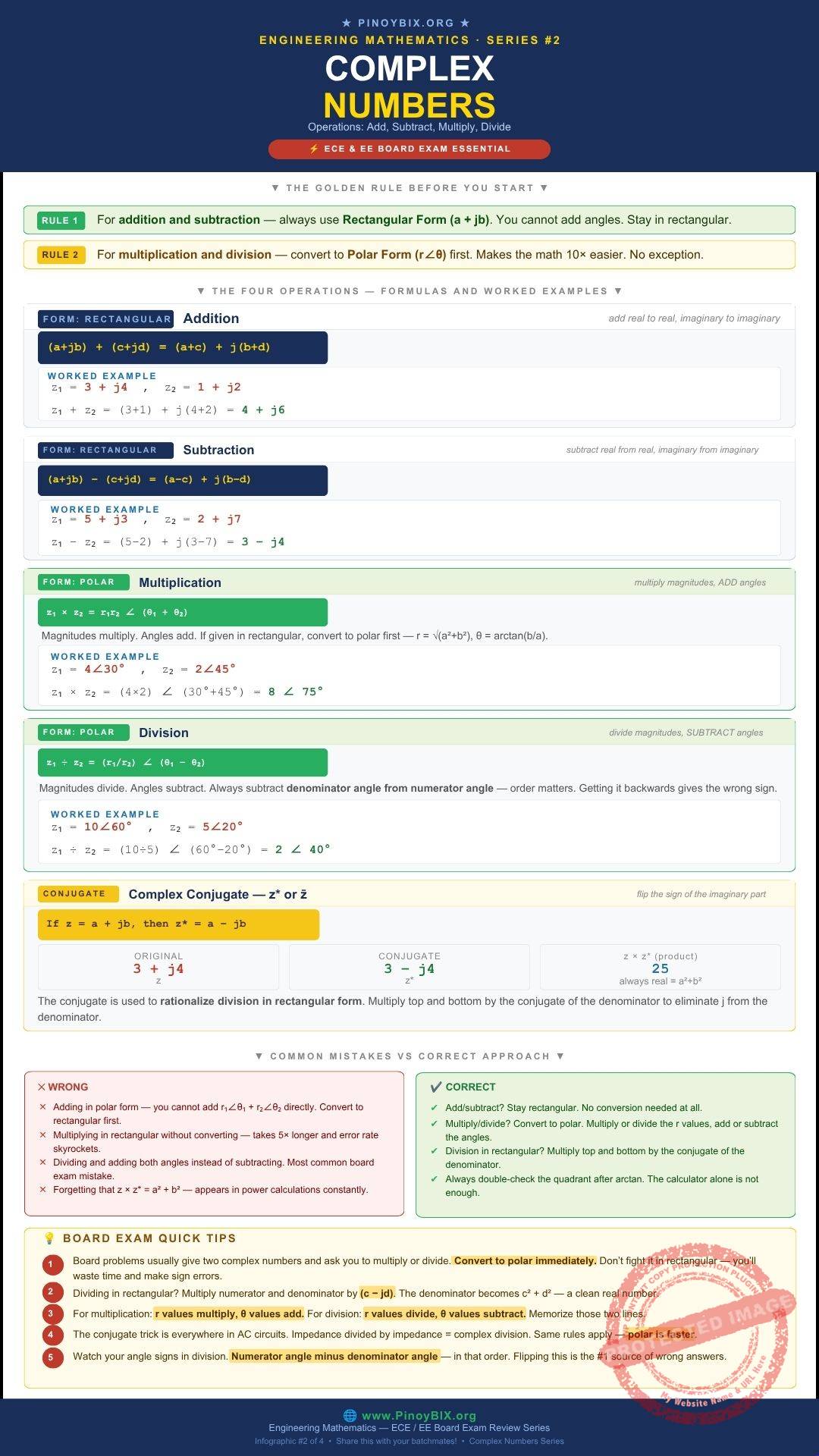
You already know the four forms of a complex number from Part 1 of this series. Now comes the part that actually shows up on the board exam: what do you do with them? Addition, subtraction, multiplication, division, and the conjugate method — these five operations cover the majority of complex number problems you will face in the ECE, EE, ME, CE, and ChE board exams.
This is Part 2 of the Complete Complex Numbers ECE and EE Board Exam Reviewer Series on PinoyBIX.org. The goal here is not just to show you the formulas. The goal is to make the form selection rule automatic so you never waste time choosing the wrong approach under exam pressure.
- ECE (Electronics Engineer) — Operations on complex numbers appear in Engineering Mathematics and directly in Electronics and Communications subjects. Multiplication and division in polar form are essential for phasor and impedance calculations. High frequency topic. Expect 4 to 8 items.
- EE (Electrical Engineer) — Operations are tested heavily in Engineering Mathematics and Electrical Circuits. Division using the conjugate method appears in impedance ratio problems. High frequency topic.
- ME (Mechanical Engineer) — Operations appear in Engineering Mathematics. Moderate frequency. Addition, subtraction, and multiplication are the most tested. Division appears occasionally.
- CE (Civil Engineer) — Operations appear in Engineering Mathematics. Moderate frequency. Addition and subtraction dominate. Multiplication in polar form appears in structural dynamics problems.
- ChE (Chemical Engineer) — Operations appear in Engineering Mathematics and in process control transfer function analysis. Moderate frequency. All four operations may appear.
- GeE (Geodetic Engineer) — Basic operations appear in Engineering Mathematics. Low to moderate frequency.
- MetE and MinE — Basic addition, subtraction, and multiplication appear in Engineering Mathematics. Low frequency.
- Naval Architect and Marine Engineer — Operations appear in Engineering Mathematics and vibration analysis. Moderate frequency.
Bottom line: Every engineering board examinee needs to master addition, subtraction, and multiplication. ECE and EE examinees must also master division in both polar and conjugate forms with full confidence.
The One Rule That Changes Everything
Before writing a single number, you need to know which form to use. Most students skip this decision and dive straight into arithmetic. That is where the errors begin.
- Addition and Subtraction → use Rectangular Form

- Multiplication and Division → use Polar Form


If the numbers are not already in the correct form, convert them first. This is not optional.
Breaking this rule does not make the math impossible. It makes it significantly slower and significantly more error prone. On a timed board exam, that difference matters.
Addition of Complex Numbers
To add two complex numbers, add the real parts together and add the imaginary parts together. Both numbers must be in rectangular form before you begin.
![\[z_1 + z_2 = (a_1 + a_2) + j(b_1 + b_2)\]](https://pinoybix.org/wp-content/ql-cache/quicklatex.com-495b9fb5dc59a2b1050eb126e3351d55_l3.png "Rendered by QuickLaTeX.com")
For example: if  and
and  , then:
![\[z_1 + z_2 = (3 + 1) + j(4 + 2) = 4 + j6\]](https://pinoybix.org/wp-content/ql-cache/quicklatex.com-c5d27d774a19ad55922a4c9ce8981e89_l3.png "Rendered by QuickLaTeX.com")
Clean and fast. No conversion needed when both numbers are already in rectangular form.
Subtraction of Complex Numbers
Subtraction follows the same pattern. Subtract the real parts and subtract the imaginary parts separately. Stay in rectangular form.
![\[z_1 - z_2 = (a_1 - a_2) + j(b_1 - b_2)\]](https://pinoybix.org/wp-content/ql-cache/quicklatex.com-f7a37d7328d7d5614c47478d7cd96fc6_l3.png "Rendered by QuickLaTeX.com")
For example: if  and
and  , then:
![\[z_1 - z_2 = (5 - 2) + j(3 - 7) = 3 - j4\]](https://pinoybix.org/wp-content/ql-cache/quicklatex.com-b06181cce4fc42ad38d65f5cc31a3343_l3.png "Rendered by QuickLaTeX.com")
Watch the sign on the imaginary part. Subtracting a positive imaginary term gives a negative imaginary result. This is where sign errors happen.
Multiplication of Complex Numbers
Multiplication is done in polar form. Multiply the magnitudes and add the angles. If the numbers are given in rectangular form, convert to polar first.
![\[z_1 \times z_2 = r_1 r_2 \angle(\theta_1 + \theta_2)\]](https://pinoybix.org/wp-content/ql-cache/quicklatex.com-5b166373cf53fc9a51be1f9b0db18fe7_l3.png "Rendered by QuickLaTeX.com")
Magnitudes multiply. Angles add.
You can also multiply in rectangular form using the FOIL method and substituting  . This works but takes significantly longer and produces more arithmetic errors. Use polar form whenever you can.
Rectangular multiplication as a reference:
![\[(a_1 + jb_1)(a_2 + jb_2) = (a_1 a_2 - b_1 b_2) + j(a_1 b_2 + a_2 b_1)\]](https://pinoybix.org/wp-content/ql-cache/quicklatex.com-c2a9359e8c9a5ecfd975f46e99058e6c_l3.png "Rendered by QuickLaTeX.com")
Note that turns the  term into
  , which shifts from the imaginary to the real component. Students who forget this substitution get the real part wrong.
Division of Complex Numbers
Division is done in polar form. Divide the magnitudes and subtract the angles. Denominator angle is always subtracted from numerator angle — not the other way around.
![\[\dfrac{z_1}{z_2} = \dfrac{r_1}{r_2} \angle(\theta_1 - \theta_2)\]](https://pinoybix.org/wp-content/ql-cache/quicklatex.com-86371da61ddfebfed6b2eecd03978c25_l3.png "Rendered by QuickLaTeX.com")
Magnitudes divide. Angles subtract. Always numerator angle minus denominator angle.
When the numbers are in rectangular form and you cannot convert to polar easily, use the conjugate method instead.
![\[\dfrac{z_1}{z_2} = \dfrac{a_1 + jb_1}{a_2 + jb_2} \cdot \dfrac{a_2 - jb_2}{a_2 - jb_2} = \dfrac{(a_1 + jb_1)(a_2 - jb_2)}{a_2^2 + b_2^2}\]](https://pinoybix.org/wp-content/ql-cache/quicklatex.com-b263cffd7c78ad6b36c59f7e0176af62_l3.png "Rendered by QuickLaTeX.com")
Multiply numerator and denominator by the conjugate of the denominator. The denominator becomes the real number  .
.
The Complex Conjugate
The complex conjugate of is written as  or
or  and is formed by flipping the sign of the imaginary part.
![\[\text{If } z = a + jb \text{, then } z^* = a - jb\]](https://pinoybix.org/wp-content/ql-cache/quicklatex.com-beb80209013fe8f55fbee4e82329c7a2_l3.png "Rendered by QuickLaTeX.com")
![\[z \cdot z^* = a^2 + b^2 = |z|^2\]](https://pinoybix.org/wp-content/ql-cache/quicklatex.com-0e56438763851c0a0fb17ba4e6abb576_l3.png "Rendered by QuickLaTeX.com")
The product of a complex number and its conjugate is always a real number equal to the square of the modulus.
The conjugate has three main uses. First, it rationalizes the denominator in rectangular division. Second, it appears in power calculations in AC circuits as  . Third, it is used to extract the real and imaginary parts of complex expressions in signal processing problems.
Worked Problems — Board Exam Type Questions
The following 10 problems represent actual ECE, EE, ME, CE, and ChE board exam question types on complex number operations. Work each problem completely before reading the solution.
Problem 1 — ECE Board Exam Type
Add  and
and  .
.
Given: ,
Find: 
Solution:
Step 1: Add the real parts.
![\[a = 4 + (-2) = 2\]](https://pinoybix.org/wp-content/ql-cache/quicklatex.com-6f29b22bae8544235b0aa11a73a95a8c_l3.png "Rendered by QuickLaTeX.com")
Step 2: Add the imaginary parts.
![\[b = 3 + 5 = 8\]](https://pinoybix.org/wp-content/ql-cache/quicklatex.com-611a7c945b8af41ac31e52c0e959da97_l3.png "Rendered by QuickLaTeX.com")
Step 3: Write the result.
![\[z_1 + z_2 = 2 + j8\]](https://pinoybix.org/wp-content/ql-cache/quicklatex.com-20a9fbeafcabcc8a2486a210fbdb53a2_l3.png "Rendered by QuickLaTeX.com")

Examiner note: Addition of a negative real part  and a positive real part
  gives
gives  . Students sometimes write
  by ignoring the negative sign. Read the sign of each component carefully before adding.
Problem 2 — EE Board Exam Type
Subtract  from
from  .
.
Given: ,
Find: 
Solution:
Step 1: Subtract the real parts.
![\[a = 1 - 3 = -2\]](https://pinoybix.org/wp-content/ql-cache/quicklatex.com-db20195f8c611b22eb4321527888aee9_l3.png "Rendered by QuickLaTeX.com")
Step 2: Subtract the imaginary parts. Note that subtracting  gives
gives  .
.
![\[b = 4 - (-7) = 4 + 7 = 11\]](https://pinoybix.org/wp-content/ql-cache/quicklatex.com-1201fc21a0805e8eb4bee874bb545718_l3.png "Rendered by QuickLaTeX.com")
Step 3: Write the result.
![\[z_1 - z_2 = -2 + j11\]](https://pinoybix.org/wp-content/ql-cache/quicklatex.com-1a381f645a06b24de80bc2e7ea1f93c3_l3.png "Rendered by QuickLaTeX.com")

Examiner note: Subtracting a negative imaginary part flips the sign.  , not
, not  . Double-check the sign of the imaginary part of the number being subtracted before computing.
Problem 3 — ECE Board Exam Type
Multiply  and
and  .
.
Given: ,
Find: 
Solution:
Step 1: Both numbers are already in polar form. Apply the multiplication rule directly.
Step 2: Multiply the magnitudes.
![\[r = r_1 \times r_2 = 3 \times 4 = 12\]](https://pinoybix.org/wp-content/ql-cache/quicklatex.com-551cac79dc0c90636e89c68932cbd4a0_l3.png "Rendered by QuickLaTeX.com")
Step 3: Add the angles.
![\[\theta = \theta_1 + \theta_2 = 25° + 40° = 65°\]](https://pinoybix.org/wp-content/ql-cache/quicklatex.com-92e597c8317f0eb1bffda73da379800d_l3.png "Rendered by QuickLaTeX.com")
Step 4: Write the result.
![\[z_1 \times z_2 = 12\angle 65°\]](https://pinoybix.org/wp-content/ql-cache/quicklatex.com-f78b1005b6543393c0d1c3fb7ed787f1_l3.png "Rendered by QuickLaTeX.com")

Examiner note: When both numbers are already in polar form, multiplication takes two arithmetic steps. No conversion needed. This is why the form selection rule exists — it eliminates unnecessary work.
Problem 4 — ME Board Exam Type
Divide  by
by  .
.
Given: ,
Find: 
Solution:
Step 1: Both numbers are in polar form. Apply the division rule directly.
Step 2: Divide the magnitudes.
![\[r = \dfrac{r_1}{r_2} = \dfrac{15}{3} = 5\]](https://pinoybix.org/wp-content/ql-cache/quicklatex.com-e4102c9953353dd73b6403829cae5b73_l3.png "Rendered by QuickLaTeX.com")
Step 3: Subtract the angles. Numerator angle minus denominator angle.
![\[\theta = \theta_1 - \theta_2 = 80° - 35° = 45°\]](https://pinoybix.org/wp-content/ql-cache/quicklatex.com-36f294449014cba3f79c4b732c194a82_l3.png "Rendered by QuickLaTeX.com")
Step 4: Write the result.
![\[\dfrac{z_1}{z_2} = 5\angle 45°\]](https://pinoybix.org/wp-content/ql-cache/quicklatex.com-ea0ff7efcbad0cfd024b5a524c089415_l3.png "Rendered by QuickLaTeX.com")

Examiner note: The order of subtraction matters. It is always  , meaning numerator angle minus denominator angle. Reversing this gives
  instead of
  , which is the wrong answer. This error appears frequently in board exam answer sheets.
Problem 5 — CE Board Exam Type
Multiply  and
and  using rectangular form.
Given: ,
Find: in rectangular form.
Solution:
Step 1: Apply the FOIL method.
![\[(2 + j3)(1 - j2) = 2(1) + 2(-j2) + j3(1) + j3(-j2)\]](https://pinoybix.org/wp-content/ql-cache/quicklatex.com-d9cbfadea3afc4bdd43fcf6ae9c1290e_l3.png "Rendered by QuickLaTeX.com")
Step 2: Expand each term.
![\[= 2 - j4 + j3 - j^2 6\]](https://pinoybix.org/wp-content/ql-cache/quicklatex.com-bb23f15dfb9815c1d83a46098d9103bc_l3.png "Rendered by QuickLaTeX.com")
Step 3: Substitute .
![\[= 2 - j4 + j3 - (-1)(6) = 2 - j4 + j3 + 6\]](https://pinoybix.org/wp-content/ql-cache/quicklatex.com-6378637ab1279edc301cffa88056d39c_l3.png "Rendered by QuickLaTeX.com")
Step 4: Collect real and imaginary parts.
![\[= (2 + 6) + j(-4 + 3) = 8 - j1\]](https://pinoybix.org/wp-content/ql-cache/quicklatex.com-ddcd132a3f3d5a11e053c22b935006eb_l3.png "Rendered by QuickLaTeX.com")

Examiner note: The critical step is substituting after expanding. The term  becomes
  , not
, not  . Students who forget the substitution keep
  in the expression and get an incorrect result. Always substitute before collecting terms.
Problem 6 — ECE Board Exam Type
Divide  by
by  using the conjugate method.
Given: ,
Find: in rectangular form.
Solution:
Step 1: Identify the conjugate of the denominator.
![\[z_2^* = 3 - j1\]](https://pinoybix.org/wp-content/ql-cache/quicklatex.com-737af483ad6ac563d331cc73a5e37ddb_l3.png "Rendered by QuickLaTeX.com")
Step 2: Multiply numerator and denominator by  .
.
![\[\dfrac{4 + j2}{3 + j1} \cdot \dfrac{3 - j1}{3 - j1}\]](https://pinoybix.org/wp-content/ql-cache/quicklatex.com-336fe458b4c01d4296da8f28e6193a12_l3.png "Rendered by QuickLaTeX.com")
Step 3: Expand the numerator using FOIL.
![\[(4 + j2)(3 - j1) = 12 - j4 + j6 - j^2 2 = 12 + j2 + 2 = 14 + j2\]](https://pinoybix.org/wp-content/ql-cache/quicklatex.com-7212ea351c90b2d7eefb3d36253cc458_l3.png "Rendered by QuickLaTeX.com")
Step 4: Compute the denominator using  .
.
![\[3^2 + 1^2 = 9 + 1 = 10\]](https://pinoybix.org/wp-content/ql-cache/quicklatex.com-224414d17fe1924b3846679615983385_l3.png "Rendered by QuickLaTeX.com")
Step 5: Divide each part of the numerator by the denominator.
![\[\dfrac{14 + j2}{10} = \dfrac{14}{10} + j\dfrac{2}{10} = 1.4 + j0.2\]](https://pinoybix.org/wp-content/ql-cache/quicklatex.com-051ae464915c022ca3640b6153124c84_l3.png "Rendered by QuickLaTeX.com")
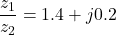
Examiner note: The conjugate method always produces a real number denominator equal to . If your denominator still contains  after multiplying by the conjugate, you made an error in the expansion. Go back and check the FOIL step.
Problem 7 — ChE Board Exam Type
Given  and
and  , find and express the result in rectangular form.
Given: ,
Find: in rectangular form 
Solution:
Step 1: Multiply in polar form first.
![\[z_1 \times z_2 = (2 \times 5)\angle(30° + 60°) = 10\angle 90°\]](https://pinoybix.org/wp-content/ql-cache/quicklatex.com-cf56485a4f5aaa57109144b251c1fbc6_l3.png "Rendered by QuickLaTeX.com")
Step 2: Convert  to rectangular form.
![\[a = 10\cos 90° = 10(0) = 0\]](https://pinoybix.org/wp-content/ql-cache/quicklatex.com-a9f17a8d3d61db20dac1367ddf0dcf08_l3.png "Rendered by QuickLaTeX.com")
![\[b = 10\sin 90° = 10(1) = 10\]](https://pinoybix.org/wp-content/ql-cache/quicklatex.com-08d6a81fbdae1ded91d56942eb106a13_l3.png "Rendered by QuickLaTeX.com")
Step 3: Write the rectangular form.
![\[z_1 \times z_2 = 0 + j10 = j10\]](https://pinoybix.org/wp-content/ql-cache/quicklatex.com-98b758589d07c70ac96e756ebb511b04_l3.png "Rendered by QuickLaTeX.com")

Examiner note: A result of  always gives a pure imaginary number with zero real part. A result of
  always gives a pure real number with zero imaginary part. These are quick sanity checks you can apply without converting.
Problem 8 — EE Board Exam Type
Find the conjugate of  and verify that
  equals
  .
.
Given:
Find: and verify 
Solution:
Step 1: Write the conjugate by flipping the sign of the imaginary part.
![\[z^* = -4 - j6\]](https://pinoybix.org/wp-content/ql-cache/quicklatex.com-7f9d6c80f6c72b9b01fff37e82b1c4ec_l3.png "Rendered by QuickLaTeX.com")
Step 2: Compute .
![\[z \cdot z^* = (-4 + j6)(-4 - j6)\]](https://pinoybix.org/wp-content/ql-cache/quicklatex.com-ae390b124494f91e4fb67c902d2b31e0_l3.png "Rendered by QuickLaTeX.com")
Step 3: Apply  .
.
![\[z \cdot z^* = (-4)^2 + (6)^2 = 16 + 36 = 52\]](https://pinoybix.org/wp-content/ql-cache/quicklatex.com-a6364765865bf7dc96234f5918f884e8_l3.png "Rendered by QuickLaTeX.com")
Step 4: Verify using the modulus formula.
![\[|z|^2 = \sqrt{(-4)^2 + 6^2}^2 = 16 + 36 = 52 \quad \checkmark\]](https://pinoybix.org/wp-content/ql-cache/quicklatex.com-9d833aa27ee3b5454da49e1ccc224b94_l3.png "Rendered by QuickLaTeX.com")
 and
and  ✓
✓
Examiner note: The verification step is a self-checking tool you can use on the board exam whenever you compute a conjugate product. If the result is not equal to , there is an error in your expansion.
Problem 9 — ECE Board Exam Type
Simplify  and express the result in rectangular form.
Given:
Find: Result in form.
Solution:
Step 1: Identify the conjugate of the denominator. The denominator is  , so the conjugate is
  .
.
Step 2: Multiply numerator and denominator by the conjugate.
![\[\dfrac{j}{1 + j} \cdot \dfrac{1 - j}{1 - j}\]](https://pinoybix.org/wp-content/ql-cache/quicklatex.com-fb5554f8e706d9d289f414b79f52ec35_l3.png "Rendered by QuickLaTeX.com")
Step 3: Expand the numerator.
![\[j(1 - j) = j - j^2 = j - (-1) = 1 + j\]](https://pinoybix.org/wp-content/ql-cache/quicklatex.com-1c0b828b397efee51defd8578e499698_l3.png "Rendered by QuickLaTeX.com")
Step 4: Compute the denominator using .
![\[1^2 + 1^2 = 2\]](https://pinoybix.org/wp-content/ql-cache/quicklatex.com-d8520156d6241f38282fe6b27883b8d3_l3.png "Rendered by QuickLaTeX.com")
Step 5: Divide.
![\[\dfrac{1 + j}{2} = \dfrac{1}{2} + j\dfrac{1}{2} = 0.5 + j0.5\]](https://pinoybix.org/wp-content/ql-cache/quicklatex.com-fb60c64d018cfaea208f89c0be615a5d_l3.png "Rendered by QuickLaTeX.com")
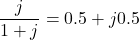
Examiner note: The numerator here is alone, not a full complex number. The conjugate method still applies exactly the same way. Multiply  carefully and remember that
  .
.
Problem 10 — ECE Board Exam Type
Given and  , find in polar form.
Given: ,
Find: in polar form 
Solution:
Step 1: Convert  to polar form.
![\[r_1 = \sqrt{3^2 + 4^2} = \sqrt{25} = 5\]](https://pinoybix.org/wp-content/ql-cache/quicklatex.com-51c88a4c21c0a2a3133bb6afee04c93e_l3.png "Rendered by QuickLaTeX.com")
![\[\theta_1 = \arctan\!\left(\dfrac{4}{3}\right) = 53.13° \quad \text{(Quadrant I)}\]](https://pinoybix.org/wp-content/ql-cache/quicklatex.com-c9ce6ef41a8cc933594866702cfca3ac_l3.png "Rendered by QuickLaTeX.com")
![\[z_1 = 5\angle 53.13°\]](https://pinoybix.org/wp-content/ql-cache/quicklatex.com-c4e18d1668823fec1532388b2845f1cb_l3.png "Rendered by QuickLaTeX.com")
Step 2: Convert  to polar form. Since
  and
and  , the number is in Quadrant IV.
![\[r_2 = \sqrt{4^2 + (-3)^2} = \sqrt{16 + 9} = \sqrt{25} = 5\]](https://pinoybix.org/wp-content/ql-cache/quicklatex.com-523e315e14b7acc2c91272f25e34dc54_l3.png "Rendered by QuickLaTeX.com")
![\[\theta_2 = -\arctan\!\left(\dfrac{3}{4}\right) = -36.87° \quad \text{(Quadrant IV, negative angle)}\]](https://pinoybix.org/wp-content/ql-cache/quicklatex.com-f23271490f35bbc0dd8f7ee1aba3a9a5_l3.png "Rendered by QuickLaTeX.com")
![\[z_2 = 5\angle{-36.87°}\]](https://pinoybix.org/wp-content/ql-cache/quicklatex.com-77cca392fe837f56563ee2afb14a8cad_l3.png "Rendered by QuickLaTeX.com")
Step 3: Apply the division rule.
![\[\dfrac{z_1}{z_2} = \dfrac{5}{5}\angle(53.13° - (-36.87°)) = 1\angle 90°\]](https://pinoybix.org/wp-content/ql-cache/quicklatex.com-19b9f61d60356e5b52a9ae7d87e8a684_l3.png "Rendered by QuickLaTeX.com")

Examiner note: This result tells you that dividing by produces a unit vector pointing straight up along the imaginary axis. In rectangular form,  . The answer is a valid and complete rectangular form result. Some board exam choices present it this way.
Common Mistakes and Examiner Traps
These are the most consistent error patterns in board exam solutions for complex number operations.
| ❌ Common Mistake | ✅ Correct Approach |
|---|---|
Adding complex numbers in polar form directly. Attempting  without converting to rectangular form first. without converting to rectangular form first. |
Convert both numbers to rectangular form first. Add real parts and imaginary parts separately. Convert back to polar only if the final answer requires it. |
Adding angles when dividing. Writing 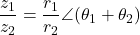 instead of subtracting the angles. instead of subtracting the angles. |
Division in polar form subtracts angles: 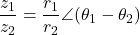 . The angle of the denominator is always subtracted from the angle of the numerator. . The angle of the denominator is always subtracted from the angle of the numerator. |
Forgetting to substitute when multiplying in rectangular form. Leaving in the expression or writing  . . |
After expanding using FOIL, immediately substitute before collecting like terms. The term  becomes becomes  and moves from the imaginary component to the real component. and moves from the imaginary component to the real component. |
| Using the wrong conjugate in division. Multiplying by the conjugate of the numerator instead of the conjugate of the denominator. | The conjugate you multiply by is always the conjugate of the denominator. The purpose is to eliminate from the bottom of the fraction. Conjugating the numerator achieves nothing useful. |
Leaving in the denominator of a final answer. Writing  or or  as a final result. as a final result. |
Always rationalize the denominator before writing the final answer. A complex number in the denominator is not in standard form. Multiply top and bottom by the conjugate of the denominator to clear it. |
Subtracting the numerator angle from the denominator angle instead of the reverse. Computing  instead of . instead of . |
The rule is always numerator angle minus denominator angle: . If the result is negative, that is a valid negative angle. Do not flip the order to make it positive. |
| Multiplying in polar form when the problem asks for rectangular form, without converting the final answer. Stopping at when the problem asks for . |
Read the problem statement carefully. If the final answer must be in rectangular form, convert your polar result using  and and  before writing the answer. before writing the answer. |
Board Exam Quick Tips
- Decide the form before touching a number. Read the operation first. Addition or subtraction means rectangular. Multiplication or division means polar. Make this decision automatic before the board exam.
- The conjugate of
 is . Only the sign of the imaginary part changes. The real part stays exactly the same. Changing the real part is a common error that invalidates the entire rationalization.
 - After multiplying in rectangular form, always substitute
 before collecting terms. This is a separate step, not something to do mentally. Write it explicitly in your solution to avoid the most common sign error in complex number multiplication.
 - For division in polar form, the angle subtraction is
 . Say it out loud if needed: numerator angle minus denominator angle. Write it in that order every time. The board exam exploits this consistently by placing the wrong-order result among the choices.
 - When a problem gives mixed forms — one number in rectangular, one in polar — convert both to the same form before operating. Match the form to the operation: rectangular for addition and subtraction, polar for multiplication and division. Never mix forms mid-calculation.
 . Only the sign of the imaginary part changes. The real part stays exactly the same. Changing the real part is a common error that invalidates the entire rationalization.
Frequently Asked Questions
Q1. Can I always use rectangular form for multiplication instead of polar form?
Yes, you can. The FOIL method works for rectangular multiplication and gives the correct answer. The reason polar form is strongly recommended is speed and accuracy. Polar multiplication takes two arithmetic steps. Rectangular multiplication takes five to seven steps and introduces more opportunities for sign errors. On a timed board exam, this difference is significant.
Q2. What happens when the result of division in polar form has a negative angle?
A negative angle is valid and correct. For example,  means the vector points
  below the positive real axis, which places it in Quadrant IV. You can leave it as a negative angle or convert to a positive equivalent by adding
  :
:  . Both represent the same complex number. Check which form your answer choices use.
Q3. Why does the conjugate method work for division?
Multiplying any complex number by its own conjugate always produces a real number: . When you multiply both the numerator and denominator by the conjugate of the denominator, you are multiplying the fraction by  — so its value does not change — but the denominator becomes a real number, which makes the division straightforward.
Q4. Is it possible to have a complex number in the denominator in the final answer?
No, not in standard form. A complex number written as requires both  and
and  to be real numbers. If appears in the denominator of either component, the number is not in standard rectangular form. Always rationalize using the conjugate before writing the final answer.
Q5. How do I multiply three or more complex numbers together?
Convert all of them to polar form first. Then multiply all the magnitudes together and add all the angles together. For example,  . This scales directly to any number of factors. In rectangular form, you would need to multiply two at a time, which becomes increasingly tedious.
What is Next
Now that all four operations and the conjugate method are clear, the next topic is the one that produces the most incomplete answers on the board exam. Part 3 of this series covers De Moivre’s theorem — how to raise a complex number to any integer power and how to find all nth roots, not just the principal one.
→ Continue to Part 3 — De Moivre’s Theorem: Powers and Roots of Complex Numbers
→ Back to the Complete Complex Numbers ECE and EE Board Exam Reviewer Series
Published by PinoyBIX.org — Engineering Education for Every Filipino Student. Electronics · Mathematics · Board Exam Review · Free for Everyone.
Related Content



P inoyBIX educates thousands of reviewers and students a day in preparation for their board examinations. Also provides professionals with materials for their lectures and practice exams. Help me go forward with the same spirit.
“Will you subscribe today via YOUTUBE?”
TIRED OF ADS?
- Become Premium Member and experienced complete ads-free content browsing.
- Full Content Access to Premium Solutions Exclusive for Premium members
- Access to PINOYBIX FREEBIES folder
- Download Reviewers and Learning Materials Free
- Download Content: You can see download/print button at the bottom of each post.
PINOYBIX FREEBIES FOR PREMIUM MEMBERSHIP:
- CIVIL ENGINEERING REVIEWER
- CIVIL SERVICE EXAM REVIEWER
- CRIMINOLOGY REVIEWER
- ELECTRONICS ENGINEERING REVIEWER (ECE/ECT)
- ELECTRICAL ENGINEERING & RME REVIEWER
- FIRE OFFICER EXAMINATION REVIEWER
- LET REVIEWER
- MASTER PLUMBER REVIEWER
- MECHANICAL ENGINEERING REVIEWER
- NAPOLCOM REVIEWER
- Additional upload reviewers and learning materials are also FREE
FOR A LIMITED TIME
If you subscribe for PREMIUM today!
You will receive an additional 1 month of Premium Membership FREE.
For Bronze Membership an additional 2 months of Premium Membership FREE.
For Silver Membership an additional 3 months of Premium Membership FREE.
For Gold Membership an additional 5 months of Premium Membership FREE.
Join the PinoyBIX community.