
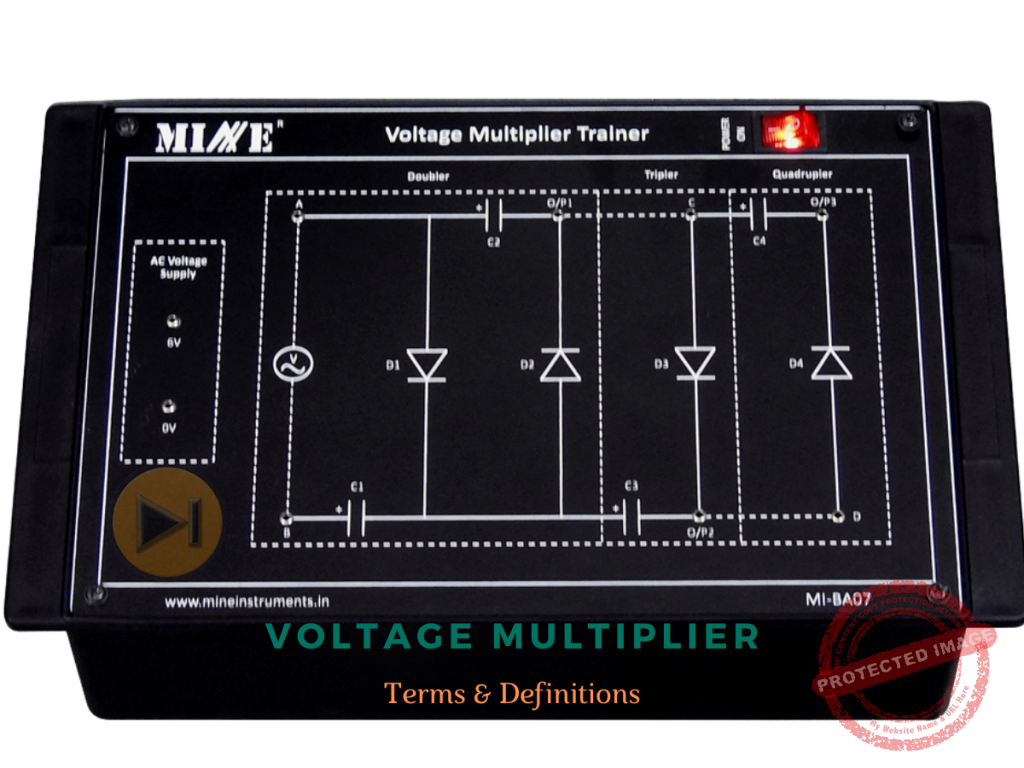
Are you struggling to master voltage multiplier for your upcoming engineering board exam? You’re not alone. Every year, thousands of engineering students grapple with these complex circuits, trying to memorize configurations and equations without truly understanding the underlying principles. The frustration is real – voltage multipliers combine diode behavior, capacitor charging sequences, and circuit analysis in ways that can seem overwhelming when you’re cramming the night before an exam.
This comprehensive guide breaks down over 100 essential voltage multiplier terms and definitions you might encounter on your board exam. Instead of presenting disconnected facts, I have organized these concepts into logical sections that build upon each other, from basic principles to practical applications. This approach mirrors how these circuits actually work, making the information easier to retain when exam pressure hits.
As a former board exam taker myself, I remember highlighting textbooks until my fingers turned yellow, only to freeze up when facing questions phrased differently than my notes. That’s why this guide uses straightforward language that clarifies rather than complicates. Each definition includes the key phrases examiners look for in your answers, helping you earn those crucial points even when questions come from unexpected angles.
Whether you’re just starting your review or doing last-minute preparation, this resource will strengthen your understanding of voltage multiplier circuits and boost your confidence going into the exam room. Let’s transform this challenging topic from a source of anxiety into points that will help you pass your board exam.
Fundamentals of Voltage Multipliers
1. Voltage Multiplier: An electronic circuit that converts AC or pulsating DC input voltage into a higher DC output voltage using capacitors and diodes arranged in a specific configuration.
2. DC Voltage Multiplication: The process of increasing a DC voltage level without using transformers, commonly achieved through capacitive charge transfer techniques.
3. Capacitive Voltage Multiplier: A circuit that uses capacitors as charge storage elements to achieve voltage multiplication through sequential charging and discharging.
4. Diode-Capacitor Ladder: The fundamental structure in voltage multipliers where diodes and capacitors are arranged in a ladder-like configuration to progressively increase voltage.
5. Charge Pump: A type of voltage multiplier that transfers charge from the input to the output using capacitors to achieve higher voltage levels.
6. Clamp Circuit: A fundamental building block in voltage multipliers that uses a diode and capacitor to clamp a voltage to a different DC level.
7. Step Charging: The process in voltage multipliers where capacitors are charged in steps or stages to achieve progressive voltage multiplication.
8. Peak Detector: A circuit element in voltage multipliers that captures and holds the peak value of an AC input signal.
9. Rectification: The process of converting AC voltage to DC voltage using diodes in voltage multiplier circuits.
10. Unidirectional Current Flow: The characteristic of diodes in voltage multipliers that allows current to flow in only one direction, enabling charge accumulation.
11. Charge Transfer Efficiency: The ratio of charge transferred to the output versus the charge supplied at the input in voltage multiplier circuits.
12. Voltage Multiplication Factor: The ratio of output voltage to input voltage in a voltage multiplier circuit, indicating how many times the voltage has been multiplied.
13. No-Load Output Voltage: The theoretical maximum output voltage of a multiplier when no current is being drawn from the output.
14. Forward Bias: The operating condition of diodes in voltage multipliers when they conduct current, allowing capacitors to charge.
15. Reverse Bias: The non-conducting state of diodes in voltage multipliers that prevents capacitors from discharging through unintended paths.
Voltage Multiplier Configurations
16. Half-Wave Voltage Doubler: A voltage multiplier configuration that uses two diodes and two capacitors to approximately double the peak input voltage.
17. Full-Wave Voltage Doubler: A circuit arrangement that produces twice the peak input voltage by utilizing both halves of the AC cycle, resulting in lower ripple than half-wave doublers.
18. Cockcroft-Walton Multiplier: A cascade connection of voltage doublers that can produce very high DC voltages from a relatively low AC input voltage.
19. Villard Circuit: A basic voltage doubler circuit that outputs a DC voltage approximately twice the peak value of the AC input voltage, with significant ripple.
20. Greinacher Circuit: An improved voltage doubler that offers better voltage regulation and reduced ripple compared to the Villard configuration.
21. Dickson Charge Pump: A voltage multiplier configuration commonly used in integrated circuits that requires a clock signal to drive the multiplication stages.
22. Negative Voltage Multiplier: A circuit configuration that generates negative output voltages from positive input voltages.
23. Symmetric Multiplier: A voltage multiplier that generates both positive and negative output voltages of equal magnitude.
24. Bridge Voltage Doubler: A voltage multiplier configuration that uses a bridge rectifier arrangement to achieve voltage doubling.
25. Series-Connected Multiplier: A voltage multiplier where the output stages are connected in series to achieve higher multiplication factors.
26. Parallel-Connected Multiplier: A voltage multiplier arrangement where multiple multiplier stages are connected in parallel to increase current capability.
27. Cascaded Voltage Multiplier: A configuration where multiple voltage multiplier stages are connected in series to achieve progressively higher output voltages.
28. Multi-Stage Multiplier: A voltage multiplier circuit with multiple stages, each contributing to the overall voltage multiplication factor.
29. Single-Phase Multiplier: A voltage multiplier designed to operate from a single-phase AC input voltage.
30. Three-Phase Multiplier: A voltage multiplier circuit designed to operate from a three-phase AC input for higher efficiency and lower ripple.
Circuit Components and Parameters
31. Coupling Capacitor: A capacitor in voltage multipliers that transfers energy between stages while blocking DC voltage.
32. Storage Capacitor: A capacitor in voltage multipliers that stores the charge and maintains the output voltage between cycles.
33. Filter Capacitor: A capacitor used at the output of voltage multipliers to reduce ripple voltage.
34. Fast Recovery Diode: A specialized diode with quick recovery from forward to reverse bias, important in high-frequency voltage multiplier applications.
35. High Voltage Diode: A diode with a high reverse voltage rating used in voltage multipliers generating very high voltages.
36. Voltage Rating: The maximum voltage a component in a voltage multiplier can withstand without breakdown.
37. Current Rating: The maximum current that components in a voltage multiplier can safely conduct continuously.
38. Diode Forward Voltage Drop: The voltage drop across a conducting diode in a voltage multiplier, typically 0.7V for silicon diodes.
39. Diode Reverse Recovery Time: The time required for a diode to switch from its conducting state to blocking state in voltage multiplier circuits.
40. Capacitance Value: The charge storage capability of capacitors in voltage multipliers, measured in farads.
41. ESR (Equivalent Series Resistance): The internal resistance of capacitors in voltage multipliers that affects efficiency and output voltage regulation.
42. Dielectric Strength: The maximum electric field a capacitor’s insulating material can withstand before breakdown in high-voltage multiplier applications.
43. Leakage Current: The small current flowing through capacitors and diodes in voltage multipliers even when ideally no current should flow.
44. Voltage Distribution: The way voltage is distributed across components in a voltage multiplier circuit.
45. Pulse Frequency: The frequency of the input signal affecting the operation and efficiency of voltage multiplier circuits.
Performance Characteristics
46. Output Voltage Regulation: The ability of a voltage multiplier to maintain a constant output voltage under varying load conditions.
47. Voltage Drop: The reduction in output voltage of a voltage multiplier when current is drawn from the output.
48. Ripple Voltage: The AC component present in the DC output voltage of a voltage multiplier, typically expressed as a percentage of the output voltage.
49. Ripple Frequency: The frequency of the AC component in the DC output of a voltage multiplier, typically related to the input frequency.
50. Output Impedance: The effective internal resistance of a voltage multiplier that affects its voltage regulation under load.
51. Efficiency: The ratio of output power to input power in a voltage multiplier circuit, typically lower than transformer-based solutions.
52. Power Conversion Ratio: The relationship between output power and input power in voltage multiplier circuits.
53. Voltage Gain: The ratio of output voltage to input voltage in a voltage multiplier circuit under specified load conditions.
54. Load Regulation: The change in output voltage of a voltage multiplier when the load current changes from no load to full load.
55. Line Regulation: The change in output voltage of a voltage multiplier when the input voltage varies within specified limits.
56. Dynamic Response: The response of a voltage multiplier circuit to rapid changes in load current or input voltage.
57. Recovery Time: The time required for a voltage multiplier output to return to within specified limits after a load change.
58. Temperature Coefficient: The change in output voltage of a voltage multiplier per degree change in temperature.
59. Stability: The ability of a voltage multiplier to maintain its output characteristics over time and varying conditions.
60. Voltage Stacking: The process of adding the output voltages of multiple voltage multiplier stages to achieve a higher overall voltage.
Mathematical Analysis
61. Ideal Multiplication Factor: The theoretical voltage multiplication factor of a voltage multiplier with ideal components.
62. Actual Multiplication Factor: The practical voltage multiplication factor achieved in real voltage multiplier circuits, accounting for losses.
63. Capacitive Reactance: The opposition to current flow in capacitors of voltage multiplier circuits, calculated as Xc = 1/(2πfC).
64. Charge Transfer Equation: Mathematical expression describing the charge transfer process in voltage multiplier circuits.
65. RC Time Constant: The product of resistance and capacitance that determines the charging and discharging rates in voltage multiplier circuits.
66. Input-Output Voltage Relationship: The mathematical relationship between input and output voltages in a voltage multiplier circuit.
67. Steady-State Analysis: The mathematical analysis of voltage multiplier circuits under stable, unchanging conditions.
68. Transient Analysis: The mathematical analysis of voltage multiplier circuits during changing conditions such as startup or load changes.
69. Voltage Division: The mathematical principle describing how voltage is divided across series components in voltage multiplier circuits.
70. Current Division: The mathematical principle describing how current is divided across parallel components in voltage multiplier circuits.
71. Power Dissipation: The calculation of power lost as heat in the components of a voltage multiplier circuit.
72. Ripple Factor: The mathematical expression for the ratio of RMS value of ripple voltage to the DC output voltage in multiplier circuits.
73. Multiplication Efficiency: The mathematical expression for the ratio of actual voltage multiplication to theoretical voltage multiplication.
74. Voltage Doubler Equation: Output voltage equation for a voltage doubler: Vout ≈ 2Vin(peak) – Vd, where Vd is the diode forward voltage drop.
75. N-Stage Multiplier Equation: For an N-stage Cockcroft-Walton multiplier, the ideal output voltage is 2N times the peak input voltage.
Applications and Practical Considerations
76. High Voltage Generation: The use of voltage multipliers to produce high DC voltages for scientific instruments and industrial applications.
77. X-Ray Power Supply: Application of voltage multipliers in generating the high voltages required for X-ray tubes.
78. Particle Accelerator Power: Use of voltage multipliers to generate high voltages for particle acceleration in physics research.
79. Oscilloscope CRT Bias: Application of voltage multipliers to generate bias voltages for cathode ray tubes in oscilloscopes.
80. Photomultiplier Tube Supply: Use of voltage multipliers to create high voltages needed for photomultiplier tube operation.
81. Backlight Inverter: Application of voltage multipliers in LCD display backlight power supplies.
82. Electronic Flash Charger: Use of voltage multipliers to charge capacitors for camera flash units.
83. Electrostatic Precipitator: Application of voltage multipliers in air pollution control systems that require high DC voltages.
84. Insulation Testing: Use of voltage multipliers to generate high test voltages for insulation resistance testing.
85. Capacitive Power Transfer: The principle used in voltage multipliers to transfer power through capacitors rather than magnetic coupling.
86. Integrated Circuit Application: The use of voltage multipliers in integrated circuits to generate higher voltages from low supply voltages.
87. Non-Volatile Memory Programming: Application of voltage multipliers to generate programming voltages for EEPROM and Flash memory.
88. RF Power Detection: Use of voltage multipliers in RF power measurement circuits to detect and measure RF signals.
89. Energy Harvesting: Application of voltage multipliers in systems that collect and store energy from low-voltage environmental sources.
90. Bias Voltage Generation: Use of voltage multipliers to create bias voltages for electronic circuits.
Troubleshooting and Testing
91. Voltage Breakdown: The catastrophic failure of insulation in voltage multiplier components when subjected to excessive voltage stress.
92. Corona Discharge: The ionization of air around high-voltage components in voltage multipliers, leading to power loss and potential damage.
93. Diode Failure Analysis: The process of identifying and diagnosing failed diodes in voltage multiplier circuits.
94. Capacitor Leakage Testing: Methods to test for excessive leakage current in voltage multiplier capacitors.
95. Voltage Multiplier Load Testing: Procedures to test voltage multiplier performance under various load conditions.
96. Thermal Analysis: The study of heat generation and distribution in voltage multiplier circuits during operation.
97. Reliability Testing: Methods to evaluate the long-term reliability of voltage multiplier circuits under various operating conditions.
98. Partial Discharge: Localized electrical discharges that partially bridge insulation between conductors in high-voltage multipliers.
99. EMI Generation: The production of electromagnetic interference by voltage multiplier circuits, especially at high frequencies.
100. Output Voltage Stabilization: Techniques to improve the stability of voltage multiplier output voltages.
101. Voltage Balancing: Methods to ensure equal voltage distribution across components in high-voltage multiplier circuits.
102. Failure Mode Analysis: A Systematic approach to identifying potential failure mechanisms in voltage multiplier circuits.
103. Life Expectancy Calculation: Methods to estimate the operational lifetime of voltage multiplier circuits based on component ratings and operating conditions.
104. Voltage Multiplier Testing Procedures: Standardized methods for testing and verifying the performance of voltage multiplier circuits.
105. Safety Considerations: Essential safety practices when working with high-voltage multiplier circuits to prevent electrical hazards.
Mastering voltage multipliers doesn’t have to be the roadblock that keeps you from passing your engineering board exam. By systematically working through these 105 terms and definitions, you’ve now built a solid foundation that connects theoretical concepts with practical applications – exactly what examiners are looking for in top-scoring answers.
Remember that understanding beats memorization every time. When you comprehend how each component interacts within voltage multiplier circuits, you can apply this knowledge to solve unfamiliar problems that might appear on your exam. The relationships between terms across different sections – from basic components to troubleshooting techniques – reflect the integrated nature of real-world engineering challenges.
Keep this guide handy during your review sessions, but don’t just passively read it. Try explaining these concepts to classmates, sketch circuit diagrams for different multiplier configurations, and practice identifying which terms apply to specific exam-style problems. These active learning techniques will cement your understanding far better than highlighting or re-reading.
Engineering board exams test not just what you know, but how well you can apply that knowledge under pressure. With this comprehensive understanding of voltage multipliers, you’ve eliminated one more potential stumbling block on your path to becoming a licensed engineer. Good luck on your exam – though with preparation like this, you’re creating your own luck.
Have questions about specific voltage multiplier concepts? Drop them in the comments below, and our engineering community will help clarify any remaining confusion. We’re all in this together!
Related Content



P inoyBIX educates thousands of reviewers and students a day in preparation for their board examinations. Also provides professionals with materials for their lectures and practice exams. Help me go forward with the same spirit.
“Will you subscribe today via YOUTUBE?”
TIRED OF ADS?
- Become Premium Member and experienced complete ads-free content browsing.
- Full Content Access to Premium Solutions Exclusive for Premium members
- Access to PINOYBIX FREEBIES folder
- Download Reviewers and Learning Materials Free
- Download Content: You can see download/print button at the bottom of each post.
PINOYBIX FREEBIES FOR PREMIUM MEMBERSHIP:
- CIVIL ENGINEERING REVIEWER
- CIVIL SERVICE EXAM REVIEWER
- CRIMINOLOGY REVIEWER
- ELECTRONICS ENGINEERING REVIEWER (ECE/ECT)
- ELECTRICAL ENGINEERING & RME REVIEWER
- FIRE OFFICER EXAMINATION REVIEWER
- LET REVIEWER
- MASTER PLUMBER REVIEWER
- MECHANICAL ENGINEERING REVIEWER
- NAPOLCOM REVIEWER
- Additional upload reviewers and learning materials are also FREE
FOR A LIMITED TIME
If you subscribe for PREMIUM today!
You will receive an additional 1 month of Premium Membership FREE.
For Bronze Membership an additional 2 months of Premium Membership FREE.
For Silver Membership an additional 3 months of Premium Membership FREE.
For Gold Membership an additional 5 months of Premium Membership FREE.
Join the PinoyBIX community.