

This is the Multiple Choice Questions in Field Effect Transistor Amplifiers from the book Electronic Devices and Circuit Theory 10th Edition by Robert L. Boylestad. If you are looking for a reviewer in Electronics Engineering this will definitely help. I can assure you that this will be a great help in reviewing the book in preparation for your Board Exam. Make sure to familiarize each and every questions to increase the chance of passing the ECE Board Exam.
Online Questions and Answers Topic Outline
- MCQ in FET Amplifiers
- MCQ in FET Small-Signal Model
- MCQ in JFET Fixed-Bias Configuration
- MCQ in JFET Self-Bias Configuration
- MCQ in JFET Voltage-Divider Configuration
- MCQ in JFET Source-Follower (Common-Drain) Configuration
- MCQ in JFET Common-Gate Configuration
- MCQ in Depletion-type MOSFETs
- MCQ in Enhancement-type MOSFETs
- MCQ in E-MOSFET Drain-Feedback Configuration
- MCQ in E-MOSFET Voltage-Divider Configuration
- MCQ in Designing FET Amplifier Networks
Practice Exam Test Questions
Choose the letter of the best answer in each questions.
1. FET amplifiers provide _________.
A) excellent voltage gain
B) high input impedance
C) low power consumption
D) All of the above
Answer: Option D
Solution:
2. A BJT is a _________-controlled device.
A) current
B) voltage
C) power
D) resistance
Answer: Option A
Solution:
3. An FET is a _________-controlled device.
A) current
B) voltage
C) power
D) resistance
Answer: Option B
Solution:
4. The E-MOSFET is quite popular in _________ applications.
A) digital circuitry
B) high-frequency
C) buffering
D) All of the above
Answer: Option D
Solution:
5. What is the range of gm for JFETs?
A) 1 µS to 10 µS
B) 100 µS to 1000 µS
C) 1000 µS to 5000 µS
D) 10000 µS to 100000 µS
Answer: Option C
Solution:
6. For what value of ID is gm equal to 0.5 gm0?
A) 0 mA
B) 0.25 IDSS
C) 0.5 IDSS
D) IDSS
Answer: Option B
Solution:
7. What is the typical value for the input impedance Zi for JFETs?
A) 100 kΩ
B) 1 MΩ
C) 10 MΩ
D) 1000 MΩ
Answer: Option D
Solution:
8. Referring to the transfer characteristics shown below, calculate gm at VGSQ = –1 V.

A) 2 mS
B) 3 mS
C) 4 mS
D) 5 mS
Answer: Option B
Solution:
9. Use the following equation to calculate gm for a JFET having IDSS = 10 mA, VP = –5 V, and VGSQ = –2.5 V.

A) 2 mS
B) 3 mS
C) 4 mS
D) 5 mS
Answer: Option A
Solution:
10. Referring to the following figure, calculate gm for VGSQ = –1.25 V.
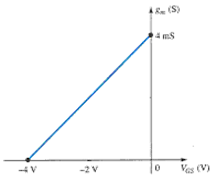
A) 2 mS
B) 2.5 mS
C) 2.75 mS
D) 3.25 mS
Answer: Option C
Solution:
11. Referring to this figure, obtain gm for ID = 6 mA.

A) 2.83 mS
B) 3.00 mS
C) 3.25 mS
D) 3.46 mS
Answer: Option D
Solution:
12. Referring to the figure below, determine the output impedance for VGS = –3 V at VDS = 5 V.

A) 100 kΩ
B) 80 kΩ
C) 25 kΩ
D) 5 kΩ
Answer: Option A
Solution:
13. Calculate gm and rd if yfs = 4 mS and yos = 15 ΩS.
A) 4 mS, 66.7 kΩ
B) 4 mS, 15 kΩ
C) 66.7 kΩ, 4 mS
D) None of the above
Answer: Option A
Solution:
14. The steeper the slope of the ID versus VGS curve, the ________ the level of gm.
A) less
B) same
C) greater
D) all of the above
Answer: Option C
Solution:
15. When VGS = 0.5 Vp gm is ________ the maximum value.
A) one-fourth
B) one-half
C) three-fourths
D) two-thirds
Answer: Option B
Solution:
16. If ID = IDSS/2, gm = ___________ gmo.
A) 1
B) 0.707
C) 0.5
D) 1.414
Answer: Option B
Solution:
17. The more horizontal the characteristic curves on the drain characteristics, the ________ the output impedance.
A) less
B) same
C) greater
D) all of the above
Answer: Option C
Solution:
18. What is (are) the function(s) of the coupling capacitors C1 and C2 in an FET circuit?
A) to create an open circuit for dc analysis
B) to isolate the dc biasing arrangement from the applied signal and load
C) to create a short-circuit equivalent for ac analysis
D) All of the above
Answer: Option D
Solution:
19. Where do you get the level of gm and rd for an FET transistor?
A) from the dc biasing arrangement
B) from the specification sheet
C) from the characteristics
D) All of the above
Answer: Option D
Solution:
20. Referring to this figure, find Zo if yos = 20 µS.

A) 1.85 kΩ
B) 1.92 kΩ
C) 2.05 kΩ
D) 2.15 kΩ
Answer: Option B
Solution:
21. Referring to this figure, calculate Av if yos = 20 µS.

A) –3.48
B) –3.56
C) –3.62
D) –4.02
Answer: Option C
Solution:
22. For the fixed-bias configuration, if rd < 10 • RD, then Zo = ________. A) RD B) RD || rd C) RG D) -gm • (RD || rd) [toggle title="View Answer:"] Answer: Option B
Solution:
[/toggle]
23. Which of the following is a required condition to simplify the equations for Zo and Av for the self-bias configuration?
A) rd ≤ 10RD
B) rd = RD
C) rd ≥ 10RD
D) None of the above
Answer: Option C
Solution:
24. Referring to this figure, calculate Zo if yos = 40 µS.

A) 2.92 kΩ
B) 3.20 kΩ
C) 3.25 kΩ
D) 3.75 kΩ
Answer: Option A
Solution:
25. On which of the following parameters does rd have no or little impact in a source-follower configuration?
A) Zi
B) Zo
C) Av
D) All of the above
Answer: Option D
Solution:
26. Referring to this figure, calculate Zo for VGSQ = –3.2 V.

A) 362.52 Ω
B) 340.5 Ω
C) 420.5 Ω
D) 480.9 Ω
Answer: Option D
Solution:
27. Referring to this figure, calculate Zi for yos = 20 µS. Assume VGSQ = −2.2V.

A) 300.2 Ω
B) 330.4 Ω
C) 340.5 Ω
D) 350.0 Ω
Answer: Option B
Solution:
28. Which of the following is (are) related to depletion-type MOSFETs?
A) VGSQ can be negative, zero, or positive.
B) gm can be greater or smaller than gm0’.
C) ID can be larger than IDSS’.
D) All of the above
Answer: Option D
Solution:
29. Referring to this figure, calculate Av for yos = 58 µS.

A) –7.29
B) –7.50
C) –8.05
D) –8.55
Answer: Option A
Solution:
30. Referring to this figure, calculate Zi if rd = 19 kΩ.

A) 2.42 MΩ
B) 2.50 MΩ
C) 2.53 MΩ
C) 2.59 MΩ
Answer: Option C
Solution:
31. Referring to this figure, calculate Zo if rd = 19 kΩ.

A) 1.75 kΩ
B) 1.81 kΩ
C) 1.92 kΩ
D) 2.00 kΩ
Answer: Option B
Solution:
32. Referring to this figure, calculate Av if rd = 19 kΩ.

A) –2.85
B) –3.26
C) –2.95
D) –3.21
Answer: Option C
Solution:
33. Determine the value for RD if the ac gain is 8.

A) 1.51 kΩ
B) 1.65 kΩ
C) 1.85 kΩ
D) 2.08 kΩ
Answer: Option B
Solution:
34. Referring to this figure, calculate the value of RD if the ac gain is 10. Assume VGSQ = ¼Vp.

A) 2.2 kΩ
B) 2.42 kΩ
C) 2.62 kΩ
D) 2.82 kΩ
Answer: Option D
Solution:
35. For an FET small-signal amplifier, one could go about troubleshooting a circuit by _________.
A) viewing the circuit board for poor solder joints
B) using a dc meter
C) applying a test ac signal
D) All of the above
Answer: Option D
Solution:
Fill-in-the-blanks Questions
1. A field-effect transistor amplifier provides excellent voltage gain with the added feature of a _______ input impedance.
A) low
B) medium
C) high
D) None of the above
Answer: Option C
Solution:
2. The depletion MOSFET circuit has a _______ input impedance than a similar JFET configuration.
A) much higher
B) much lower
C) lower
D) higher
Answer: Option A
Solution:
3. The _______ is quite popular in digital circuits, especially in CMOS circuits that require very low power consumption.
A) JFET
B) BJT
C) D-type MOSFET
D) E-type MOSFET
Answer: Option D
Solution:
4. _______ is the amplification factor in FET transistor amplifiers.
A) Zi
B) gm
C) ID
D) IG
Answer: Option B
Solution:
5. _____ is an undefined quantity in a JFET.
A) Ai
B) Av
C) Zi
D) Zo
Answer: Option A
Solution:
6. The ______ controls the ______ of an FET.
A) ID’, VGS
B) VGS’, ID
C) IG’, VDS
D) IG’, ID
Answer: Option B
Solution:
7. Transconductance is the ratio of changes in _______.
A) ID to VGS
B) ID to VDS
C) VGS to IG
D) VGS to VDS
Answer: Option A
Solution:
8. The transconductance gm _______ as the Q-point moves from Vp to IDSS
A) decreases
B) remains the same
C) increases
D) None of the above
Answer: Option C
Solution:
9. gm has its maximum value for a JFET at ______.
A) Vp
B) 0.5 Vp
C) 0.3 Vp
D) IDSS
Answer: Option D
Solution:
10. The value of gm is at its maximum gm0 at VGS equal to _____ and zero at VGS equal to _____.
A) 0 V, Vp
B) Vp, 0 V
C) 0.5Vp, 0.3Vp
D) 0.3Vp , 0.5Vp
Answer: Option A
Solution:
11. The range of input impedance Zi for MOSFETs is _______.
A) 1 kΩ –10 kΩ
B) 100 kΩ –1 MΩ
C) 10 MΩ –100 MΩ
D) 1012 Ω to 1015 Ω
Answer: Option D
Solution:
12. The range of output admittance yos for FETs is _______.
A) 5 µS –10 µS
B) 10 µS –50 µS
C) 50 µS –100 µS
D) 200 µS –500 µS
Answer: Option B
Solution:
13. The _______ configuration has the distinct disadvantage of requiring two dc voltage sources.
A) self-bias
B) voltage-divider
C) fixed-bias
D) All of the above
Answer: Option C
Solution:
14. _____ is the network-input impedance for a JFET fixed-bias configuration.
A) RG
B) RD
C) Zero
D) None of the above
Answer: Option A
Solution:
15. _______ is a required step in order to calculate Zo.
A) Setting IG equal to zero
B) Setting Vi equal to zero
C) Setting ID equal to IDSS
D) None of the above
Answer: Option B
Solution:
16. _______ configuration(s) has (have) Zo ≈ RD.
A) Fixed-bias
B) Self-bias
C) Voltage-divider
D) All of the above
Answer: Option D
Solution:
17. _____ is the only parameter that is different between voltage-divider and fixed-bias configurations.
A) Zi
B) Av
C) Zo
D) None of the above
Answer: Option A
Solution:
18. The input and output signals are in phase in a _______ configuration.
A) fixed-bias
B) source-follower
C) voltage-divider
D) self-bias
Answer: Option B
Solution:
19. A _______ configuration has a voltage gain less than 1.
A) fixed-bias
B) self-bias
C) source-follower
D) voltage-divider
Answer: Option C
Solution:
20. The input and output signals are 180º out of phase in a _______ configuration.
A) source-follower
B) common-gate
C) common-drain
D) voltage-divider
Answer: Option D
Solution:
21. The isolation between input and output circuits in the ac equivalent circuit is lost in a ________ configuration.
A) common-gate
B) common-source
C) common-drain
D) None of the above
Answer: Option A
Solution:
22. The ________ configuration has an input impedance, which is other than RG.
A) common-source
B) common-gate
C) common-drain
D) None of the above
Answer: Option B
Solution:
23. The gate-to-source voltage VGS of a(n) _______ must be larger than the threshold VGS(Th) for the transistor to conduct.
A) JFET
B) D-type MOSFET
C) E-type MOSFET
D) None of the above
Answer: Option C
Solution:
24. rd changes from one operation region to another with _______ values typically occurring at _______ levels of VGS (closer to zero).
A) lower, lower
B) lower, higher
C) higher, lower
D) None of the above
Answer: Option A
Solution:
25. The ________ does not support Shockley’s equation.
A) JFET
B) D-type MOSFET
C) E-type MOSFET
D) None of the above
Answer: Option C
Solution:
Check your work.
Complete List of Chapter Quiz in Electronic Devices and Circuit Theory
Related Content



P inoyBIX educates thousands of reviewers and students a day in preparation for their board examinations. Also provides professionals with materials for their lectures and practice exams. Help me go forward with the same spirit.
“Will you subscribe today via YOUTUBE?”
TIRED OF ADS?
- Become Premium Member and experienced complete ads-free content browsing.
- Full Content Access to Premium Solutions Exclusive for Premium members
- Access to PINOYBIX FREEBIES folder
- Download Reviewers and Learning Materials Free
- Download Content: You can see download/print button at the bottom of each post.
PINOYBIX FREEBIES FOR PREMIUM MEMBERSHIP:
- CIVIL ENGINEERING REVIEWER
- CIVIL SERVICE EXAM REVIEWER
- CRIMINOLOGY REVIEWER
- ELECTRONICS ENGINEERING REVIEWER (ECE/ECT)
- ELECTRICAL ENGINEERING & RME REVIEWER
- FIRE OFFICER EXAMINATION REVIEWER
- LET REVIEWER
- MASTER PLUMBER REVIEWER
- MECHANICAL ENGINEERING REVIEWER
- NAPOLCOM REVIEWER
- Additional upload reviewers and learning materials are also FREE
FOR A LIMITED TIME
If you subscribe for PREMIUM today!
You will receive an additional 1 month of Premium Membership FREE.
For Bronze Membership an additional 2 months of Premium Membership FREE.
For Silver Membership an additional 3 months of Premium Membership FREE.
For Gold Membership an additional 5 months of Premium Membership FREE.
Join the PinoyBIX community.