
This is the Multiple Choice Questions in Bipolar Junction Transistors from the book Electronic Devices and Circuit Theory 10th Edition by Robert L. Boylestad. If you are looking for a reviewer in Electronics Engineering this will definitely help. I can assure you that this will be a great help in reviewing the book in preparation for your Board Exam. Make sure to familiarize each and every questions to increase the chance of passing the ECE Board Exam.
Online Questions and Answers Topic Outline
- MCQ in Transistor Construction
- MCQ in Transistor Operation
- MCQ in Common-Base Configuration
- MCQ in Transistor Amplifying Action
- MCQ in Common-Emitter Configuration
- MCQ in Common-Collector Configuration
- MCQ in Limits of Operation
- MCQ in Transistor Specification Sheet
- MCQ in Transistor Testing
- MCQ in Transistor Casing and Terminal Identification
Practice Exam Test Questions
Choose the letter of the best answer in each questions.
1. In what decade was the first transistor created?
A) 1930s
B) 1940s
C) 1950s
D) 1960s
Answer: Option B
Solution:
2. How many layers of material does a transistor have?
A) 1
B) 2
C) 3
D) 4
Answer: Option C
Solution:
3. What is the ratio of the total width to that of the center layer for a transistor?
A) 1:15
B) 1:150
C) 15:1
D) 150:1
Answer: Option D
Solution:
4. Which of the following is (are) the terminal(s) of a transistor?
A) Emitter
B) Base
C) Collector
D) All of the above
Answer: Option D
Solution:
5. List the types of bipolar junction transistors.
A) ppn, npn
B) pnp, npn
C) npp, ppn
D) nnp, pnp
Answer: Option B
Solution:
6. Transistors are _______-terminal devices.
A) 2
B) 3
C) 4
D) 5
Answer: Option B
Solution:
7. How many carriers participate in the injection process of a unipolar device?
A) 1
B) 2
C) 0
D) 3
Answer: Option A
Solution:
8. Which component of the collector current IC is called the leakage current?
A) Majority
B) Independent
C) Minority
D) None of the above
Answer: Option C
Solution:
9. For a properly biased pnp transistor, let IC = 10 mA and IE = 10.2 mA. What is the level of IB?
A) 0.2 A
B) 200 mA
C) 200 µA
D) 20.2 mA
Answer: Option C
Solution:
10. Calculate minority current ICO if IC = 20.002 mA and IC majority = 20 mA.
A) 2 µA
B) 0.002 µA
C) 2 nA
D) 2 pA
Answer: Option A
Solution:
11. Which of the following regions is (are) part of the output characteristics of a transistor?
A) Active
B) Cutoff
C) Saturation
D) All of the above
Answer: Option D
Solution:
12. In which region are both the collector-base and base-emitter junctions forward-biased?
A) Active
B) Cutoff
C) Saturation
D) All of the above
Answer: Option C
Solution:
13. How much is the base-to-emitter voltage of a transistor in the “on” state?
A) 0 V
B) 0.7 V
C) 0.7 mV
D) Undefined
Answer: Option B
Solution:
14. In the active region, while the collector-base junction is ______-biased, the base-emitter is ______-biased.
A) forward, forward
B) forward, reverse
C) reverse, forward
D) reverse, reverse
Answer: Option C
Solution:
15. What is βdc equal to?
A) IB / IE
B) IC / IE
C) IC / IB
D) None of the above
Answer: Option C
Solution:
16. What are the ranges of the ac input and output resistance for a common-base configuration?
A) 10 Ω–100 Ω, 50 kΩ–1 MΩ
B) 50 kΩ–1 MΩ, 10 Ω–100 Ω
C) 10 Ω–100 kΩ, 50 Ω–1 kΩ
D) None of the above
Answer: Option A
Solution:
17. For what kind of amplifications can the active region of the common-emitter configuration be used?
A) Voltage
B) Current
C) Power
D) All of the above
Answer: Option D
Solution:
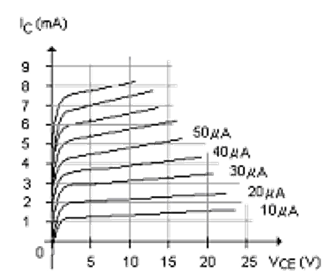
18. Use this table of collector characteristics to calculate βac at VCE = 15 V and IB = 30 µA.
A) 100
B) 106
C) 50
D) 400
Answer: Option A
Solution:
19. Calculate βdc at VCE = 15 V and IB = 30 µA.
A) 100
B) 116
C) 50
D) 110
Answer: Option D
Solution:
20. Which of the following configurations can a transistor set up?
A) Common-base
B) Common-emitter
C) Common-collector
D) All of the above
Answer: Option D
Solution:
21. Determine the value of α when β = 100.
A) 1.01
B) 101
C) 0.99
D) Cannot be solved with the information provided
Answer: Option C
Solution:
22. What is the most frequently encountered transistor configuration?
A) Common-base
B) Common-collector
C) Common-emitter
D) Emitter-collector
Answer: Option C
Solution:
23. βdc for this set of collector characteristics is within _____ percent of βac.
A) 2
B) 5
C) 7
D) 10
Answer: Option D
Solution:
24. βdc = ________
A) IB / IE
B) IC / IE
C) IC / IB
D) None of the above
Answer: Option C
Solution:
25. What is (are) the component(s) of most specification sheets provided by the manufacturer?
A) Maximum ratings
B) Thermal characteristics
C) Electrical characteristics
D) All of the above
Answer: Option D
Solution:
26. What is (are) the component(s) of electrical characteristics on the specification sheets?
A) On
B) Off
C) Small-signal characteristics
D) All of the above
Answer: Option D
Solution:
27. Most specification sheets are broken down into _______.
A) maximum ratings
B) thermal characteristics
C) electrical characteristics
D) All of the above
Answer: Option D
Solution:
28. An example of a pnp silicon transistor is a 2N4123.
A) True
B) False
Answer: Option B
Solution:
29. Which of the following equipment can check the condition of a transistor?
A) Current tracer
B) Digital display meter (DDM)
C) Ohmmeter (VOM)
D) All of the above
Answer: Option D
Solution:
30. Which of the following can be obtained from the last scale factor of a curve tracer?
A) hFE
B) αdc
C) αac
D) βac
Answer: Option D
Solution:
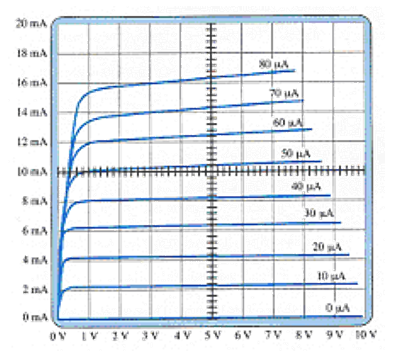
31. Calculate βac for IC = 15 mA and VCE = 5 V.
A) 200
B) 180
C) 220
D) None of the above
Answer: Option A
Solution:
32. What range of resistor values would you get when checking a transistor for forward- and reverse-biased conditions by an ohmmeter?
A) 100 Ω to a few kΩ, exceeding 100 kΩ
B) Exceeding 100 kΩ, 100 Ω to a few kΩ
C) Exceeding 100 kΩ, exceeding 100 kΩ
D) 100 Ω to a few kΩ, 100 Ω to a few kΩ
Answer: Option A
Solution:
33. What does a reading of a large or small resistance in forward- and reverse-biased conditions indicate when checking a transistor using an ohmmeter?
A) Faulty device
B) Good device
C) Bad ohmmeter
D) None of the above
Answer: Option A
Solution:
34. A transistor can be checked using a(n) _______.
A) curve tracer
B) digital meter
C) ohmmeter
D) Any of the above
Answer: Option D
Solution:
35. How many individual pnp silicon transistors can be housed in a 14-pin plastic dual-in-line package?
A) 4
B) 7
C) 10
D) 14
Answer: Option A
Solution:
Fill-in-the-blanks Questions
1. All amplifiers should have at least _____ terminals with _____ terminal(s) controlling the flow between _____ other terminal(s).
A) 2, 1, 1
B) 3, 1, 2
C) 3, 2, 1
D) 3, 0, 3
Answer: Option B
Solution:
2. The outer layers of a transistor are _______ the sandwiched layer.
A) much smaller than
B) the same as
C) much larger than
D) None of the above
Answer: Option C
Solution:
3. The doping of the sandwiched layer is _______ that of the outer layers.
A) considerably less than
B) the same as
C) considerably more than
D) None of the above
Answer: Option A
Solution:
4. The lower doping level _______ the conductivity and _______ the resistivity of the material.
A) increases, decreases
B) increases, increases
C) decreases, decreases
D) decreases, increases
Answer: Option D
Solution:
5. The term bipolar reflects the fact that _______ and _______ participate in the injection process into the oppositely polarized material.
A) holes, neutrons
B) holes, electrons
C) neutrons, electrons
D) None of the above
Answer: Option B
Solution:
6. One p-n junction of a transistor is _______-biased and the other one is _______-biased in the active region.
A) reverse, reverse
B) forward, forward
C) reverse, forward
D) None of the above
Answer: Option C
Solution:
7. The magnitude of the base current is typically on the order of _______ as compared to _______ for the emitter.
A) µA, µA
B) µA, mA
C) mA, µA
D) mA, mA
Answer: Option B
Solution:
8. The base current is the _______ of the emitter and collector currents.
A) sum
B) difference
C) product
D) None of the above
Answer: Option B
Solution:
9. The _______ region is the region normally employed for linear (undistorted) amplifiers.
A) active
B) cutoff
C) saturation
D) All of the above
Answer: Option A
Solution:
10. In the cutoff region the collector-base junction is _______-biased and the base-emitter junction is _______-biased for a transistor.
A) reverse, forward
B) forward, reverse
C) reverse, reverse
D) forward, forward
Answer: Option C
Solution:
11. In the saturation region the collector-base junction is _______-biased and the base-emitter junction is _______-biased for a transistor.
A) reverse, forward
B) forward, reverse
C) reverse, reverse
D) forward, forward
Answer: Option D
Solution:
12. For practical transistors the level of alpha typically extends from _____ to _____ with most approaching the higher end of the range.
A) 0.0, 1
B) 0.90, 0.998
C) 50, 400
D) None of the above
Answer: Option B
Solution:
13. Typical values of voltage amplification for the common-base configurations vary from _______ and the current gain is always _______.
A) less than 1, 50 to 300
B) 50 to 300, larger than 1
C) 50 to 300, less than 1
D) larger than 1, 50 to 300
Answer: Option C
Solution:
14. If a value of beta.gif is specified for a particular transistor configuration it will normally be used for _____ calculations.
A) ac
B) dc
C) ac and dc
D) None of the above
Answer: Option C
Solution:
15. The common-collector configuration has a ______ input impedance and a ______ output impedance.
A) low, high
B) high, low
C) high, high
D) low, low
Answer: Option B
Solution:
16. The active region of a transistor is bounded by the _______.
A) cutoff region
B) saturation region
C) power dissipation curve
D) All of the above
Answer: Option D
Solution:
17. The “on” and “off” characteristics refer to _____ limits while the small-signal characteristics indicate the parameters of importance to _____ operation.
A) ac, dc
B) dc, ac
C) ac, dc and ac
D) dc and ac, dc
Answer: Option B
Solution:
18. The step function (per step) of a curve tracer reveals the scale for _______.
A) collector current IC
B) VCE voltage
C) base current IB
D) All of the above
Answer: Option C
Solution:
19. The level of _____ is determined and displayed by advanced digital meters.
A) VCE
B) IB
C) IC
D) βdc
Answer: Option D
Solution:
20. The level of _____ is determined and displayed by advanced digital meters if using diode-testing mode.
A) VBE
B) IC
C) IB
D) IE
Answer: Option A
Solution:
21. When checking a transistor by ohmmeter, a relatively _______ resistance is displayed for a forward-biased junction and ______ resistance for a reverse-biased junction.
A) low, very high
B) low, low
C) high, high
D) high, very low
Answer: Option A
Solution:
22. An OL indication on an advanced digital meter indicates _______ while checking a transistor.
A) forward bias
B) reverse bias
C) definitely a defective transistor
D) None of the above
Answer: Option B
Solution:
23. If the positive lead of an ohmmeter is connected to the base and the negative lead to the emitter, a low resistance reading would indicate a ______ transistor and a high resistance reading would indicate a ______ transistor.
A) npn, pnp
B) pnp, npn
C) npn, npn
D) pnp, pnp
Answer: Option A
Solution:
24. The leads of a transistor are typically made of _______.
A) gold
B) aluminum
C) nickel
D) All of the above
Answer: Option B
Solution:
25. There is(are) _______ in the internal construction of a TO-92 package.
A) gold bond wires
B) a copper frame
C) epoxy encapsulation
D) All of the above
Answer: Option D
Solution:
Check your work.
Complete List of Chapter Quiz in Electronic Devices and Circuit Theory
Download File in PDF
Related Content



P inoyBIX educates thousands of reviewers and students a day in preparation for their board examinations. Also provides professionals with materials for their lectures and practice exams. Help me go forward with the same spirit.
“Will you subscribe today via YOUTUBE?”
TIRED OF ADS?
- Become Premium Member and experienced complete ads-free content browsing.
- Full Content Access to Premium Solutions Exclusive for Premium members
- Access to PINOYBIX FREEBIES folder
- Download Reviewers and Learning Materials Free
- Download Content: You can see download/print button at the bottom of each post.
PINOYBIX FREEBIES FOR PREMIUM MEMBERSHIP:
- CIVIL ENGINEERING REVIEWER
- CIVIL SERVICE EXAM REVIEWER
- CRIMINOLOGY REVIEWER
- ELECTRONICS ENGINEERING REVIEWER (ECE/ECT)
- ELECTRICAL ENGINEERING & RME REVIEWER
- FIRE OFFICER EXAMINATION REVIEWER
- LET REVIEWER
- MASTER PLUMBER REVIEWER
- MECHANICAL ENGINEERING REVIEWER
- NAPOLCOM REVIEWER
- Additional upload reviewers and learning materials are also FREE
FOR A LIMITED TIME
If you subscribe for PREMIUM today!
You will receive an additional 1 month of Premium Membership FREE.
For Bronze Membership an additional 2 months of Premium Membership FREE.
For Silver Membership an additional 3 months of Premium Membership FREE.
For Gold Membership an additional 5 months of Premium Membership FREE.
Join the PinoyBIX community.