
This is the Multiple Choice Questions in BJT and FET Frequency Response from the book Electronic Devices and Circuit Theory 10th Edition by Robert L. Boylestad. If you are looking for a reviewer in Electronics Engineering this will definitely help. I can assure you that this will be a great help in reviewing the book in preparation for your Board Exam. Make sure to familiarize each and every questions to increase the chance of passing the ECE Board Exam.
Online Questions and Answers Topic Outline
- MCQ in Logarithms
- MCQ in Decibels
- MCQ in General Frequency Considerations
- MCQ in Low-frequency analysis – Bode Plot
- MCQ in Low-frequency response – BJT Amplifier
- MCQ in Low-frequency response – FET Amplifier
- MCQ in Miller Effect Capacitance
- MCQ in High-frequency response – BJT Amplifier
- MCQ in High-frequency response – FET Amplifier
- MCQ in Multistage Frequency Effects
- MCQ in Square wave testing
- MCQ in Computer Analysis
Practice Exam Test Questions
Choose the letter of the best answer in each questions.
1. What is the ratio of the common logarithm of a number to its natural logarithm?
a. 0.435
b. 2
c. 2.3
d. 3.2
Answer: Option C
Solution:
2. logea = _______ log10a
a. 2.3
b. 2.718
c. e
d. 1.414
Answer: Option A
Solution:
3. By what factor does an audio level change if the power level changes from 4 W to 4096 W?
a. 2
b. 4
c. 6
d. 8
Answer: Option C
Solution:
4. The input power to a device is 10,000 W at 1000 V. The output power is 500 W, and the output impedance is 100 Ω. Find the voltage gain in decibels.
a. –30.01 dB
b. –20.0 dB
c. –13.01 dB
d. –3.01 dB
Answer: Option C
Solution:
5. What magnitude voltage gain corresponds to a decibel gain of 50?
a. 31.6238
b. 316.228
c. 3162.38
d. 31623.8
Answer: Option B
Solution:
6. An amplifier rated at 30-W output is connected to a 5-Ω speaker. Calculate the input power required for full power output if the power gain is 20 dB.
a. 3 mW
b. 30 mW
c. 300 mW
d. 3 W
Answer: Option C
Solution:
7. An amplifier rated at 30-W output is connected to a 5-Ω speaker. Calculate the input voltage for the rated output if the amplifier voltage gain is 20 dB.
a. 1.225 mV
b. 12.25 mV
c. 122.5 mV
d. 1.225 V
Answer: Option D
Solution:
8. For audio systems, the reference level is generally accepted as
a. 1 mW
b. 1 W
c. 10 mW
d. 100 mW
Answer: Option A
Solution:
9. For which of the following frequency region(s) can the coupling and bypass capacitors no longer be replaced by the short-circuit approximation?
a. Low-frequency
b. Mid-frequency
c. High-frequency
d. All of the above
Answer: Option A
Solution:
10. By what other name(s) are the cut-off frequencies in a frequency response plot called?
a. Corner frequency
b. Break frequency
c. Half-power frequency
d. All of the above
Answer: Option D
Solution:
11. What is the ratio of the output power to the input power at the cut-off frequencies in a normalized frequency response plot?
a. 0.25
b. 0.50
c. 0.707
d. 1
Answer: Option B
Solution:
12. What is the ratio of the output voltage to the input voltage at the cut-off frequencies in a normalized frequency response plot?
a. 0.25
b. 0.50
c. 0.707
d. 1
Answer: Option C
Solution:
13. What is the normalized gain expressed in dB for the cut-off frequencies?
a. –3 dB
b. +3 dB
c. –6 dB
d. –20 dB
Answer: Option A
Solution:
14. The ________-frequency response of a transformer-coupled system is calculated primarily by the stray capacitance between the turns of the primary and secondary windings.
a. Low
b. Mid
c. High
d. any of the above
Answer: Option C
Solution:
15. The larger capacitive elements of the design will determine the ________ cut-off frequency.
a. Low
b. Mid
c. High
Answer: Option A
Solution:
16. The smaller capacitive elements of the design will determine the ________ cut-off frequencies.
a. Low
b. Mid
c. High
d. any of the above
Answer: Option C
Solution:
17. What is the ratio of the capacitive reactance XCS to the input resistance RI of the input RC circuit of a single-stage BJT amplifier at the low-frequency cut-off?
a. 0.25
b. 0.50
c. 0.75
d. 1.0
Answer: Option D
Solution:
18. In the input RC circuit of a single-stage BJT, by how much does the base voltage lead the input voltage for frequencies much larger than the cut-off frequency in the low-frequency region?
a. About 0°
b. 45°
c. About 90°
d. None of the above
Answer: Option A
Solution:
19. In the input RC circuit of a single-stage BJT, by how much does the base voltage lead the input voltage at the cut-off frequency in the low-frequency region?
a. About 0°
b. 45°
c. About 90°
d. None of the above
Answer: Option B
Solution:
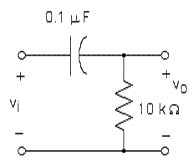
20. Determine the break frequency for this circuit.
a. 15.915 Hz
b. 159.15 Hz
c. 31.85 Hz
d. 318.5 Hz
Answer: Option B
Solution:
21. Refer to Figure 9.19. Calculate θ at 0.5f1.
a. 63.43°
b. 26.56°
c. 45°
d. Undefined
Answer: Option A
Solution:
22. A change in frequency by a factor of ________ is equivalent to 1 octave.
a. 2
b. 10
c. 5
d. 20
Answer: Option A
Solution:
23. A change in frequency by a factor of ________ is equivalent to 1 decade.
a. 2
b. 10
c. 5
d. 20
Answer: Option B
Solution:
24. For the low-frequency response of a BJT amplifier, the maximum gain is where ________ .
a. RB = 0 Ω
b. RC = 0 Ω
c. RE = 0 Ω
d. none of the above
Answer: Option C
Solution:
25. Which of the low-frequency cutoffs determined by CS, CC, or CE will be the predominant factor in determining the low-frequency response for the complete system?
a. Lowest
b. Middle
c. Highest
d. None of the above
Answer: Option C
Solution:
26. Determine the lower cut-off frequency of this network.
a. 15.8 Hz
b. 46.13 Hz
c. 238.73 Hz
d. 1575.8 Hz
Answer: Option C
Solution:
27. Which of the following elements is (are) important in determining the gain of the system in the high-frequency region?
a. Interelectrode capacitances
b. Wiring capacitances
c. Miller effect capacitance
d. All of the above
Answer: Option D
Solution:
28. In the ________-frequency region, the capacitive elements of importance are the interelectrode (between terminals) capacitances internal to the active device and the wiring capacitance between the leads of the network.
a. Low
b. Mid
c. High
d. any of the above
Answer: Option B
Solution:
29. Which of the following capacitors is (are) included in Ci for the high-frequency region of a BJT or FET amplifier?
a. Input wiring capacitance Cwi
b. The transition capacitance (Cbe/Cqs)
c. Miller capacitance Cmi
d. All of the above
Answer: Option D
Solution:
30. In the hybrid π or Giacoletto model, which one of the following does rb include?
a. Base spreading resistance
b. Base contact
c. Base bulk
d. All of the above
Answer: Option D
Solution:
31. Which of the following configurations does (do) not involve the Miller effect capacitance?
a. Common-emitter
b. Common-base
c. Common-collector
d. All of the above
Answer: Option B
Solution:
32. A 3-dB drop in hfe will occur at a frequency defined by ________.
a. f∞
b. fβ
c. 1
d. 2
Answer: Option B
Solution:
33. What is the range of the capacitors Cgs and Cgd?
a. 1 to 10 pF
b. 1 to 10 nF
c. 1 to 10 F
d. 1 to 10 F
Answer: Option A
Solution:
34. What is the range of the capacitor Cds?
a. 0.01 to 0.1 pF
b. 0.1 to 1 pF
c. 0.1 to 1 nF
d. 0.1 to 1 F
Answer: Option B
Solution:
35. Which of the following statements is true for a square-wave signal?
a. It is composed of both even and odd harmonics.
b. It is composed only of odd harmonics.
c. It is composed only of even harmonics.
d. The harmonics waveforms are also square waves.
Answer: Option B
Solution:
FILL-IN-THE-BLANKS
1. Logarithms taken to the base _____ are referred to as common logarithms, while logarithms taken to the base _____ are referred to as natural logarithms.
A. 10, e
B. e, 10
C. 5, e
D. 10, 5
Answer: Option A
Solution:
2. The logarithm of a number _______ than 1 is always _______.
A. greater, negative
B. less, positive
C. less, negative
D. None of the above
Answer: Option C
Solution:
3. The decibel (dB) is defined such that _____ decibel(s) = _____ bel(s).
A. 1, 10
B. 10, 1
C. 1, 1
D. 10, 10
Answer: Option B
Solution:
4. The resistance associated with the 1-mW power level is ______ , chosen because it is the characteristic impedance of audio transmission lines.
A. 100
B. 250
C. 400
D. 600
Answer: Option D
Solution:
5. The decibel gain of a cascaded system is the _______ of the decibel gains of each stage.
A. sum
B. difference
C. product
D. quotient
Answer: Option A
Solution:
6. Voltage gains of _______ dB or higher should immediately be recognized as being quite high.
A. 3
B. 6
C. 20
D. 50
Answer: Option D
Solution:
7. For the RC-coupled amplifier, the drop in gain at low frequencies is due to the increasing reactance of _______.
A. CC
B. Cs
C. CE
D. All of the above
Answer: Option D
Solution:
8. To fix the frequency boundaries of relatively high gain, _______ was chosen to be the gain at the cut-off levels.
A. 0.5Av mid
B. 0.707Av mid
C. Av low
D. 0.5Av high
Answer: Option B
Solution:
9. In the input RC circuit of a single-stage BJT or FET amplifier, as the frequency _______, the capacitive reactance _______ and _______ of the input voltage appears across the output terminals.
A. increases, decreases, more
B. increases, decreases, less
C. increases, increases, more
D. decreases, decreases, less
Answer: Option A
Solution:
10. A change in frequency by a factor of 2 results in a _______ change in the ratio of the normalized gain.
A. 3-dB
B. 6-dB
C. 10-dB
D. 20-dB
Answer: Option B
Solution:
11. A change in frequency by a factor of 10 results in a _______ change in the ratio of the normalized gain.
A. 3-dB
B. 6-dB
C. 10-dB
D. 20-dB
Answer: Option D
Solution:
12. In the low-frequency region, the _______ low-frequency cut-off determined by CS, CC, or CE will have the greatest impact on the network.
A. highest
B. average
C. lowest
D. None of the above
Answer: Option A
Solution:
13. The ________ region produces the maximum voltage gain in a single-stage BJT or FET amplifier.
A. low-frequency
B. mid-frequency
C. high-frequency
D. None of the above
Answer: Option B
Solution:
14. For any inverting amplifier, the impedance capacitance will be _______ by a Miller effect capacitance sensitive to the gain of the amplifier and the interelectrode capacitance.
A. unaffected
B. increased
C. decreased
D. None of the above
Answer: Option C
Solution:
15. The Miller effect is meaningful in the _______ amplifier.
A. inverting
B. noninverting
C. inverting/noninverting
D. None of the above
Answer: Option A
Solution:
16. With a BJT amplifier in the high-frequency region, the capacitance Cbe is the _______ of the parasitic capacitances while Cce is the _______.
A. smallest, largest
B. largest, smallest
C. smallest, medium
D. None of the above
Answer: Option B
Solution:
17. At very high frequencies, the effect of Ci is to ________ the total impedance of the parallel combination of R1, R2, R3, and Ci.
A. increase
B. maintain
C. decrease
D. None of the above
Answer: Option C
Solution:
18. If the parasitic capacitors were the only elements to determine the high cut-off frequency, the _______ frequency would be the determining factor.
A. lowest
B. highest
C. lowest or highest
D. None of the above
Answer: Option A
Solution:
19. The _______ configuration displays improved high-frequency characteristics over the _______ configuration.
A. common-collector, common-emitter
B. common-emitter, common-base
C. common-emitter, common-collector
D. common-base, common-emitter
Answer: Option D
Solution:
20. The _______ of the upper cut-off frequencies defines a ________ possible bandwidth for a system.
A. highest, maximum
B. lowest, maximum
C. lowest, minimum
D. None of the above
Answer: Option B
Solution:
21. f∞ is _________ than fβ in a common-base configuration.
A. significantly smaller
B. smaller
C. significantly greater
D. None of the above
Answer: Option C
Solution:
22. For two identical stages in cascade, the drop-off rate in the high- and low-frequency regions has increased to _______ per decade.
A. –3 dB
B. –6 dB
C. –20 dB
D. –40 dB
Answer: Option D
Solution:
23. The bandwidth ________ in a multistage amplifier compared to an identical single-stage amplifier.
A. increases
B. decreases
C. remains the same
D. None of the above
Answer: Option B
Solution:
24. The ________ in the Fourier series has the same frequency as the square wave itself.
A. fundamental
B. third harmonic
C. fifth harmonic
D. seventh harmonic
Answer: Option A
Solution:
25. The magnitude of the third harmonic is _______ of the magnitude of the fundamental.
A. 1
B. 0.5
C. 0.33
D. 0.25
Answer: Option C
Solution:
Check your work.
Complete List of Chapter Quiz in Electronic Devices and Circuit Theory
Related Content



P inoyBIX educates thousands of reviewers and students a day in preparation for their board examinations. Also provides professionals with materials for their lectures and practice exams. Help me go forward with the same spirit.
“Will you subscribe today via YOUTUBE?”
TIRED OF ADS?
- Become Premium Member and experienced complete ads-free content browsing.
- Full Content Access to Premium Solutions Exclusive for Premium members
- Access to PINOYBIX FREEBIES folder
- Download Reviewers and Learning Materials Free
- Download Content: You can see download/print button at the bottom of each post.
PINOYBIX FREEBIES FOR PREMIUM MEMBERSHIP:
- CIVIL ENGINEERING REVIEWER
- CIVIL SERVICE EXAM REVIEWER
- CRIMINOLOGY REVIEWER
- ELECTRONICS ENGINEERING REVIEWER (ECE/ECT)
- ELECTRICAL ENGINEERING & RME REVIEWER
- FIRE OFFICER EXAMINATION REVIEWER
- LET REVIEWER
- MASTER PLUMBER REVIEWER
- MECHANICAL ENGINEERING REVIEWER
- NAPOLCOM REVIEWER
- Additional upload reviewers and learning materials are also FREE
FOR A LIMITED TIME
If you subscribe for PREMIUM today!
You will receive an additional 1 month of Premium Membership FREE.
For Bronze Membership an additional 2 months of Premium Membership FREE.
For Silver Membership an additional 3 months of Premium Membership FREE.
For Gold Membership an additional 5 months of Premium Membership FREE.
Join the PinoyBIX community.