
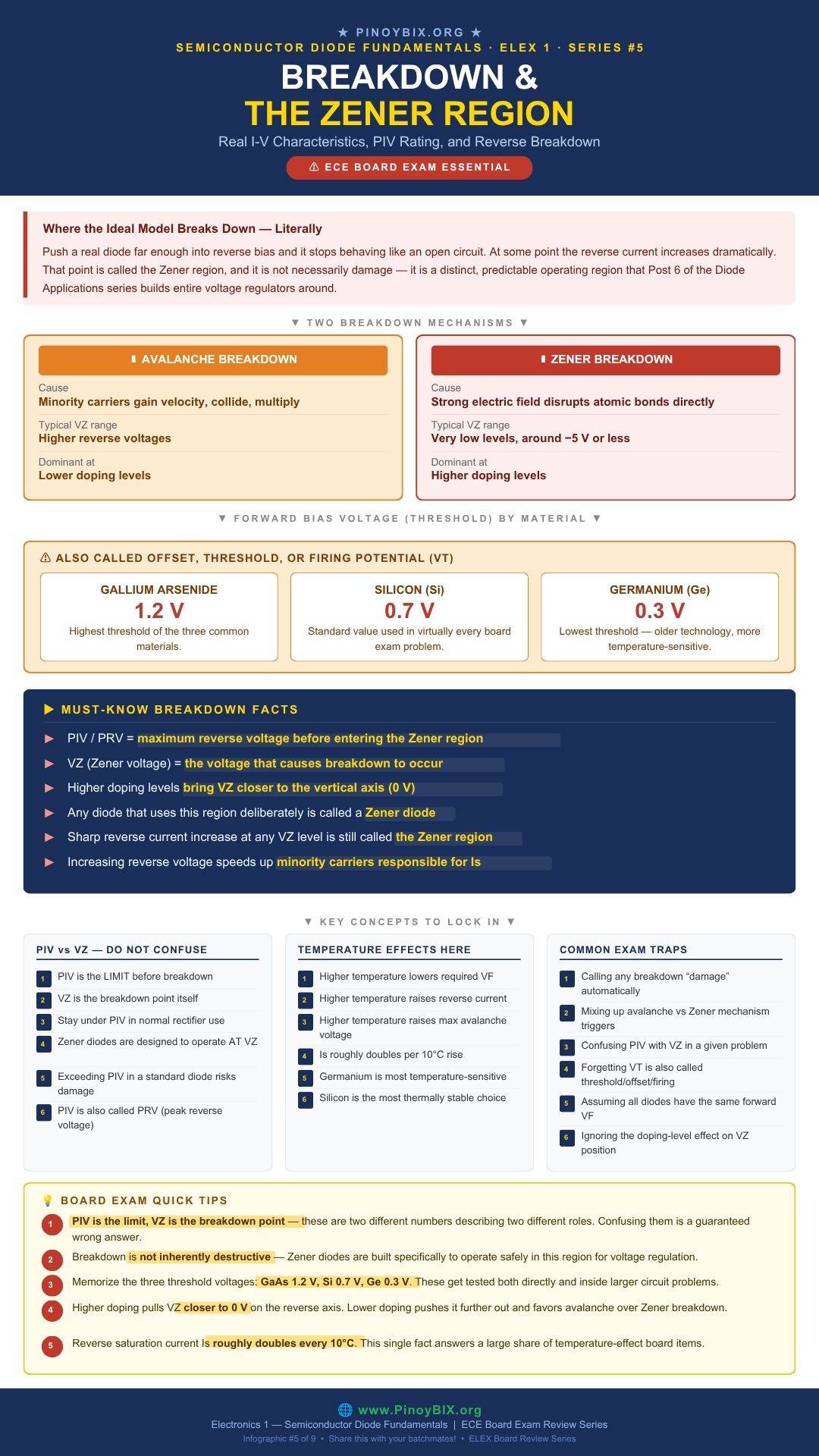
Push a real diode far enough into reverse bias and it stops behaving like an open circuit. At some point the reverse current increases dramatically. That point is called the Zener region, and it is not necessarily damage — it is a distinct, predictable operating region that an entire class of diodes is built around. This post covers the real I-V characteristic of a diode, the PIV rating that limits ordinary use, and the two mechanisms — avalanche and Zener breakdown — that produce this region.
This is Part 5 of the Semiconductor Diode Fundamentals ECE Board Exam Reviewer Series on PinoyBIX.org. Part 4 covered the PN junction and diode biasing. This part pushes the reverse bias condition further, into breakdown territory. If you are reviewing for the ECE or EE board exam or currently enrolled in Electronics 1, save this page.
- ECE (Electronics Engineer) — PIV rating, breakdown voltage, and the forward threshold voltages by material appear regularly in Electronic Devices and Circuits items. Expect 3 to 5 items covering PIV versus VZ distinction, avalanche versus Zener mechanism identification, and threshold voltage recall. This topic is also the direct foundation for Zener voltage regulator circuits in the Diode Applications series.
- EE (Electrical Engineer) — Appears with moderate frequency, mostly testing PIV rating concepts and basic threshold voltage recall.
Bottom line: ECE examinees must know PIV versus VZ cold, the two breakdown mechanisms, and all three threshold voltages by material. EE examinees need confident PIV and threshold voltage recognition. This is not a significant topic for ME, CE, ChE, GeE, MetE, MinE, or Naval Architecture boards.
The Real I-V Curve vs the Ideal Model
The ideal and practical models from Post 1 describe a diode’s behavior with straight lines. A real diode’s actual current-voltage characteristic is a smooth curve, rising exponentially in forward bias once the threshold voltage is exceeded, and staying nearly flat at a small leakage current through most of the reverse bias region — until reverse voltage grows large enough to trigger breakdown, at which point reverse current increases sharply.
Forward Bias Voltage (Threshold, Offset, or Firing Potential)
The voltage where a real diode’s forward current begins rising rapidly is called the threshold voltage, offset voltage, or firing potential, symbolized  . This is the same
  value used throughout the practical diode model. It depends directly on the semiconductor material.
![\[V_T(\text{GaAs}) = 1.2\text{ V} \qquad V_T(\text{Si}) = 0.7\text{ V} \qquad V_T(\text{Ge}) = 0.3\text{ V}\]](https://pinoybix.org/wp-content/ql-cache/quicklatex.com-1f6ff1b7ec5be1f23c4da6b50dd4516f_l3.png "Rendered by QuickLaTeX.com")
PIV: The Limit Before Breakdown
Every diode has a maximum reverse voltage rating called the peak inverse voltage (PIV), also called peak reverse voltage (PRV). Operating below this rating in reverse bias keeps the diode safely in its normal blocking region, conducting only the small reverse saturation current  . Exceeding PIV pushes the diode into the Zener region.
PIV (or PRV): the maximum reverse voltage a standard diode should be exposed to before entering breakdown. This is a safety limit for ordinary rectifier and switching diodes.
VZ (Zener voltage): the specific voltage at which breakdown actually occurs. For a Zener diode, this is the intended, designed-for operating point — not a limit to avoid.
Two Breakdown Mechanisms: Avalanche and Zener
Reverse breakdown can happen through two different physical mechanisms, and the doping level of the diode determines which one dominates.
Avalanche breakdown: minority carriers accelerated by a strong reverse field gain enough velocity to collide with lattice atoms and knock loose additional carriers, which repeat the process. Dominant at higher breakdown voltages and lower doping levels.
Zener breakdown: a very strong electric field directly disrupts covalent bonds, releasing carriers without relying on carrier collisions. Dominant at lower breakdown voltages (typically below about 5 V) and higher doping levels, which narrow the depletion region and intensify the field at a given voltage.
Despite the naming difference, any diode built to operate deliberately in this region — regardless of which mechanism dominates — is commonly called a Zener diode, and the term “Zener region” is used generically for the sharp reverse current increase in either case.
Temperature Effects on Breakdown Voltage
Temperature affects VZ differently depending on which mechanism dominates. Zener-mechanism breakdown, common in lower-voltage devices, typically shows a negative temperature coefficient — VZ decreases slightly as temperature rises. Avalanche-mechanism breakdown, common in higher-voltage devices, typically shows a positive temperature coefficient — VZ increases slightly as temperature rises. Diodes rated near 5 V often show close to a zero temperature coefficient, since both mechanisms are present in roughly equal measure.
Worked Problems — Board Exam Type Questions
The following 10 problems are representative of actual ECE and EE board exam questions on diode breakdown and the Zener region. Work each problem by hand before reading the solution.
Problem 1 — ECE Board Exam Type
A diode data sheet lists a forward threshold voltage of 0.7 V at rated current. Identify the semiconductor material.
Given:  V
V
Find: Semiconductor material
Solution:
Step 1: Compare against the known threshold values: GaAs = 1.2 V, Si = 0.7 V, Ge = 0.3 V.
Step 2: The value matches silicon.
Examiner note: Reverse-lookup questions from threshold voltage to material are common. Memorize the three values as a set.
Problem 2 — ECE Board Exam Type
A diode data sheet lists a forward threshold voltage of 1.2 V. Identify the semiconductor material.
Given:  V
V
Find: Semiconductor material
Solution:
Step 1: Compare against the known threshold values.
Step 2: The value matches gallium arsenide.
Examiner note: GaAs has the highest threshold voltage of the three common materials — the opposite end of the range from germanium.
Problem 3 — ECE Board Exam Type
A standard rectifier diode is rated with a PIV of 100 V. It is tested in reverse bias and found to conduct heavily at exactly 100 V. Explain what is occurring.
Given: PIV = 100 V, heavy conduction observed at 100 V reverse
Find: Explanation of the observed behavior
Solution:
Step 1: PIV marks the maximum safe reverse voltage before breakdown.
Step 2: Heavy conduction at exactly this voltage indicates the diode has entered the Zener (breakdown) region right at its rated limit.
Examiner note: For a standard rectifier diode, this is generally an unsafe operating condition unless current is limited, since it is not designed for sustained operation in this region.
Problem 4 — ECE Board Exam Type
A Zener diode has  V. Based on this value, which breakdown mechanism most likely dominates?
Given: V
Find: Dominant breakdown mechanism
Solution:
Step 1: Zener breakdown dominates at lower voltages, typically below about 5 V, due to higher doping levels.
Step 2: At 5.1 V, this diode sits right at the transition point, where both mechanisms contribute roughly equally.
Examiner note: Diodes rated near 5 V are the textbook example of the transition zone between the two mechanisms, often cited for their near-zero temperature coefficient.
Problem 5 — ECE Board Exam Type
A Zener diode has  V. Based on this value, which breakdown mechanism dominates?
Given: V
Find: Dominant breakdown mechanism
Solution:
Step 1: Higher breakdown voltages are associated with lower doping levels and wider depletion regions.
Step 2: At this voltage, carrier collisions inside the wider depletion region are the dominant breakdown trigger.
Examiner note: Despite the mechanism being avalanche, the diode is still commonly called a Zener diode in everyday terminology.
Problem 6 — ECE Board Exam Type
A rectifier diode has PIV = 50 V. In its circuit, it experiences a maximum reverse voltage of 45 V. Is the diode operating safely?
Given: PIV = 50 V, applied reverse voltage = 45 V
Find: Safety assessment
Solution:
Step 1: Compare the applied reverse voltage to the PIV rating.
Step 2:  , so the diode stays below its rated limit, with a 5 V margin remaining.
Examiner note: Design problems like this test whether you understand PIV as a ceiling to stay under, not a target value.
Problem 7 — ECE Board Exam Type
Using the same diode from Problem 6, the circuit is modified and the diode now experiences a reverse voltage of 55 V. What happens?
Given: PIV = 50 V, applied reverse voltage = 55 V
Find: Expected outcome
Solution:
Step 1: Compare the applied reverse voltage to the PIV rating.
Step 2:  , exceeding the rated limit and pushing the diode into breakdown.
Examiner note: For a standard rectifier diode not designed for this region, this is a design failure that should be corrected by selecting a diode with a higher PIV rating.
Problem 8 — ECE Board Exam Type
True or False: Entering the Zener (breakdown) region always destroys a diode.
Given: Statement about breakdown and diode damage
Find: True or False, with reasoning
Solution:
Step 1: Breakdown itself is a predictable, repeatable electrical behavior, not inherently destructive.
Step 2: Zener diodes are specifically designed to operate safely in this region as long as current is properly limited by external circuitry.
Examiner note: Damage occurs from excessive power dissipation due to unlimited current, not from breakdown voltage itself.
Problem 9 — ECE Board Exam Type
A GaAs diode ( V) is in series with
  and a 6 V source, forward biased. Find the current through the circuit.
Given: GaAs diode, V, ,  V
V
Find: 
Solution:
Step 1:  V
V
Step 2:  mA
mA
 mA
mA
Examiner note: This reinforces the same subtract-then-divide method from Post 1, now applied specifically to the GaAs threshold voltage.
Problem 10 — EE Board Exam Type
A 3.3 V Zener diode, dominated by the Zener breakdown mechanism, is heated from room temperature. Does  increase or decrease?
Given:  V, Zener-mechanism dominated, temperature increased
Find: Direction of change in
Solution:
Step 1: Zener-mechanism breakdown, dominant at lower voltages, typically has a negative temperature coefficient.
Step 2: As temperature rises, for this device decreases slightly.
decreases
Examiner note: This is the opposite behavior of a higher-voltage, avalanche-dominated Zener diode, which would show increasing with temperature.
Common Mistakes and Examiner Traps
| ❌ Mistake | ✅ Correction |
|---|---|
| Calling any breakdown “damage” automatically | Breakdown is a predictable operating region, not inherently destructive — Zener diodes are built specifically to operate here safely. |
| Mixing up avalanche versus Zener mechanism triggers | Zener dominates at lower voltages with higher doping; avalanche dominates at higher voltages with lower doping — tie the mechanism to the voltage range. |
| Confusing PIV with VZ in a given problem | PIV is a safety limit to stay under; VZ is the actual breakdown point, intentional for a Zener diode. |
| Forgetting is also called threshold, offset, or firing potential |
These are all the same value as the practical model’s — just different names used across textbooks and data sheets. |
| Assuming all diodes have the same forward threshold voltage | Threshold voltage depends on the material: GaAs = 1.2 V, Si = 0.7 V, Ge = 0.3 V. |
Board Exam Quick Tips
- PIV is the limit, VZ is the breakdown point — these are two different numbers describing two different roles. Confusing them is a guaranteed wrong answer.
- Breakdown is not inherently destructive — Zener diodes are built specifically to operate safely in this region for voltage regulation.
- Memorize the three threshold voltages: GaAs 1.2 V, Si 0.7 V, Ge 0.3 V. These get tested both directly and inside larger circuit problems.
- Higher doping pulls VZ closer to 0 V on the reverse axis. Lower doping pushes it further out and favors avalanche over Zener breakdown.
- Reverse saturation current Is roughly doubles every 10°C. This single fact answers a large share of temperature-effect board items.
Frequently Asked Questions
Q1. Is a “Zener diode” always breaking down through the Zener mechanism specifically?
Not necessarily. Higher-voltage Zener diodes actually operate through the avalanche mechanism, but the term “Zener diode” is used generically in industry for any diode designed to operate in the reverse breakdown region.
Q2. Why does a standard rectifier diode need a PIV rating if breakdown is not always destructive?
Standard rectifier diodes are not designed with the thermal and structural characteristics needed to safely dissipate the power involved in sustained breakdown operation. PIV keeps them safely away from this region during normal use.
Q3. What determines whether a diode breaks down through avalanche or Zener mechanism?
Doping level is the primary factor. Higher doping narrows the depletion region and intensifies the electric field at a given voltage, favoring the Zener mechanism at lower breakdown voltages. Lower doping favors the avalanche mechanism at higher voltages.
Q4. Why do some Zener diodes have a nearly zero temperature coefficient?
Diodes rated near 5 V sit at the transition point between Zener and avalanche mechanisms. Since Zener breakdown has a negative temperature coefficient and avalanche has a positive one, the two effects roughly cancel out near this voltage.
Q5. How does this topic connect to the Diode Applications series?
Everything covered here is the physical foundation for Zener diode voltage regulator circuits, where a diode is deliberately operated in the breakdown region to hold a stable reference voltage.
What Is Next
Now that you understand PIV, breakdown mechanisms, and threshold voltage, the next post shifts from voltage behavior to resistance behavior, covering the three ways to describe a diode’s resistance and how temperature affects each one.
→ Continue to Post 6 — Temperature Effects and Diode Resistance Levels
→ Back to the Semiconductor Diode Fundamentals Series Index
Published by PinoyBIX.org — Engineering Education for Every Filipino Student. Electronics · Mathematics · Board Exam Review · Free for Everyone.
Related Content




P inoyBIX educates thousands of reviewers and students a day in preparation for their board examinations. Also provides professionals with materials for their lectures and practice exams. Help me go forward with the same spirit.
“Will you subscribe today via YOUTUBE?”
TIRED OF ADS?
- Become Premium Member and experienced complete ads-free content browsing.
- Full Content Access to Premium Solutions Exclusive for Premium members
- Access to PINOYBIX FREEBIES folder
- Download Reviewers and Learning Materials Free
- Download Content: You can see download/print button at the bottom of each post.
PINOYBIX FREEBIES FOR PREMIUM MEMBERSHIP:
- CIVIL ENGINEERING REVIEWER
- CIVIL SERVICE EXAM REVIEWER
- CRIMINOLOGY REVIEWER
- ELECTRONICS ENGINEERING REVIEWER (ECE/ECT)
- ELECTRICAL ENGINEERING & RME REVIEWER
- FIRE OFFICER EXAMINATION REVIEWER
- LET REVIEWER
- MASTER PLUMBER REVIEWER
- MECHANICAL ENGINEERING REVIEWER
- NAPOLCOM REVIEWER
- Additional upload reviewers and learning materials are also FREE
FOR A LIMITED TIME
If you subscribe for PREMIUM today!
You will receive an additional 1 month of Premium Membership FREE.
For Bronze Membership an additional 2 months of Premium Membership FREE.
For Silver Membership an additional 3 months of Premium Membership FREE.
For Gold Membership an additional 5 months of Premium Membership FREE.
Join the PinoyBIX community.