
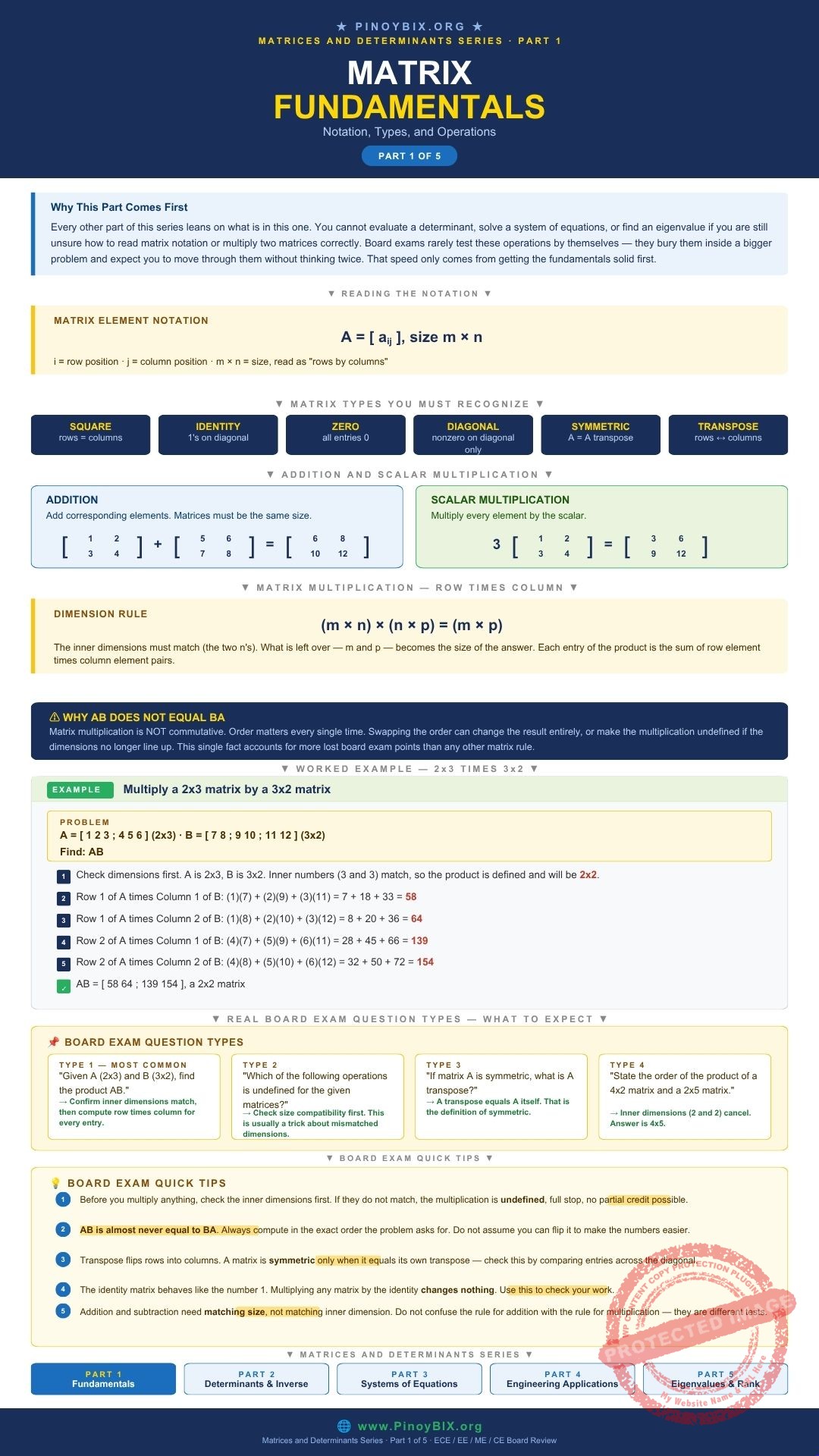
Matrices show up in every engineering board exam in the Philippines, and they always start the same way: a notation question, a multiplication problem, or a dimension check that separates students who actually studied from those who guessed. Matrix operations are the entry point for the entire Matrices and Determinants topic. If you cannot add, subtract, and multiply matrices correctly, and know when multiplication is even possible, every downstream application collapses. Circuit mesh analysis, Cramer’s rule, structural force systems: all of it starts here. This post covers every matrix operation tested on the board exam for ECE, EE, ME, CE, and ChE, with 10 fully worked problems in the same step-by-step format you will use on exam day. This is Part 1 of the Matrices and Determinants Series.
- ECE (Electronics Engineer) — Tested in Engineering Mathematics. Matrix operations underpin signal flow graphs, state-space analysis, and filter design problems.
- EE (Electrical Engineer) — High frequency. Mesh and nodal analysis require matrix setup and multiplication. The [Z][I]=[V] system appears directly on the board exam.
- ME (Mechanical Engineer) — Tested in Engineering Mathematics. Stiffness matrices in structural analysis use matrix multiplication and transpose operations.
- CE (Civil Engineer) — Tested in Engineering Mathematics. Truss analysis and force resolution problems set up as matrix systems.
- ChE (Chemical Engineer) — Tested in Engineering Mathematics. Mass balance systems in multi-component mixing require matrix operations.
- GeE (Geodetic Engineer) — Moderate frequency. Coordinate transformations use matrix multiplication.
- MetE and MinE — Low to moderate frequency. Basic matrix operations appear in Engineering Mathematics.
- Naval Architect and Marine Engineer — Moderate frequency. Structural load analysis and stability calculations use matrix methods.
Bottom line: ECE, EE, ME, and CE examinees should master every operation in this post cold, since mesh analysis and stiffness matrices depend on them directly. ChE, GeE, MetE, MinE, and Naval Architecture examinees need the notation, addition, and multiplication rules solid — that is what carries into the systems-of-equations problems later in this series.
What is a Matrix
A matrix is a rectangular array of numbers arranged in rows and columns. You write it inside brackets and describe its size by stating rows first, then columns. A matrix with  rows and
  columns is called an
  matrix.
![\[A = [a_{ij}]_{m \times n}\]](https://pinoybix.org/wp-content/ql-cache/quicklatex.com-883e81b207907cd606dd2a20eefc76f9_l3.svg "Rendered by QuickLaTeX.com")
 is the row position,
  is the column position. The element
  sits in row 2, column 3. Row index always comes first.
Matrix Types You Must Recognize
The board exam tests matrix types through identification questions. These are not difficult, but students who never memorize the definitions lose easy points.
Square matrix: number of rows equals number of columns. All determinant problems use square matrices.
Identity matrix  : a square matrix with 1’s on the main diagonal and 0’s everywhere else. Multiplying any matrix by gives the original matrix back:
  .
.
Zero matrix: every entry is 0.
Diagonal matrix: square matrix with nonzero entries only on the main diagonal. All other entries are 0.
Symmetric matrix: a square matrix equal to its own transpose.  . Every entry
  .
.
Transpose  : swap rows and columns. Row of
  becomes column of .
Addition and Subtraction
You can only add or subtract two matrices when they have exactly the same size — same number of rows and same number of columns. When the sizes match, add or subtract the corresponding elements. There is no shortcut here and no polar-form equivalent. You go entry by entry.
![\[[A + B]_{ij} = a_{ij} + b_{ij} \qquad \text{(same size only)}\]](https://pinoybix.org/wp-content/ql-cache/quicklatex.com-46575841e0e8b8f90bf980d7a62ec4ee_l3.svg "Rendered by QuickLaTeX.com")
Add the element in row , column of matrix to the element in the same position of matrix  .
.
Addition is commutative:  . Subtraction is not — always check which matrix comes first.
Scalar Multiplication
Multiplying a matrix by a scalar (a single number) means multiplying every element of the matrix by that number. No size restriction applies — scalar multiplication works on any matrix.
![\[kA = [k \cdot a_{ij}]\]](https://pinoybix.org/wp-content/ql-cache/quicklatex.com-537bba29432bafc48cf707600c54be3b_l3.svg "Rendered by QuickLaTeX.com")
Every element gets multiplied by  , including the negative and zero entries.
Matrix Multiplication
This is the operation that trips up the most students. Matrix multiplication is not element-by-element multiplication. You take the dot product of rows from the first matrix with columns of the second matrix.
Compatibility condition: 
The inner dimensions must match. The result has the outer dimensions.
![\[[AB]_{ij} = \sum_{k=1}^{n} a_{ik} \cdot b_{kj}\]](https://pinoybix.org/wp-content/ql-cache/quicklatex.com-d7e6e0721397b91bf24ea7e431052cf9_l3.svg "Rendered by QuickLaTeX.com")
Element in row , column of the result equals the dot product of row of with column of .
The single most important fact about matrix multiplication:  in general. Order matters. On the board exam, always check which order the problem specifies, and never assume you can flip it to make the arithmetic easier.
Transpose
The transpose of a matrix flips its rows and columns. Row 1 becomes column 1, row 2 becomes column 2, and so on. If is , then is  .
.
![\[[A^T]_{ij} = [A]_{ji}\]](https://pinoybix.org/wp-content/ql-cache/quicklatex.com-cbcd3da5aa97f0cf1d6ebb7475eef1e6_l3.svg "Rendered by QuickLaTeX.com")
![\[(A^T)^T = A \qquad (A+B)^T = A^T + B^T\]](https://pinoybix.org/wp-content/ql-cache/quicklatex.com-2b65c6789668ecbc72e8f8e840b8d68f_l3.svg "Rendered by QuickLaTeX.com")
![\[(kA)^T = kA^T \qquad (AB)^T = B^T A^T\]](https://pinoybix.org/wp-content/ql-cache/quicklatex.com-733bd362cf018c88b259f871a986a29f_l3.svg "Rendered by QuickLaTeX.com")
A symmetric matrix satisfies  — its transpose equals itself.
The last rule catches most students: the transpose of a product reverses the order.  , not
, not  . Same reversal pattern as the inverse of a product, which you will see again in Part 2.
Special Matrix Types
The board exam tests recognition of special matrix types. Know these by name and property.
The identity matrix is a square matrix with 1s on the main diagonal and 0s everywhere else. It acts like the number 1 in multiplication: for any compatible matrix .
A zero matrix has all elements equal to zero. Adding the zero matrix to any matrix returns .
A square matrix has equal numbers of rows and columns ( ). Only square matrices can be symmetric, have determinants, or be invertible.
A diagonal matrix has nonzero entries only on the main diagonal. Multiplying two diagonal matrices is particularly fast — you only multiply the diagonal entries.
10 Worked Problems — Board Exam Type
Problem 1. Read the matrix element.
Given: 
Find: and  .
.
Solution:
Step 1: For , go to row 2, column 3.
![\[a_{23} = 5\]](https://pinoybix.org/wp-content/ql-cache/quicklatex.com-1b56a115c5a8d12111ae8856ff2ef184_l3.svg "Rendered by QuickLaTeX.com")
Step 2: For , go to row 3, column 1.
![\[a_{31} = 3\]](https://pinoybix.org/wp-content/ql-cache/quicklatex.com-eb98def2054dfa6bf387ff1b3df321c7_l3.svg "Rendered by QuickLaTeX.com")
 ,
, 
Examiner note: The subscript order is always row then column, never column then row. is row 2, column 3. Reversing that gives you a different element entirely.
Problem 2. Determine which additions are defined.
Given: is  , is ,
  is
is  .
.
Find: Which of  ,
,  ,
,  are defined?
Solution:
Step 1: Check size match for . Both are .
![\[A + B \text{ is defined} \quad \checkmark\]](https://pinoybix.org/wp-content/ql-cache/quicklatex.com-0157fc072b37e060119a396dac06cfef_l3.svg "Rendered by QuickLaTeX.com")
Step 2: Check size match for . is , is . Sizes differ.
![\[A + C \text{ is undefined} \quad \times\]](https://pinoybix.org/wp-content/ql-cache/quicklatex.com-c9651db80421f89e9a303dbad1186f1d_l3.svg "Rendered by QuickLaTeX.com")
Step 3: Check size match for . Same issue as above.
![\[B + C \text{ is undefined} \quad \times\]](https://pinoybix.org/wp-content/ql-cache/quicklatex.com-a8a8c43f57d6c103b927aba53fa726dc_l3.svg "Rendered by QuickLaTeX.com")
is defined.
Examiner note: A and a matrix look related but they are not the same size. Rows by columns, in that order, always.
Problem 3. Add two matrices.
Given:  ,
, 
Find:
Solution:
Step 1: Add corresponding entries.
![\[A + B = \begin{bmatrix} 3+(-2) & -1+5 \\ 2+1 & 4+(-3) \end{bmatrix}\]](https://pinoybix.org/wp-content/ql-cache/quicklatex.com-4157b62b5f7cf588631fbd34e4600d0a_l3.svg "Rendered by QuickLaTeX.com")
Step 2: Simplify.
![\[A + B = \begin{bmatrix} 1 & 4 \\ 3 & 1 \end{bmatrix}\]](https://pinoybix.org/wp-content/ql-cache/quicklatex.com-a47343c9122235ba8b22947c482b688e_l3.svg "Rendered by QuickLaTeX.com")

Examiner note: Watch the signs when a negative entry is involved.  , not
, not  . Size must match before you start — check that first, every time.
Problem 4. Subtract two matrices.
Given:  ,
, 
Find: 
Solution:
Step 1: Subtract corresponding elements.
![\[A - B = \begin{bmatrix} 6-1 & 2-(-2) & -1-4 \\ 0-3 & 3-1 & 5-(-2) \end{bmatrix}\]](https://pinoybix.org/wp-content/ql-cache/quicklatex.com-32655ad7aec996a5673c7f89a63f442e_l3.svg "Rendered by QuickLaTeX.com")
Step 2: Simplify.
![\[A - B = \begin{bmatrix} 5 & 4 & -5 \\ -3 & 2 & 7 \end{bmatrix}\]](https://pinoybix.org/wp-content/ql-cache/quicklatex.com-b758ed02a125be781ee63978f8d2c46c_l3.svg "Rendered by QuickLaTeX.com")

Examiner note: Watch the signs when subtracting negative numbers.  , not
, not  . This is where careless errors stack up, especially under exam time pressure.
Problem 5. Scalar multiplication with a negative scalar.
Given:  , scalar
Find: 
Solution:
Step 1: Multiply every entry by  .
.
![\[-3A = \begin{bmatrix} -3(2) & -3(-4) & -3(1) \\ -3(0) & -3(3) & -3(-5) \end{bmatrix}\]](https://pinoybix.org/wp-content/ql-cache/quicklatex.com-e7b74e4ec4a34c0b923c062d6dfe4b0b_l3.svg "Rendered by QuickLaTeX.com")
Step 2: Simplify.
![\[-3A = \begin{bmatrix} -6 & 12 & -3 \\ 0 & -9 & 15 \end{bmatrix}\]](https://pinoybix.org/wp-content/ql-cache/quicklatex.com-1c4ed1a9ab3264cf4622dd162f87d033_l3.svg "Rendered by QuickLaTeX.com")

Examiner note: A negative scalar multiplied by a negative entry gives a positive result.  , not
, not  . Double check every sign when the scalar is negative.
Problem 6. Determine which products are defined, and their size.
Given: is , is  , is
, is  .
.
Find: Which of (a)  , (b)
, (b)  , (c)
, (c)  , (d)
, (d)  are defined, and what size is each?
Solution:
Step 1: Check .  — inner dimensions
  ✓ — result is
  .
.
Step 2: Check .  — inner dimensions
  ✗ — not defined.
Step 3: Check .  — inner dimensions
  ✓ — result is .
Step 4: Check .  — inner dimensions
  ✓ — result is
  .
.
, , and are defined. is not defined.
Examiner note: Check compatibility before any computation. This type of item appears as a pure conceptual question with no arithmetic required — one of the fastest marks on the exam if you know the rule cold.
Problem 7. Multiply two  matrices.
Given:  ,
, 
Find:
Solution:
Step 1: Compute entry  — row 1 of times column 1 of .
![\[c_{11} = (1)(5) + (2)(7) = 5 + 14 = 19\]](https://pinoybix.org/wp-content/ql-cache/quicklatex.com-c72922a00ba5cfe5afa0d343752b64d4_l3.svg "Rendered by QuickLaTeX.com")
Step 2: Compute  — row 1 of times column 2 of .
![\[c_{12} = (1)(6) + (2)(8) = 6 + 16 = 22\]](https://pinoybix.org/wp-content/ql-cache/quicklatex.com-865f237f6e0462e96c508a89740a2203_l3.svg "Rendered by QuickLaTeX.com")
Step 3: Compute  — row 2 of times column 1 of .
![\[c_{21} = (3)(5) + (4)(7) = 15 + 28 = 43\]](https://pinoybix.org/wp-content/ql-cache/quicklatex.com-41a00f7ba9901f716655cf2f58e9f169_l3.svg "Rendered by QuickLaTeX.com")
Step 4: Compute  — row 2 of times column 2 of .
![\[c_{22} = (3)(6) + (4)(8) = 18 + 32 = 50\]](https://pinoybix.org/wp-content/ql-cache/quicklatex.com-aa6d80900002a94af2b27a9e90dadba9_l3.svg "Rendered by QuickLaTeX.com")
Step 5: Assemble the result.
![\[AB = \begin{bmatrix} 19 & 22 \\ 43 & 50 \end{bmatrix}\]](https://pinoybix.org/wp-content/ql-cache/quicklatex.com-7536498a89673126892853fde55e6144_l3.svg "Rendered by QuickLaTeX.com")

Examiner note: Each entry needs a full dot product, not a single multiplication. Work one element at a time and write out every term before you add — do not try to combine steps in your head under exam pressure.
Problem 8. Demonstrate that  .
.
Given:  ,
, 
Find: and , then compare.
Solution:
Step 1: Compute .
![\[AB = \begin{bmatrix}(1)(1)+(2)(3) & (1)(0)+(2)(1) \\ (0)(1)+(1)(3) & (0)(0)+(1)(1)\end{bmatrix} = \begin{bmatrix} 7 & 2 \\ 3 & 1 \end{bmatrix}\]](https://pinoybix.org/wp-content/ql-cache/quicklatex.com-cd541fd4c780ded75e8c055359e65c3f_l3.svg "Rendered by QuickLaTeX.com")
Step 2: Compute .
![\[BA = \begin{bmatrix}(1)(1)+(0)(0) & (1)(2)+(0)(1) \\ (3)(1)+(1)(0) & (3)(2)+(1)(1)\end{bmatrix} = \begin{bmatrix} 1 & 2 \\ 3 & 7 \end{bmatrix}\]](https://pinoybix.org/wp-content/ql-cache/quicklatex.com-f370257bf0f9e95f07a1b0e9867ec60d_l3.svg "Rendered by QuickLaTeX.com")
Step 3: Compare. .

Examiner note: Even when both and are defined and the same size, they are usually not equal. The only guaranteed case where  is when one of the matrices is the identity .
Problem 9. Find the transpose of a matrix.
Given: 
Find:
Solution:
Step 1: Swap rows and columns. Row 1 of becomes column 1 of .
![\[A^T = \begin{bmatrix} 1 & 2 & 3 \\ 4 & 5 & 6 \\ 7 & 8 & 9 \end{bmatrix}\]](https://pinoybix.org/wp-content/ql-cache/quicklatex.com-a6c0db2e391fdfd6af9191a2503c6562_l3.svg "Rendered by QuickLaTeX.com")

Examiner note: Element  moves to position
  . The main diagonal stays fixed during a transpose — the elements
  ,
,  ,
,  never move.
Problem 10. Verify  .
.
Given:  ,
, 
Find:  and
and  , then verify they are equal.
Solution:
Step 1: Compute .
![\[AB = \begin{bmatrix}(2)(1)+(1)(2) & (2)(4)+(1)(3) \\ (3)(1)+(0)(2) & (3)(4)+(0)(3)\end{bmatrix} = \begin{bmatrix} 4 & 11 \\ 3 & 12 \end{bmatrix}\]](https://pinoybix.org/wp-content/ql-cache/quicklatex.com-f5573fec877393beeac8b8cc9fa8cb68_l3.svg "Rendered by QuickLaTeX.com")
Step 2: Transpose the result.
![\[(AB)^T = \begin{bmatrix} 4 & 3 \\ 11 & 12 \end{bmatrix}\]](https://pinoybix.org/wp-content/ql-cache/quicklatex.com-2ba9fff813189cf961e2e6155c1e26c3_l3.svg "Rendered by QuickLaTeX.com")
Step 3: Find and  .
.
![\[A^T = \begin{bmatrix} 2 & 3 \\ 1 & 0 \end{bmatrix} \qquad B^T = \begin{bmatrix} 1 & 2 \\ 4 & 3 \end{bmatrix}\]](https://pinoybix.org/wp-content/ql-cache/quicklatex.com-998c7f6c122d1308b3b81344edb148da_l3.svg "Rendered by QuickLaTeX.com")
Step 4: Compute .
![\[B^T A^T = \begin{bmatrix}(1)(2)+(2)(1) & (1)(3)+(2)(0) \\ (4)(2)+(3)(1) & (4)(3)+(3)(0)\end{bmatrix} = \begin{bmatrix} 4 & 3 \\ 11 & 12 \end{bmatrix}\]](https://pinoybix.org/wp-content/ql-cache/quicklatex.com-6897b7b3343d15e24df8217fee7caa83_l3.svg "Rendered by QuickLaTeX.com")
Step 5: Compare. Both give  .
.
 ✓ Verified.
Examiner note: The order reverses when you transpose a product. , never . This same reversal applies to inverses:  . One rule, two applications — you will see it again in Part 2.
Common Mistakes and Examiner Traps
These are the most consistent error patterns seen in board exam solutions for this topic. Read each one carefully.
| ❌ Common Mistake | ✅ Correct Approach |
|---|---|
| Adding matrices of different sizes, e.g. adding a to a . |
Check sizes first. Addition requires identical dimensions. A and a cannot be added, even though the numbers look related. |
| Multiplying element by element (the Hadamard product) instead of row by column. | Matrix multiplication is a dot product of rows with columns. ![[AB]_{ij} = \sum a_{ik} b_{kj}](https://pinoybix.org/wp-content/ql-cache/quicklatex.com-162b71cd3041bba50cd03c0a6314a6f4_l3.svg "Rendered by QuickLaTeX.com") . Never just multiply matching positions. . Never just multiply matching positions. |
| Assuming and computing only one product. |
Always treat and as separate computations. They are equal only in special cases, such as when one matrix is the identity. |
Getting the result size wrong, e.g. multiplying  and expecting a and expecting a  result. result. |
Result size comes from the outer dimensions:  . The inner dimensions cancel out, they do not appear in the answer. . The inner dimensions cancel out, they do not appear in the answer. |
| Forgetting to reverse the order in , writing instead of . |
. The reversal rule. The same pattern applies to inverses: . |
| Reading as row 3, column 2 instead of row 2, column 3. |
always means row , column . Row index first, column index second, no exceptions. |
Board Exam Quick Tips
- Check compatibility before computing. Write the sizes side by side:
 . If the inner numbers don’t match, the product does not exist. This takes 3 seconds and saves you from working a problem that has no answer.
 - The result size comes from the outer dimensions.
 gives a
  result. If the problem asks for the order of the result, this is your answer — no computation needed.
 - in general. If a problem asks whether the product is commutative, the answer is almost always no. The only common exceptions are when one of the matrices is the identity matrix or when both are diagonal matrices of the same size.
- For
 , reverse the order. . This comes up in proof-type questions and mirrors the exact same reversal rule for inverses, which you will use constantly starting in Part 2.
 - A symmetric matrix satisfies
 . If the problem gives you a matrix and asks whether it is symmetric, transpose it and check if you get the same matrix back. The main diagonal is always symmetric with itself.
 . If the inner numbers don’t match, the product does not exist. This takes 3 seconds and saves you from working a problem that has no answer.
 gives a
  result. If the problem asks for the order of the result, this is your answer — no computation needed.
Frequently Asked Questions
Q1. Is matrix multiplication the same as scalar multiplication?
No. Scalar multiplication means multiplying every element of the matrix by a single number. Matrix multiplication means taking the dot product of rows of the first matrix with columns of the second. The two operations are completely different. Scalar multiplication has no size restriction. Matrix multiplication requires the inner dimensions to match.
Q2. Can I add a matrix to a matrix?
No. Addition requires identical sizes. A matrix has 2 rows and 3 columns. A matrix has 3 rows and 2 columns. They are not the same size, so addition is not defined. You can, however, compute the product  , because the inner dimensions match — the result would be a
  matrix.
Q3. What does it mean when two matrices commute?
Two matrices and commute when . This is the exception, not the rule. It happens when both matrices are diagonal and the same size, when one matrix is a scalar multiple of the identity, or in a few other structured cases. On the board exam, assume matrices do not commute unless the problem gives you specific information proving they do.
Q4. Why does the transpose reverse the order in ?
Think of it this way: if you put on your socks then your shoes, you have to take off your shoes before your socks. Operations that stack in one direction reverse when you undo them. The same reversal shows up in the inverse rule . It is a fundamental property of linear algebra that you will run into again in Laplace transforms and signal analysis.
Q5. What is the difference between a zero matrix and a zero determinant?
A zero matrix has every entry equal to zero. A zero determinant means the matrix is singular, but the matrix itself may still have nonzero entries. These are two different concepts that show up in different types of board exam problems. A zero matrix always has a zero determinant, but a zero determinant does not mean the matrix is a zero matrix. Part 2 covers this in full.
What is Next
Part 1 gave you the vocabulary and the operation rules. Part 2 builds directly on that foundation, covering how to evaluate determinants for and matrices, expand using cofactors, and find the inverse using two different methods. Determinants appear in almost every board exam problem involving linear systems, so Part 2 is the pivot point of the whole series.
→ Continue to Part 2 — Determinants and the Inverse Matrix
→ Back to the Matrices and Determinants Series Index
Published by PinoyBIX.org — Engineering Education for Every Filipino Student. Electronics · Mathematics · Board Exam Review · Free for Everyone.
Related Content


P inoyBIX educates thousands of reviewers and students a day in preparation for their board examinations. Also provides professionals with materials for their lectures and practice exams. Help me go forward with the same spirit.
“Will you subscribe today via YOUTUBE?”
TIRED OF ADS?
- Become Premium Member and experienced complete ads-free content browsing.
- Full Content Access to Premium Solutions Exclusive for Premium members
- Access to PINOYBIX FREEBIES folder
- Download Reviewers and Learning Materials Free
- Download Content: You can see download/print button at the bottom of each post.
PINOYBIX FREEBIES FOR PREMIUM MEMBERSHIP:
- CIVIL ENGINEERING REVIEWER
- CIVIL SERVICE EXAM REVIEWER
- CRIMINOLOGY REVIEWER
- ELECTRONICS ENGINEERING REVIEWER (ECE/ECT)
- ELECTRICAL ENGINEERING & RME REVIEWER
- FIRE OFFICER EXAMINATION REVIEWER
- LET REVIEWER
- MASTER PLUMBER REVIEWER
- MECHANICAL ENGINEERING REVIEWER
- NAPOLCOM REVIEWER
- Additional upload reviewers and learning materials are also FREE
FOR A LIMITED TIME
If you subscribe for PREMIUM today!
You will receive an additional 1 month of Premium Membership FREE.
For Bronze Membership an additional 2 months of Premium Membership FREE.
For Silver Membership an additional 3 months of Premium Membership FREE.
For Gold Membership an additional 5 months of Premium Membership FREE.
Join the PinoyBIX community.