

This is the summary notes of the important terms and concepts in Chapter 14 of the book "Electronic Communications System" by Wayne Tomasi. The notes are properly synchronized and concise for much better understanding of the book. Make sure to familiarize this review notes to increase the chance of passing the ECE Board Exam.
CHAPTER 14 |
ELECTROMAGNETIC WAVE PROPAGATION |
Items |
Definitions |
Terms |
1 |
Propagation of electromagnetic waves often called radio-frequency (RF) propagation or simply radio propagation. |
Free-space |
2 |
Electrical energy that has escaped into free space. |
Electromagnetic wave |
3 |
The orientation of the electric field vector in respect to the surface of the Earth. |
Polarization |
4 |
Polarization remains constant |
Linear Polarization |
5 |
Forms of Linear polarization |
Horizontal Polarization and Vertical Polarization |
6 |
Polarization vector rotates 360◦ as the wave moves one wave-length through the space and the field strength is equal at all angles of polarization. |
Circular Polarization |
7 |
Field strength varies with changes in polarization. |
Elliptical Polarization |
8 |
Used to show the relative direction of electromagnetic wave propagation. |
Rays |
9 |
Formed when two points of equal phase on rays propagated from the same source are joined together. |
Wavefront |
10 |
A single location from which rays propagate equally in all directions. |
Point source |
11 |
Invisible force field produced by a magnet, such as a conductor when current is flowing through. |
Magnetic Field |
12 |
Strength of a magnetic field (H) produced around a conductor is expressed mathematically as: |
H = 1/2πd |
13 |
Invisible force fields produced by a difference in voltage potential between two conductors. |
Electric fields |
14 |
Electric filed strength (E) is expressed mathematically as: |
E = q/4πЄd2 |
15 |
Dielectric constant of the material separating the two conductors. |
Permittivity |
16 |
The permittivity of air or free space is approximately. |
8.85 x 10⁻¹² F/m |
17 |
The rate at which energy passes through a given surface area in free space. |
Power density |
18 |
Intensity of the electric and magnetic fields of an electromagnetic wave propagating in free space. |
Field intensity |
19 |
Mathematically power density is expressed as: |
P = €H W/m2 |
20 |
The characteristic impedance of a lossless transmission medium is equal to the square root of the ratio of its magnetic permeability to its electric permittivity. |
Zs = (μo/Єo)1/2 |
21 |
Point source that radiates power at a constant rate uniformly in all directions. |
Isotropic radiator |
22 |
Power density is inversely proportional to the square of the distance from the source. |
Inverse Square Law |
23 |
Propagation medium. |
Isotropic medium |
24 |
Waves propagate through free space; they spread out, resulting in a reduction in power density. |
Attenuation |
25 |
Reduction of Power. |
Absorption Loss |
26 |
Reduction in power density with distance is equivalent to a power loss. |
Wave attenuation |
27 |
Spherical spreading of the wave. |
Space attenuation |
28 |
One with uniform properties throughout. |
Homogeneous medium |
29 |
Absorption coefficient varies considerably with location, thus creating a difficult problem for radio systems engineers. |
Inhomogeneous medium |
30 |
Optical properties of Radio Waves. |
Refraction, Reflection, Diffraction and Interference |
31 |
Bending of the radio wave path. |
Refraction |
32 |
Square root of the dielectric constant and is expressed in: |
Refractive index; n = (k) |
33 |
(k) Equivalent dielectric constant relative to free space (vacuum). |
K = (1- 81N/f2)1/2 |
34 |
Boundary between two media with different densities. |
Plane |
35 |
Imaginary line drawn perpendicular to the interface at the point of incidence. |
Normal |
36 |
Angle formed between the incident wave and the normal. |
Angle of Incidence |
37 |
Angle formed between the refracted wave and the normal. |
Angle of Refraction |
38 |
Ratio of velocity of propagation of a light ray in free space to the velocity of propagation of a light ray in a given material. |
Refractive Index |
39 |
Perpendicular to the direction of propagation (parallel to the waveform) |
Density gradient |
40 |
To cast or turn back. |
Reflect |
41 |
Ratio of the reflected to the incident voltage intensities. |
Reflection Coefficient |
42 |
Portion of the total incident power that is not reflected. |
Power transmission Coefficient |
43 |
Fraction of power that penetrates medium 2. |
Absorption coefficient |
44 |
Incident wave front strikes an irregular surface, it is randomly scattered in many directions. |
Diffuse reflection |
45 |
Reflection from a perfectly smooth surface. |
Specular (mirror like) Reflection |
46 |
Surfaces that fall between smooth and irregular. |
Semirough surfaces |
47 |
Semirough surface will reflect as if it were a smooth surface whenever the cosine of the angle of incidence is greater than λ/8d, where d is the depth of the surface irregularity and λ is the wavelength of the incident wave. |
Rayleigh criterion Cos θi > λ/8d |
48 |
Modulation or redistribution of energy within a wavefront when it passes near the edge of an opaque object. |
Diffraction |
49 |
Diffraction occurs around the edge of the obstacle, which allows secondary waves to “sneak” around the corner of the obstacle. |
Shadow zone |
50 |
States that the total voltage intensity at a given point in space is the sum of the individual wave vectors. |
Linear Superposition |
51 |
Electromagnetic waves travelling within Earth’s atmosphere. |
Terrestrial waves |
52 |
Communications between two or more points on Earth. |
Terrestrial radio Communications |
53 |
Used for high-frequency applications. |
Sky waves |
54 |
Earth –guided electromagnetic wave that travels over the surface of earth. |
Surface wave |
55 |
Relative Conductivity of Earth Surfaces: 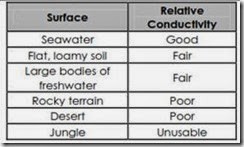
|
|
56 |
Disadvantages of surface waves. |
1. Ground waves require a relatively transmission power. 2. Ground waves are limited to very low, low and medium frequencies. 3. Requiring large antennas. 4. Ground losses vary considerably with surface material and composition. |
57 |
Advantages of ground wave propagation. |
1. Given enough transmit power, round waves can be used to communicate between any two locations in the world. 2. Ground waves are relatively unaffected by changing atmospheric conditions. |
58 |
Travel essentially in a straight line between transmit and receive antennas. |
Direct waves |
59 |
Space wave propagation with direct waves. |
Line-of-Sight (LOS) Transmission |
60 |
The curvature of Earth presents a horizon to space wave propagation. |
Radio Horizon |
61 |
Occurs when the density of the lower atmosphere is such that electromagnetic waves are trapped between it and Earth’s surface. |
Duct propagation |
62 |
Lowest layer of the ionosphere and is located approximately between 30 miles and 60 miles (50 km to 100 km) above Earth’s surface. |
D Layer |
63 |
Located approximately between 60 miles and 85 miles (100 km to 140 km) above Earth’s surface. |
E Layer |
64 |
The upper portion of the E layer. |
Sporadic E layer |
65 |
Made up of two layers, F 1 and F 2 layers. |
F Layer |
66 |
Highest frequency that can be propagated directly upward and still be returned to Earth by the ionosphere. |
Critical frequency |
67 |
Maximum vertical angle at which it can be propagated and still be refracted back by the ionosphere. |
Critical Angle |
68 |
A measurement technique used to determine the critical frequency. |
Ionospheric Sounding |
69 |
Height above the Earth’s surface from which a refracted wave appears to have been reflected. |
Virtual Height |
70 |
Highest frequency that can be used for sky wave propagation between two specific points on Earth’s surface. |
Maximum Usable Frequency (MUF) |
71 |
Secant law. |
MUF = critical frequency/cosθi |
72 |
Operating at a frequency of 85% of the MUF provides more reliable communications. |
Optimum Working Frequency (OWF) |
73 |
Minimum distance from a transmit antenna that a sky wave at a given frequency will be returned to Earth. |
Skip distance |
74 |
The area between where the surface waves are completely dissipated and the point where the first sky wave returns to Earth. |
Quiet, or skip, zone |
75 |
Formed by the ionosphere is raised, allowing sky waves to travel higher before being returned to Earth. |
Ceiling |
76 |
Define as the loss incurred by an electromagnetic waves as it propagates in a straight line through a vacuum with no absorption or reflection of energy from nearby objects. |
Free-space path loss |
77 |
Occurs simply because of the inverse square law. |
Spreading loss |
78 |
Variation in signal loss. |
Fading |
79 |
To accommodate temporary fading, an additional loss is added to the normal path loss |
Fade margin Fm = 30 logD + 10log (6ABf) – 10log (1-R) – 70 |
Complete List of Reviewers in Electronic Communications System per Chapter
Important List of Communications Engineering Materials
Related Content



P inoyBIX educates thousands of reviewers and students a day in preparation for their board examinations. Also provides professionals with materials for their lectures and practice exams. Help me go forward with the same spirit.
“Will you subscribe today via YOUTUBE?”
TIRED OF ADS?
- Become Premium Member and experienced complete ads-free content browsing.
- Full Content Access to Premium Solutions Exclusive for Premium members
- Access to PINOYBIX FREEBIES folder
- Download Reviewers and Learning Materials Free
- Download Content: You can see download/print button at the bottom of each post.
PINOYBIX FREEBIES FOR PREMIUM MEMBERSHIP:
- CIVIL ENGINEERING REVIEWER
- CIVIL SERVICE EXAM REVIEWER
- CRIMINOLOGY REVIEWER
- ELECTRONICS ENGINEERING REVIEWER (ECE/ECT)
- ELECTRICAL ENGINEERING & RME REVIEWER
- FIRE OFFICER EXAMINATION REVIEWER
- LET REVIEWER
- MASTER PLUMBER REVIEWER
- MECHANICAL ENGINEERING REVIEWER
- NAPOLCOM REVIEWER
- Additional upload reviewers and learning materials are also FREE
FOR A LIMITED TIME
If you subscribe for PREMIUM today!
You will receive an additional 1 month of Premium Membership FREE.
For Bronze Membership an additional 2 months of Premium Membership FREE.
For Silver Membership an additional 3 months of Premium Membership FREE.
For Gold Membership an additional 5 months of Premium Membership FREE.
Join the PinoyBIX community.