
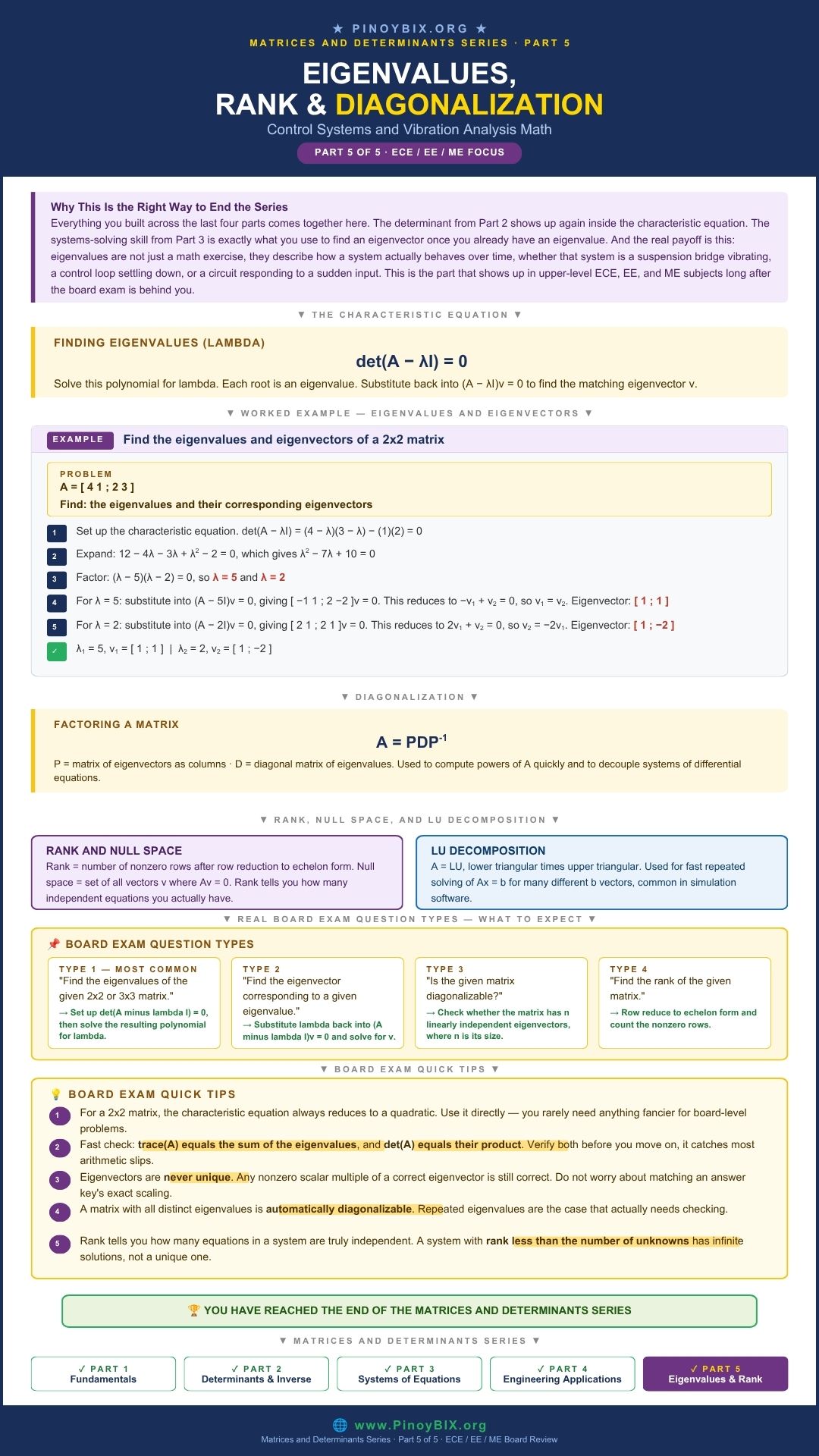
Most engineering students treat eigenvalues like a punishment reserved for graduate school. That is a mistake. Eigenvalue problems appear in the ECE, EE, and ME board exams as direct computational items, and once you see the pattern, they are not difficult — you are solving a determinant equation that you already know how to evaluate. This post covers eigenvalues and eigenvectors, matrix rank, diagonalization, and LU decomposition for the ECE, EE, and ME board exam. All 10 problems are worked step by step using the same format used throughout this series. This is Part 5 of the Matrices and Determinants Series.
ECE board examinees encounter eigenvalues in control systems stability analysis and discrete-time signal processing. A system is stable when all eigenvalues of the system matrix have negative real parts, or magnitudes less than 1 for discrete systems — that fact alone earns board exam points. EE board examinees see eigenvalues in power system small-signal stability and modal analysis. ME board examinees use eigenvalues in vibration analysis to find natural frequencies of multi-degree-of-freedom systems. Rank appears as a conceptual item across all nine boards as part of linear system consistency analysis. LU decomposition appears occasionally in ECE and EE as a factorization method in numerical computation problems.
Eigenvalues — What They Actually Are
When you multiply a matrix  by a special vector
  , something unusual happens — instead of rotating or shearing the way a general matrix would, it only scales it. The scalar by which it gets scaled is the eigenvalue
  . The vector that makes this happen is the eigenvector.
![\[Av = \lambda v\]](https://pinoybix.org/wp-content/ql-cache/quicklatex.com-cb13fd41cd3c04813642598b0c1599a9_l3.png "Rendered by QuickLaTeX.com")
is the square matrix, is the nonzero eigenvector, and is the eigenvalue. Rearranging:  . For a nonzero solution to exist, the matrix
  must be singular.
Finding Eigenvalues — The Characteristic Equation
Since must be singular, its determinant must be zero. That condition gives you the characteristic equation.
![\[\det(A - \lambda I) = 0\]](https://pinoybix.org/wp-content/ql-cache/quicklatex.com-2c153f63d580b95ce3476d6bfa8edd3b_l3.png "Rendered by QuickLaTeX.com")
Expand the determinant. You get a polynomial in of degree  for an
  matrix. The roots of that polynomial are the eigenvalues. A
  matrix gives a quadratic. A
  matrix gives a cubic.
Finding Eigenvectors
Once you have an eigenvalue  , substitute it back into
  and solve the homogeneous system. The solution gives you the eigenvector. Since any scalar multiple of an eigenvector is also an eigenvector, you typically express the answer as a direction — pick the simplest nonzero vector that satisfies the equation.
Properties Worth Memorizing
![\[\text{Sum of eigenvalues} = \text{trace}(A) = \sum a_{ii}\]](https://pinoybix.org/wp-content/ql-cache/quicklatex.com-b742ff3d273df031138914326502861b_l3.png "Rendered by QuickLaTeX.com")
![\[\text{Product of eigenvalues} = \det(A)\]](https://pinoybix.org/wp-content/ql-cache/quicklatex.com-1844ae39f3c391e97dc4762274985a65_l3.png "Rendered by QuickLaTeX.com")
![\[\text{Eigenvalues of } A^n = \lambda^n \quad \text{(same eigenvectors)}\]](https://pinoybix.org/wp-content/ql-cache/quicklatex.com-1cd6243d1216c7dd434022a969a4698d_l3.png "Rendered by QuickLaTeX.com")
![\[\text{Eigenvalues of } A^{-1} = \dfrac{1}{\lambda} \quad \text{(same eigenvectors)}\]](https://pinoybix.org/wp-content/ql-cache/quicklatex.com-d3e693609378b506ef5a11480f8a89fe_l3.png "Rendered by QuickLaTeX.com")
The trace is the sum of the main diagonal entries. These properties let you check your eigenvalue calculations without fully re-solving the characteristic equation.
Diagonalization
![\[A = PDP^{-1}\]](https://pinoybix.org/wp-content/ql-cache/quicklatex.com-b42d42aa0a3d7c8f0af5a3556a034267_l3.png "Rendered by QuickLaTeX.com")
 is the matrix whose columns are the eigenvectors of , arranged in the same order as the eigenvalues.
  is the diagonal matrix with the eigenvalues on the main diagonal. A matrix can be diagonalized if and only if it has linearly independent eigenvectors.
Matrix Rank and Null Space
![\[\text{rank}(A) = \text{number of nonzero rows after row reduction}\]](https://pinoybix.org/wp-content/ql-cache/quicklatex.com-a5b98231039b582edf26afcc7c230a40_l3.png "Rendered by QuickLaTeX.com")
![\[\text{nullity}(A) = n - \text{rank}(A)\]](https://pinoybix.org/wp-content/ql-cache/quicklatex.com-da4a72ea1dd88ca25b24c5e6bb96c869_l3.png "Rendered by QuickLaTeX.com")
![\[\text{rank}(A) + \text{nullity}(A) = n \quad \text{(Rank-Nullity Theorem)}\]](https://pinoybix.org/wp-content/ql-cache/quicklatex.com-b0139726d787c985e2b7987f39709414_l3.png "Rendered by QuickLaTeX.com")
Rank tells you how many independent equations you actually have. An matrix with rank is nonsingular and invertible. A matrix with rank less than is singular.
LU Decomposition
![\[A = LU\]](https://pinoybix.org/wp-content/ql-cache/quicklatex.com-e5f33e2934b9b9dbeb5a2c1c8d902b7e_l3.png "Rendered by QuickLaTeX.com")
 is lower triangular (ones on the diagonal, nonzero entries below).
  is upper triangular. Solving
  becomes two triangular solves:
  (forward substitution), then
  (back substitution). The advantage is that
  is computed once and reused for any number of right-hand side vectors.
10 Worked Board Exam Problems
Problem 1. Find the eigenvalues of a 2×2 matrix.
Given: 
Find: The eigenvalues of .
Solution:
Step 1: Set up the characteristic equation  .
.
![\[\det\begin{bmatrix}4-\lambda&1\\2&3-\lambda\end{bmatrix} = 0\]](https://pinoybix.org/wp-content/ql-cache/quicklatex.com-f2fd01dfdb490965458f8224302dc47a_l3.png "Rendered by QuickLaTeX.com")
Step 2: Expand the determinant.
![\[(4-\lambda)(3-\lambda) - (1)(2) = 0\]](https://pinoybix.org/wp-content/ql-cache/quicklatex.com-03ef0d0e25ee7ab410d9cd5a84a5211c_l3.png "Rendered by QuickLaTeX.com")
![\[\lambda^2 - 7\lambda + 12 - 2 = 0\]](https://pinoybix.org/wp-content/ql-cache/quicklatex.com-468eff765b1b8349eefca60942f8373a_l3.png "Rendered by QuickLaTeX.com")
![\[\lambda^2 - 7\lambda + 10 = 0\]](https://pinoybix.org/wp-content/ql-cache/quicklatex.com-5451a42c85d1ba528d26090afe07d531_l3.png "Rendered by QuickLaTeX.com")
Step 3: Factor the quadratic.
![\[(\lambda - 5)(\lambda - 2) = 0\]](https://pinoybix.org/wp-content/ql-cache/quicklatex.com-ceed550b866b06891e39cafe74a52ac1_l3.png "Rendered by QuickLaTeX.com")
![\[\lambda_1 = 5 \qquad \lambda_2 = 2\]](https://pinoybix.org/wp-content/ql-cache/quicklatex.com-aa890be2f8cdd5f8e8bccf24e54950a4_l3.png "Rendered by QuickLaTeX.com")
Step 4: Verify using the trace and determinant properties.
![\[\text{trace}(A) = 4+3 = 7 = \lambda_1 + \lambda_2 = 5+2 \quad \checkmark\]](https://pinoybix.org/wp-content/ql-cache/quicklatex.com-6d057ca4d04eddbf7c5be8677de5ba42_l3.png "Rendered by QuickLaTeX.com")
![\[\det(A) = 12-2 = 10 = \lambda_1 \cdot \lambda_2 = 5 \times 2 \quad \checkmark\]](https://pinoybix.org/wp-content/ql-cache/quicklatex.com-f015e84b5cb8991363cde2d74252a1a2_l3.png "Rendered by QuickLaTeX.com")
 ,
, 
Examiner note: Always verify eigenvalues using the trace and determinant checks. They take five seconds and confirm you factored the characteristic polynomial correctly. A wrong factorization is the most common error in eigenvalue problems.
Problem 2. Find the eigenvectors corresponding to each eigenvalue from Problem 1.
Given: , ,
Find: Eigenvectors  and
and  .
.
Solution:
Step 1: For , solve  .
.
![\[A - 5I = \begin{bmatrix}-1&1\\2&-2\end{bmatrix}\]](https://pinoybix.org/wp-content/ql-cache/quicklatex.com-8b45aa7502bbabef2bb80d6ed0a8d333_l3.png "Rendered by QuickLaTeX.com")
Row reduce:  gives
gives  . From row 1:
  . Let
. Let  .
.
![\[v_1 = \begin{bmatrix}1\\1\end{bmatrix}\]](https://pinoybix.org/wp-content/ql-cache/quicklatex.com-3d7178afa3cc144d9aa40ce734e646fd_l3.png "Rendered by QuickLaTeX.com")
Step 2: For , solve  .
.
![\[A - 2I = \begin{bmatrix}2&1\\2&1\end{bmatrix}\]](https://pinoybix.org/wp-content/ql-cache/quicklatex.com-5af5ba787f45f732587c513b8c007660_l3.png "Rendered by QuickLaTeX.com")
Row reduce:  gives
gives  . From row 1:
  . Let .
![\[v_2 = \begin{bmatrix}1\\-2\end{bmatrix}\]](https://pinoybix.org/wp-content/ql-cache/quicklatex.com-ea6b14dab5fe06fc6c929e63968a8ac4_l3.png "Rendered by QuickLaTeX.com")
 for ,
for ,  for
for
Examiner note: Eigenvectors are not unique — any nonzero scalar multiple is also valid. What matters is the direction, not the magnitude.  is equally correct for . The board exam answer key always accepts any scalar multiple.
Problem 3. Use eigenvalue properties to find the determinant and trace without full computation.
Given: A matrix has eigenvalues  ,
,  ,
,  .
.
Find:  and
and  .
.
Solution:
Step 1: Apply the product property.
![\[\det(A) = \lambda_1 \cdot \lambda_2 \cdot \lambda_3 = (1)(-2)(4) = -8\]](https://pinoybix.org/wp-content/ql-cache/quicklatex.com-07eaefeaeaa0f9124019dd7a5fbcddac_l3.png "Rendered by QuickLaTeX.com")
Step 2: Apply the sum property.
![\[\text{trace}(A) = \lambda_1 + \lambda_2 + \lambda_3 = 1 + (-2) + 4 = 3\]](https://pinoybix.org/wp-content/ql-cache/quicklatex.com-4b36dbf18c50553c0ee0a9a273823d7e_l3.png "Rendered by QuickLaTeX.com")
 ,
, 
Examiner note: These are one-line calculations once you know the eigenvalues. The board exam uses this as a fast conceptual item. If  , at least one eigenvalue is zero and the matrix is singular. That link between a zero eigenvalue and singularity is tested directly.
Problem 4. Find the eigenvalues of a 3×3 matrix with an obvious factor.
Given: 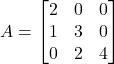
Find: The eigenvalues of .
Solution:
Step 1: Recognize the lower triangular structure. For any triangular matrix, the eigenvalues are the diagonal entries directly.
![\[\lambda_1 = 2 \qquad \lambda_2 = 3 \qquad \lambda_3 = 4\]](https://pinoybix.org/wp-content/ql-cache/quicklatex.com-0210b375449254b53b157330e05f8fc2_l3.png "Rendered by QuickLaTeX.com")
Step 2: Verify via trace and determinant.
![\[\text{trace} = 2+3+4 = 9 = 2+3+4 \quad \checkmark\]](https://pinoybix.org/wp-content/ql-cache/quicklatex.com-038c1a20ae3a97047b17465d5c7ed81d_l3.png "Rendered by QuickLaTeX.com")
![\[\det(A) = 2 \times 3 \times 4 = 24 = \lambda_1\lambda_2\lambda_3 \quad \checkmark\]](https://pinoybix.org/wp-content/ql-cache/quicklatex.com-7dcb20cecffb1f58c32571651c29ea61_l3.png "Rendered by QuickLaTeX.com")
 ,
,  ,
,
Examiner note: The eigenvalues of any triangular matrix — upper or lower — sit right on the main diagonal. No computation needed. The board exam drops this in as a quick conceptual item. If you do not recognize the pattern, you will spend two minutes on a ten-second problem.
Problem 5. Diagonalize a 2×2 matrix.
Given: with eigenvalues , and eigenvectors ,  from Problems 1 and 2.
Find: The matrices , , and  such that
  .
.
Solution:
Step 1: Assemble using eigenvectors as columns, in the same order as the eigenvalues.
![\[P = \begin{bmatrix}1&1\\1&-2\end{bmatrix}\]](https://pinoybix.org/wp-content/ql-cache/quicklatex.com-b729d9e7d31ad5bb3308ea3b666a8dfb_l3.png "Rendered by QuickLaTeX.com")
Step 2: Assemble with eigenvalues on the diagonal in the same order.
![\[D = \begin{bmatrix}5&0\\0&2\end{bmatrix}\]](https://pinoybix.org/wp-content/ql-cache/quicklatex.com-85ab4c803a114dae1d9445e6978901e9_l3.png "Rendered by QuickLaTeX.com")
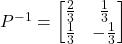
Step 3: Find using the 2×2 inverse formula.  .
.
![\[P^{-1} = \dfrac{1}{-3}\begin{bmatrix}-2&-1\\-1&1\end{bmatrix} = \begin{bmatrix}\frac{2}{3}&\frac{1}{3}\\\frac{1}{3}&-\frac{1}{3}\end{bmatrix}\]](https://pinoybix.org/wp-content/ql-cache/quicklatex.com-bf4fc28b38446bf7d5e29b44d558563e_l3.png "Rendered by QuickLaTeX.com")
Step 4: Verify  .
.
![\[PD = \begin{bmatrix}5&2\\5&-4\end{bmatrix}\]](https://pinoybix.org/wp-content/ql-cache/quicklatex.com-d2072019b0a3d99a2551a28d408d625f_l3.png "Rendered by QuickLaTeX.com")
![\[PDP^{-1} = \begin{bmatrix}5&2\\5&-4\end{bmatrix}\begin{bmatrix}\frac{2}{3}&\frac{1}{3}\\\frac{1}{3}&-\frac{1}{3}\end{bmatrix} = \begin{bmatrix}4&1\\2&3\end{bmatrix} = A \quad \checkmark\]](https://pinoybix.org/wp-content/ql-cache/quicklatex.com-81029910e1c4567a97f67b944b2e0781_l3.png "Rendered by QuickLaTeX.com")
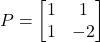 ,
,  ,
, 
Examiner note: The column order in must match the diagonal order in . If you put first in , the eigenvector for must be the first column of . Mix that order up and  .
.
Problem 6. Use diagonalization to compute a matrix power efficiently.
Given: where
Find:  using diagonalization.
Solution:
Step 1: Recall that  .
.
Step 2: Compute  by raising each diagonal entry to the fourth power.
![\[D^4 = \begin{bmatrix}5^4&0\\0&2^4\end{bmatrix} = \begin{bmatrix}625&0\\0&16\end{bmatrix}\]](https://pinoybix.org/wp-content/ql-cache/quicklatex.com-c862368f18b612de888baa8c9a961e2b_l3.png "Rendered by QuickLaTeX.com")
Step 3: The result is  .
.
![\[A^4 = \begin{bmatrix}1&1\\1&-2\end{bmatrix}\begin{bmatrix}625&0\\0&16\end{bmatrix}\begin{bmatrix}\frac{2}{3}&\frac{1}{3}\\\frac{1}{3}&-\frac{1}{3}\end{bmatrix}\]](https://pinoybix.org/wp-content/ql-cache/quicklatex.com-3cac53ddddc59f86110f2be3a71e21d5_l3.png "Rendered by QuickLaTeX.com")
![\[= \begin{bmatrix}625&16\\625&-32\end{bmatrix}\begin{bmatrix}\frac{2}{3}&\frac{1}{3}\\\frac{1}{3}&-\frac{1}{3}\end{bmatrix} = \begin{bmatrix}\dfrac{1250+16}{3}&\dfrac{625-16}{3}\\\dfrac{1250-32}{3}&\dfrac{625+32}{3}\end{bmatrix} = \begin{bmatrix}422&203\\406&219\end{bmatrix}\]](https://pinoybix.org/wp-content/ql-cache/quicklatex.com-cfc0518271f2ebc7500cb0330b2f6fdb_l3.png "Rendered by QuickLaTeX.com")
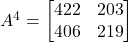
Examiner note: Computing by multiplying by itself four times requires three matrix multiplications. Using requires only three multiplications too, but the middle step is trivial since diagonal matrices raise to powers entry by entry. For  , diagonalization is the only practical method.
Problem 7. Find the rank of a matrix by row reduction.
Given: 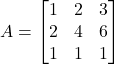
Find: 
Solution:
Step 1: Row reduce .  ,
,  .
.
![\[\begin{bmatrix}1&2&3\\0&0&0\\0&-1&-2\end{bmatrix}\]](https://pinoybix.org/wp-content/ql-cache/quicklatex.com-b2081c51225a22c1ec7cb35950c7f818_l3.png "Rendered by QuickLaTeX.com")
Step 2: Swap  and
and  .
.
![\[\begin{bmatrix}1&2&3\\0&-1&-2\\0&0&0\end{bmatrix}\]](https://pinoybix.org/wp-content/ql-cache/quicklatex.com-b9d32ddbd964ebe74409b10e5a414c6f_l3.png "Rendered by QuickLaTeX.com")
Step 3: Count nonzero rows after row reduction. Two nonzero rows, so  .
.
Step 4: Apply the rank-nullity theorem. is , so  . One free variable exists.
, 
Examiner note: Row 2 of the original matrix is exactly twice row 1 — that is the dependency that collapses it to a zero row. Always scan for obvious scalar multiples before you start row reducing. Finding them instantly reduces your work.
Problem 8. Determine if a matrix is diagonalizable based on its eigenvalues.
Given: 
Find: Is diagonalizable?
Solution:
Step 1: Find the eigenvalues.  (repeated, algebraic multiplicity 2).
Step 2: Find the eigenvectors for  . Solve .
![\[A - 2I = \begin{bmatrix}0&1\\0&0\end{bmatrix} \implies 0 \cdot v_1 + 1 \cdot v_2 = 0 \implies v_2 = 0\]](https://pinoybix.org/wp-content/ql-cache/quicklatex.com-73d700d405a6e1799fe3365332711b2c_l3.png "Rendered by QuickLaTeX.com")
Step 3: Only one free variable ( is free), so there is only one independent eigenvector:  . The geometric multiplicity is 1, but the algebraic multiplicity is 2.
Step 4: Since geometric multiplicity  algebraic multiplicity, the matrix does not have two independent eigenvectors and cannot be diagonalized.
is NOT diagonalizable. It has a repeated eigenvalue but only one independent eigenvector.
Examiner note: A repeated eigenvalue does not automatically mean the matrix is not diagonalizable. The identity matrix  has
has  repeated times but is already diagonal. What kills diagonalizability is a shortage of independent eigenvectors — geometric multiplicity less than algebraic multiplicity.
Problem 9. Perform LU decomposition on a 3×3 matrix.
Given: 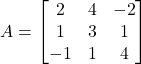
Find: Matrices and such that  .
.
Solution:
Step 1: Start with  and build as we eliminate. Begin with
 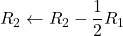 . Multiplier
  .
.
![\[U \rightarrow \begin{bmatrix}2&4&-2\\0&1&2\\-1&1&4\end{bmatrix}\]](https://pinoybix.org/wp-content/ql-cache/quicklatex.com-d2846d18ba8adc2d6487fcbc8c27f3d6_l3.png "Rendered by QuickLaTeX.com")
Step 2: 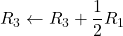 . Multiplier
  .
.
![\[U \rightarrow \begin{bmatrix}2&4&-2\\0&1&2\\0&3&3\end{bmatrix}\]](https://pinoybix.org/wp-content/ql-cache/quicklatex.com-c6bafe7dee58ee7cbabf85d496111eaf_l3.png "Rendered by QuickLaTeX.com")
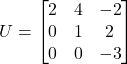
Step 3:  . Multiplier
  .
.
![\[U = \begin{bmatrix}2&4&-2\\0&1&2\\0&0&-3\end{bmatrix}\]](https://pinoybix.org/wp-content/ql-cache/quicklatex.com-4e90df767082b83f546c038e6d8681ca_l3.png "Rendered by QuickLaTeX.com")
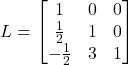
Step 4: Build from the multipliers, with 1’s on the diagonal.
![\[L = \begin{bmatrix}1&0&0\\\frac{1}{2}&1&0\\-\frac{1}{2}&3&1\end{bmatrix}\]](https://pinoybix.org/wp-content/ql-cache/quicklatex.com-b5efb4a873ea69ae4284f2d9c37c62d8_l3.png "Rendered by QuickLaTeX.com")
Step 5: Verify  .
.
![\[LU = \begin{bmatrix}1&0&0\\\frac{1}{2}&1&0\\-\frac{1}{2}&3&1\end{bmatrix}\begin{bmatrix}2&4&-2\\0&1&2\\0&0&-3\end{bmatrix} = \begin{bmatrix}2&4&-2\\1&3&1\\-1&1&4\end{bmatrix} = A \quad \checkmark\]](https://pinoybix.org/wp-content/ql-cache/quicklatex.com-4b756db171b32f8902309c0541aab886_l3.png "Rendered by QuickLaTeX.com")
 ,
, 
Examiner note: The multipliers in go exactly where you used them during elimination —  goes in row 2, column 1, and so on. The signs are the multipliers as used, not negated. Students who negate the multipliers when building get a wrong factorization that fails the verification.
Problem 10. Apply eigenvalues to a vibration analysis problem.
Given: A two-degree-of-freedom spring-mass system has the eigenvalue problem  where:
![\[A = \begin{bmatrix}3&-1\\-1&3\end{bmatrix}\]](https://pinoybix.org/wp-content/ql-cache/quicklatex.com-a3ea55ddd18bcfa8f127ed57a51cd3e8_l3.png "Rendered by QuickLaTeX.com")
and  where
where  is the natural frequency in rad/s.
Find: The natural frequencies of the system.
Solution:
Step 1: Set up the characteristic equation.
![\[\det(A - \lambda I) = \det\begin{bmatrix}3-\lambda&-1\\-1&3-\lambda\end{bmatrix} = 0\]](https://pinoybix.org/wp-content/ql-cache/quicklatex.com-ad5615193f481663f883b38151a6fcf3_l3.png "Rendered by QuickLaTeX.com")
Step 2: Expand.
![\[(3-\lambda)^2 - 1 = 0\]](https://pinoybix.org/wp-content/ql-cache/quicklatex.com-faa1270913c299575f971b4f744c8831_l3.png "Rendered by QuickLaTeX.com")
![\[\lambda^2 - 6\lambda + 9 - 1 = 0\]](https://pinoybix.org/wp-content/ql-cache/quicklatex.com-1b354b634c3c53ca422d6ae70c9eb05a_l3.png "Rendered by QuickLaTeX.com")
![\[\lambda^2 - 6\lambda + 8 = 0\]](https://pinoybix.org/wp-content/ql-cache/quicklatex.com-a4aa732309053e605620d9939e7259c0_l3.png "Rendered by QuickLaTeX.com")
![\[(\lambda-4)(\lambda-2) = 0\]](https://pinoybix.org/wp-content/ql-cache/quicklatex.com-5b6117142658a9f5471deb4a003a326a_l3.png "Rendered by QuickLaTeX.com")
![\[\lambda_1 = 2 \qquad \lambda_2 = 4\]](https://pinoybix.org/wp-content/ql-cache/quicklatex.com-984c629ed72f219dbdec4eb800724eab_l3.png "Rendered by QuickLaTeX.com")
Step 3: Since , find the natural frequencies.
![\[\omega_1 = \sqrt{2} \approx 1.414 \text{ rad/s} \qquad \omega_2 = \sqrt{4} = 2 \text{ rad/s}\]](https://pinoybix.org/wp-content/ql-cache/quicklatex.com-4ebdae91f6cc6b0b436914d2a8091b87_l3.png "Rendered by QuickLaTeX.com")
 rad/s,
  rad/s
rad/s
Examiner note: Vibration problems rename the eigenvalues as  , but the math is identical. Recognize the connection between eigenvalue problems and natural frequency problems early in the problem so you know what to do with the values once you have them — take the square root to get .
Common Mistakes and Examiner Traps
| ❌ Common Mistake | ✅ Correct Approach |
|---|---|
Setting up  with a positive sign with a positive sign |
The characteristic equation is always . Subtract  , never add it. A sign error here gives completely wrong eigenvalues. , never add it. A sign error here gives completely wrong eigenvalues. |
| Assuming a repeated eigenvalue always means the matrix is not diagonalizable | Repeated eigenvalues may or may not prevent diagonalization. Check if the number of independent eigenvectors matches the algebraic multiplicity. The identity matrix is the classic counter-example. |
| Putting eigenvalues as rows in instead of using eigenvectors as columns |
has eigenvectors as columns. has eigenvalues on the diagonal. Mixing this up produces . The column of and the diagonal entry of in the same position must correspond to each other. |
| Computing rank by counting the number of nonzero entries rather than nonzero rows after reduction | Rank is the number of nonzero rows in the row echelon form, which equals the number of pivot columns. A row with all zero entries does not contribute to the rank regardless of the original matrix entries. |
| Negating the multipliers when building during LU decomposition |
Store the multipliers in exactly as computed — the positive value used in the row operation. If you used  to eliminate, then to eliminate, then  , not , not  . . |
| Forgetting to take the square root when converting eigenvalues to natural frequencies in vibration problems | In vibration analysis, . The natural frequency is  , not itself. Report in rad/s, not . , not itself. Report in rad/s, not . |
Board Exam Quick Tips
- Use the trace and determinant to verify eigenvalues immediately. Once you solve the characteristic equation, add the eigenvalues and compare to the trace, then multiply them and compare to the determinant. Two checks, five seconds, and you know whether to trust your answer before moving on.
- Triangular matrices give eigenvalues for free. The eigenvalues of any upper or lower triangular matrix are the diagonal entries. No characteristic equation needed. Scan the matrix for triangular structure before setting up the full determinant.
- Rank equals the number of pivot columns after row reduction. Row reduce the matrix all the way to echelon form and count the nonzero rows. That number is the rank. It tells you exactly how many independent equations you have, which determines the solution type for any associated linear system.
- For repeated eigenvalues, check the number of independent eigenvectors before concluding anything about diagonalizability. Solve the system and count the free variables. If the number of free variables equals the algebraic multiplicity of , the matrix is still diagonalizable.
- In vibration and control problems, recognize eigenvalue language. Natural frequencies, mode shapes, stability margins, and system poles are all eigenvalue concepts. The moment a problem asks about the behavior of a system modeled by a matrix differential equation, eigenvalues are the answer.
Frequently Asked Questions
What does a negative eigenvalue mean physically?
It depends on the application. In a vibration system where , a negative eigenvalue means the configuration is unstable — the system cannot sustain oscillation in that mode. In a control system, eigenvalues with negative real parts mean the system is stable and will return to equilibrium after a disturbance. The sign of the eigenvalue carries direct physical meaning, which is why board exam problems ask you to classify systems using eigenvalues.
Can a matrix have complex eigenvalues?
Yes. Real matrices can have complex eigenvalues, and they always appear in conjugate pairs. A real matrix with complex eigenvalues  represents a rotation-scaling transformation. In control systems, complex eigenvalues with negative real parts mean the system is stable and oscillatory — the imaginary part sets the oscillation frequency and the real part sets the decay rate.
What is the geometric interpretation of rank?
Rank is the dimension of the column space of the matrix — the number of truly independent directions that the matrix can map vectors into. A matrix with rank 2 maps all of three-dimensional space onto a two-dimensional plane. That is why a rank-deficient matrix cannot be inverted: it compresses space and you cannot recover the original directions from the output.
When does LU decomposition fail?
LU decomposition without row pivoting fails when a zero appears in a pivot position during elimination. This requires either partial pivoting — swapping rows to bring a nonzero entry into the pivot position — which produces a modified form  where is a permutation matrix, or full pivoting for maximum numerical stability. Most board exam problems use matrices where LU decomposition works cleanly without pivoting.
Is diagonalization the same as finding the singular value decomposition?
No, they are different. Diagonalization requires a square matrix with independent eigenvectors and produces . Singular value decomposition works for any matrix, including non-square ones, and produces  where and
  are orthogonal matrices and
  contains the singular values. The board exam tests eigenvalue diagonalization, not SVD, at this level.
What is Next
You have now worked through the complete Matrices and Determinants series — five parts, 50 worked problems, and the full range of topics that appear on the ECE, EE, CE, and ME board exams. The next step is the practice exam. Head to the Matrices and Determinants Series Index for the consolidated formula sheet, the 30-item practice exam with answer key, the score interpretation table, and the study schedule. After you take the practice exam, check your answers against the Complete Solutions Post.
Series navigation: Part 1 — Fundamentals and Operations | Part 2 — Determinants and Inverse | Part 3 — Systems of Equations | Part 4 — Engineering Applications
Related Content




P inoyBIX educates thousands of reviewers and students a day in preparation for their board examinations. Also provides professionals with materials for their lectures and practice exams. Help me go forward with the same spirit.
“Will you subscribe today via YOUTUBE?”
TIRED OF ADS?
- Become Premium Member and experienced complete ads-free content browsing.
- Full Content Access to Premium Solutions Exclusive for Premium members
- Access to PINOYBIX FREEBIES folder
- Download Reviewers and Learning Materials Free
- Download Content: You can see download/print button at the bottom of each post.
PINOYBIX FREEBIES FOR PREMIUM MEMBERSHIP:
- CIVIL ENGINEERING REVIEWER
- CIVIL SERVICE EXAM REVIEWER
- CRIMINOLOGY REVIEWER
- ELECTRONICS ENGINEERING REVIEWER (ECE/ECT)
- ELECTRICAL ENGINEERING & RME REVIEWER
- FIRE OFFICER EXAMINATION REVIEWER
- LET REVIEWER
- MASTER PLUMBER REVIEWER
- MECHANICAL ENGINEERING REVIEWER
- NAPOLCOM REVIEWER
- Additional upload reviewers and learning materials are also FREE
FOR A LIMITED TIME
If you subscribe for PREMIUM today!
You will receive an additional 1 month of Premium Membership FREE.
For Bronze Membership an additional 2 months of Premium Membership FREE.
For Silver Membership an additional 3 months of Premium Membership FREE.
For Gold Membership an additional 5 months of Premium Membership FREE.
Join the PinoyBIX community.