
Problem Statement: Transmission and Antenna Systems
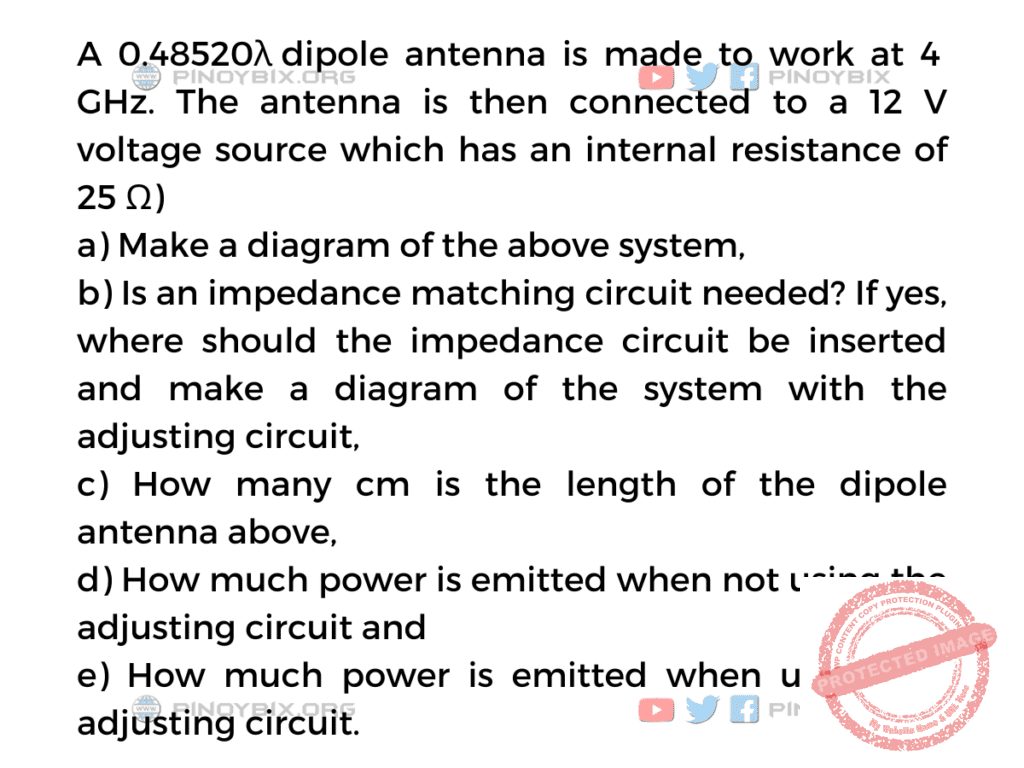
Radiation and Wave Propagation Problem SolvingA 0.48520λ0 dipole antenna is made to work at 4 GHz. The antenna is then connected to a 12 V voltage source which has an internal resistance of 25 Ω.
a) Make a diagram of the above system,
b) Is an impedance-matching circuit needed? If yes, where should the impedance circuit be inserted and make a diagram of the system with the adjusting circuit,
c) How many cm is the length of the dipole antenna above,
d) How much power is emitted when not using the adjusting circuit and
e) How much power is emitted when using the adjusting circuit?
Problem Answer:
a) see solution,
b) yes, see solution
c) The length of the dipole antenna is equal to 3.639 cm.
d) The power emitted when not using the adjusting circuit is equal to 1.0945 W.
e) The power emitted when using the adjusting circuit is equal to 1.44 W.
This content is for Premium Member. Tired of ads?
Subscribe To Unlock The Content! and Remove Ads.
- Solution: What is the height above the ground of the receiving antenna
- Solution: What is the critical angle of the signal when it passes from glass
- Solution: What is the angle of incidence if the MUF is 19 MHz
- Solution: What is the relative permittivity?
- Solution: Calculate the optimum working frequency
- Solution: The maximum transmission distance is
- Solution: What is the resultant field strength between waves travelling
- Solution: What is the maximum line of sight distance between a paging antenna
- Solution: How far away is the radio horizon of an antenna 100 ft high?
- Solution: What is the path loss of the signal if the operating frequency is 3 GHz?
- Solution: What is the propagation velocity of a signal in a transmission line
- Solution: What is its refractive index?
- Solution: What is the refractive index of an ionosphere layer
- Solution: What is its critical frequency?
- Solution: What is the best frequency to use?
- Solution: Determine the critical frequency value of an HF signal
- Solution: What is the index of refraction of a certain substance
- Solution: Determine the refractive index of an ionosphere layer
- Solution: What is the critical frequency if the maximum number of free electrons
- Solution: What is the free space loss between two microwave parabolic antennas
- Solution: Determine the effective radiated power of 20 kW TV broadcast transmitter
- Solution: Calculate the electric field intensity in millivolts per meter at 30 kW
- Solution: Determine the power density at a distance of 100 meters
- Solution: What is the effective radiated power of a repeater with 450 W
- Solution: Calculate the field strength at a receiving antenna
- Solution: What is the critical frequency?
- Solution: What is the best frequency to use assuming 30 degree of radiation angle?
- Solution: What power density is required to produce electric field strength
- Solution: What is the effective isotropic radiate power (EIRP) in W?
- Solution: How much power is emitted when using the adjusting circuit?
- Solution: Determine the received signal (in dBm) for the free space condition
- Solution: Use the free space model to compute the free space path loss for a 900 MHz signal
- Solution: Calculate the free space loss at 300 MHz between the earth station and a satellite transponder
- Solution: Determine the isotropic free space loss at 8 GHz for the shortest path to a geostationary satellite
- Solution: What is the path loss in dB of the signal if the operating frequency is 3 GHz
- Solution: What is the Free Space Path Loss in dB?
- Solution: What is the free space path loss in dB over 80 meters at the 2.4 GHz band?
- Solution: At what angle relative to the water’s surface will this light be completely polarized?
- Solution: At what angle is light inside crown glass completely polarized when reflected from water
- Solution: Determine the distance separating the red and violet light as it emerges from the glass
- Solution: Determine the angle at which the two colors of light emerge from the crown glass
- Solution: What is the luminous intensity of this source of light?
- Solution: The critical angle of incidence for light going from crown glass (n=1.5) to ice (n=1.3) is
- Solution: The angle of refraction is 60 degrees The index of refraction of water is
- Solution: What is the effective radiated power (ERP) of a repeater
- Solution: Calculate ZL and voltage reflection coefficient at the load
More Questions in: Radiation and Wave Propagation Problem
Series of Online Questions and Answers in Radiation and Wave Propagation
Online Questions and Answers in Communications Engineering per topic
Related Content



P inoyBIX educates thousands of reviewers and students a day in preparation for their board examinations. Also provides professionals with materials for their lectures and practice exams. Help me go forward with the same spirit.
“Will you subscribe today via YOUTUBE?”
TIRED OF ADS?
- Become Premium Member and experienced complete ads-free content browsing.
- Full Content Access to Premium Solutions Exclusive for Premium members
- Access to PINOYBIX FREEBIES folder
- Download Reviewers and Learning Materials Free
- Download Content: You can see download/print button at the bottom of each post.
PINOYBIX FREEBIES FOR PREMIUM MEMBERSHIP:
- CIVIL ENGINEERING REVIEWER
- CIVIL SERVICE EXAM REVIEWER
- CRIMINOLOGY REVIEWER
- ELECTRONICS ENGINEERING REVIEWER (ECE/ECT)
- ELECTRICAL ENGINEERING & RME REVIEWER
- FIRE OFFICER EXAMINATION REVIEWER
- LET REVIEWER
- MASTER PLUMBER REVIEWER
- MECHANICAL ENGINEERING REVIEWER
- NAPOLCOM REVIEWER
- Additional upload reviewers and learning materials are also FREE
FOR A LIMITED TIME
If you subscribe for PREMIUM today!
You will receive an additional 1 month of Premium Membership FREE.
For Bronze Membership an additional 2 months of Premium Membership FREE.
For Silver Membership an additional 3 months of Premium Membership FREE.
For Gold Membership an additional 5 months of Premium Membership FREE.
Join the PinoyBIX community.