

Determinants are where matrices stop being abstract notation and start answering a real question: does this system have one solution, many solutions, or none at all? On the Philippine engineering board exam, determinant problems show up in three forms — compute it directly, use it to test whether a matrix is invertible, or apply it inside Cramer’s rule to solve a system. This post covers the  formula, the
  Sarrus rule, cofactor expansion for anything larger, and then moves into the inverse matrix itself using two different methods: the adjugate method and Gauss-Jordan elimination. Work through all 10 problems before checking your answers. This is Part 2 of the Matrices and Determinants Series.
- ECE (Electronics Engineer) — Tested in Engineering Mathematics. Determinants appear in Cramer’s rule applications and in testing system consistency for circuit analysis problems.
- EE (Electrical Engineer) — High frequency. The determinant of the impedance matrix determines whether a mesh system has a unique solution, and the inverse matrix solves that system directly. determinants appear regularly in three-mesh circuit problems.
- ME (Mechanical Engineer) — Tested in Engineering Mathematics. Determinants of stiffness matrices and force coefficient matrices appear in structural analysis problems.
- CE (Civil Engineer) — Tested in Engineering Mathematics. Cramer’s rule for truss and force systems requires determinant computation. Area of a triangle using determinants also appears in coordinate geometry items.
- ChE (Chemical Engineer) — Tested in Engineering Mathematics. Determinants determine whether a mass balance system is well-posed, and matrix inversion solves multi-component mixing problems directly.
- GeE (Geodetic Engineer) — Moderate frequency. Determinants appear in coordinate transformation problems and in testing linear independence of survey control equations.
- MetE and MinE — Low to moderate frequency. Basic determinant and inverse computation in Engineering Mathematics.
- Naval Architect and Marine Engineer — Moderate frequency. Stability and structural analysis problems use determinants to test matrix conditions.
Bottom line: EE and ECE examinees will use the inverse matrix directly in mesh and nodal circuit analysis, so both methods in this post need to be second nature. CE, ME, and ChE need determinant evaluation solid for Cramer’s rule and structural or mass-balance systems. All nine boards test determinant properties as standalone recall items, so the properties list below is worth memorizing regardless of which board you are taking.
What a Determinant Is
A determinant is a single scalar number computed from the elements of a square matrix. It is written as  or
or  . Only square matrices have determinants — you cannot compute the determinant of a
  matrix, no matter how hard you try.
The determinant tells you the one fact that matters most: whether the matrix is invertible. If  , the matrix has an inverse and any linear system it represents has a unique solution. If
  , the matrix is singular — no inverse exists, and the system either has infinitely many solutions or no solution at all, depending on the constants involved.
![\[\det(A) \neq 0 \quad \Rightarrow \quad A \text{ is invertible (nonsingular)} \quad \Rightarrow \quad \text{unique solution exists}\]](https://pinoybix.org/wp-content/ql-cache/quicklatex.com-19bb62ca1402ed3b7e13beac8d55e13c_l3.png "Rendered by QuickLaTeX.com")
![\[\det(A) = 0 \quad \Rightarrow \quad A \text{ is singular} \quad \Rightarrow \quad A^{-1} \text{ does not exist}\]](https://pinoybix.org/wp-content/ql-cache/quicklatex.com-62b12caacb48be257f9dcb1078c55358_l3.png "Rendered by QuickLaTeX.com")
The Determinant
For a matrix, the determinant is one of the most useful shortcuts in engineering mathematics. You subtract the product of the cross diagonal from the product of the main diagonal.
Determinant
![\[\det\begin{bmatrix}a&b\\c&d\end{bmatrix} = ad - bc\]](https://pinoybix.org/wp-content/ql-cache/quicklatex.com-c0d26197a66037b71efc4cdc65ebb723_l3.png "Rendered by QuickLaTeX.com")
Main diagonal product minus cross diagonal product. Memorize this exactly as written — it also appears inside every cofactor expansion for larger matrices.
The Determinant — Two Methods
For matrices you have two options. The Sarrus rule is fast but works only for . Cofactor expansion works for any size square matrix. Learn both — reach for Sarrus when the problem is exactly , and use cofactor expansion for everything else, including problems where a row or column full of zeros makes expansion faster than Sarrus.
Determinants
![\[A = \begin{bmatrix} a & b & c \\ d & e & f \\ g & h & i \end{bmatrix}\]](https://pinoybix.org/wp-content/ql-cache/quicklatex.com-69469d9ac6adc122716c3781413c96a2_l3.png "Rendered by QuickLaTeX.com")
![\[\det(A) = (aei + bfg + cdh) - (ceg + afh + bdi)\]](https://pinoybix.org/wp-content/ql-cache/quicklatex.com-efda63d1d26ba078fd505a911d1c4d64_l3.png "Rendered by QuickLaTeX.com")
Positive terms: three downward diagonals (left to right). Negative terms: three upward diagonals (right to left). Extend the matrix by copying the first two columns to the right to see the diagonals clearly.
![\[\det(A) = a_{i1}C_{i1} + a_{i2}C_{i2} + a_{i3}C_{i3} \qquad \text{where } C_{ij} = (-1)^{i+j} M_{ij}\]](https://pinoybix.org/wp-content/ql-cache/quicklatex.com-76ce3c1c989e3c5f34cd899182d4c187_l3.png "Rendered by QuickLaTeX.com")
 is the minor — the determinant of the submatrix left after deleting row
  and column
  . Expand along any row or column, the result is always the same number. Pick the row or column with the most zeros to save arithmetic.
Sign pattern for :
![\[\begin{bmatrix} + & - & + \\ - & + & - \\ + & - & + \end{bmatrix}\]](https://pinoybix.org/wp-content/ql-cache/quicklatex.com-f689fcb999bba3414b0c1a71c623fd11_l3.png "Rendered by QuickLaTeX.com")
Determinant Properties
These properties appear as direct board exam questions, some pure recall, some designed to save you computation time if you recognize them fast enough.
![\[\text{Row/column swap: sign flips} \qquad \det(kA) = k^n \det(A) \text{ for an } n \times n \text{ matrix}\]](https://pinoybix.org/wp-content/ql-cache/quicklatex.com-e2264de32469661ab77928c3d40d2389_l3.png "Rendered by QuickLaTeX.com")
![\[\det(AB) = \det(A) \cdot \det(B) \qquad \det(A^T) = \det(A) \qquad \det(A^{-1}) = \dfrac{1}{\det(A)}\]](https://pinoybix.org/wp-content/ql-cache/quicklatex.com-3c11f03c214d7d5bcef2ad921dea5f41_l3.png "Rendered by QuickLaTeX.com")
Identical rows or columns, or any row or column of all zeros, both force with no computation required. The last property means you can find  without ever computing the inverse itself — if
  , then
  .
.
The Inverse Matrix — Two Methods
An inverse exists only when  . Always check the determinant first before attempting to find the inverse. Trying to invert a singular matrix is a guaranteed wrong answer, no matter how carefully you do the rest of the work.
Inverse (fastest method)
![\[A^{-1} = \dfrac{1}{ad-bc}\begin{bmatrix}d&-b\\-c&a\end{bmatrix}\]](https://pinoybix.org/wp-content/ql-cache/quicklatex.com-17b4b4d5d91d7cf650ee07f91001aeec_l3.png "Rendered by QuickLaTeX.com")
Swap the main diagonal entries, negate the off-diagonal entries, divide everything by the determinant. This works for only. For and larger, use the adjugate or Gauss-Jordan method below.
and larger)
![\[A^{-1} = \dfrac{1}{\det A}\,\text{adj}(A)\]](https://pinoybix.org/wp-content/ql-cache/quicklatex.com-834a833c804e5f5977f7fc419a45c2af_l3.png "Rendered by QuickLaTeX.com")
Build the matrix of cofactors  , then transpose it to get the adjugate:
 ![\text{adj}(A) = [C_{ij}]^T](https://pinoybix.org/wp-content/ql-cache/quicklatex.com-e9996b2fafc1899a3e0df51f91b71167_l3.png "Rendered by QuickLaTeX.com") . Divide every entry by
. Divide every entry by  .
.
![\[[A \mid I] \xrightarrow{\text{row reduce}} [I \mid A^{-1}]\]](https://pinoybix.org/wp-content/ql-cache/quicklatex.com-d5c73faf936c8540171bf941937cc8d6_l3.png "Rendered by QuickLaTeX.com")
Augment  with the identity matrix. Apply row operations until the left side becomes
  . Whatever appears on the right side is
  . Preferred for larger matrices and for solving
  directly without finding the inverse first.
![\[AA^{-1} = A^{-1}A = I \qquad (A^{-1})^{-1} = A\]](https://pinoybix.org/wp-content/ql-cache/quicklatex.com-5bef1f2ad08c726611ed22ad16cabf51_l3.png "Rendered by QuickLaTeX.com")
![\[(AB)^{-1} = B^{-1}A^{-1}\]](https://pinoybix.org/wp-content/ql-cache/quicklatex.com-b4ddb25bef345a99bf6470d4cfc64984_l3.png "Rendered by QuickLaTeX.com")
The product rule reverses the order.  , not
, not  . Same reversal pattern you saw for the transpose of a product back in Part 1.
Six Key Determinant Properties
These properties appear as direct questions on the board exam — some are pure recall, some require you to apply them to save computation time.
Property 1: Swapping any two rows (or columns) changes the sign of the determinant:  .
.
Property 2: If any two rows (or columns) are identical, .
Property 3: If any row (or column) is all zeros, .
Property 4: Multiplying one row by a scalar  multiplies the determinant by :
  for an
  matrix.
Property 5:  . The determinant of a product equals the product of the determinants.
Property 6:  . The transpose has the same determinant.
10 Worked Problems — Board Exam Type
Problem 1. Evaluate a determinant.
Given: 
Find:
Solution:
Step 1: Apply the determinant formula.
![\[\det A = (5)(8) - (3)(2)\]](https://pinoybix.org/wp-content/ql-cache/quicklatex.com-154e0e30b113e1aa2f1450416d2c7336_l3.png "Rendered by QuickLaTeX.com")
Step 2: Compute.
![\[\det A = 40 - 6 = 34\]](https://pinoybix.org/wp-content/ql-cache/quicklatex.com-c1ca4690100539990ed555b7ea68170f_l3.png "Rendered by QuickLaTeX.com")

Examiner note: Main diagonal  , cross diagonal
  , subtract in that order, never add. A positive nonzero determinant means the matrix is invertible.
Problem 2. Find the value of that makes the matrix singular.
Given: 
Find: value of such that is singular
Solution:
Step 1: A singular matrix has  . Set up the equation.
![\[\det A = k^2 - (4)(3) = 0\]](https://pinoybix.org/wp-content/ql-cache/quicklatex.com-f78fd1e4f7c350ed213e7988ba038b8b_l3.png "Rendered by QuickLaTeX.com")
Step 2: Solve for .
![\[k^2 = 12 \implies k = \pm 2\sqrt{3}\]](https://pinoybix.org/wp-content/ql-cache/quicklatex.com-b43b33b3f0084ab537764144c88cbbce_l3.png "Rendered by QuickLaTeX.com")

Examiner note: Singular matrix means zero determinant, period. Set and solve. This type of item tests the determinant formula and the definition of singularity in a single question.
Problem 3. Evaluate a determinant using the Sarrus Rule.
Given: 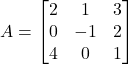
Find:
Solution:
Step 1: Compute the three positive (downward) diagonals.
![\[(2)(-1)(1) + (1)(2)(4) + (3)(0)(0) = -2 + 8 + 0 = 6\]](https://pinoybix.org/wp-content/ql-cache/quicklatex.com-ac79bf7e8be447ea3edd9f02c50c11f3_l3.png "Rendered by QuickLaTeX.com")
Step 2: Compute the three negative (upward) diagonals.
![\[(3)(-1)(4) + (2)(2)(0) + (1)(0)(1) = -12 + 0 + 0 = -12\]](https://pinoybix.org/wp-content/ql-cache/quicklatex.com-7cbf2004a89bb949748972c88f10413c_l3.png "Rendered by QuickLaTeX.com")
Step 3: Subtract.
![\[\det A = 6 - (-12) = 18\]](https://pinoybix.org/wp-content/ql-cache/quicklatex.com-0de4794f5204fb615cf9331082acb50b_l3.png "Rendered by QuickLaTeX.com")

Examiner note: Write out all six diagonal products before combining them. Skipping that step is the most common source of sign errors in Sarrus rule problems.
Problem 4. Evaluate a determinant by cofactor expansion along the zero-heavy column.
Given: 
Find: 
Solution:
Step 1: Column 2 has two zeros. Expand along column 2 to minimize work.
![\[\det B = (0)C_{12} + (0)C_{22} + (7)C_{32}\]](https://pinoybix.org/wp-content/ql-cache/quicklatex.com-650f5547b3662c0156974c8c99cec8f0_l3.png "Rendered by QuickLaTeX.com")
Step 2: Only the  term survives. Compute its cofactor with sign
  .
.
![\[C_{32} = (-1)\det\begin{bmatrix}3&2\\-1&5\end{bmatrix} = (-1)\big[(3)(5)-(2)(-1)\big] = (-1)(17) = -17\]](https://pinoybix.org/wp-content/ql-cache/quicklatex.com-cb105a8dc267457f8a191fb0bd34a6cc_l3.png "Rendered by QuickLaTeX.com")
Step 3: Compute the determinant.
![\[\det B = (7)(-17) = -119\]](https://pinoybix.org/wp-content/ql-cache/quicklatex.com-f4813d18da78e4bedc62dc410df49fb4_l3.png "Rendered by QuickLaTeX.com")

Examiner note: Two zeros in one column reduced this from three separate computations down to one. Scan for zeros before you pick a row or column — on a timed exam, that choice matters.
Problem 5. Apply the determinant product rule.
Given: and 
Find: 
Solution:
Step 1: Apply the product rule directly. There is no need to compute  itself.
![\[\det(AB) = \det(A) \cdot \det(B)\]](https://pinoybix.org/wp-content/ql-cache/quicklatex.com-9ad7370d5ae72ba92428d74299c201a3_l3.png "Rendered by QuickLaTeX.com")
Step 2: Substitute and compute.
![\[\det(AB) = (4)(-3) = -12\]](https://pinoybix.org/wp-content/ql-cache/quicklatex.com-8c9855cfd7392ee22a0e3366fe99cb3b_l3.png "Rendered by QuickLaTeX.com")

Examiner note: Also note that  , even though
  in general. Determinants of products are commutative even when matrix multiplication itself is not.
Problem 6. Find the inverse of a matrix.
Given: 
Find:
Solution:
Step 1: Compute .
![\[\det A = (4)(2) - (3)(3) = 8 - 9 = -1\]](https://pinoybix.org/wp-content/ql-cache/quicklatex.com-4ec54e2eea8c6adc0389b05a9f6dee73_l3.png "Rendered by QuickLaTeX.com")
Step 2: Since , the inverse exists. Swap the main diagonal, negate the off-diagonal.
![\[A^{-1} = \dfrac{1}{-1}\begin{bmatrix} 2 & -3 \\ -3 & 4 \end{bmatrix}\]](https://pinoybix.org/wp-content/ql-cache/quicklatex.com-aa99dd3aab3f79b9788174ce83608dfb_l3.png "Rendered by QuickLaTeX.com")
Step 3: Simplify.
![\[A^{-1} = \begin{bmatrix} -2 & 3 \\ 3 & -4 \end{bmatrix}\]](https://pinoybix.org/wp-content/ql-cache/quicklatex.com-7e91ca10068c301a468e1c664089030f_l3.png "Rendered by QuickLaTeX.com")
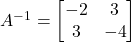
Examiner note: Dividing by  flips every sign. Students who forget this step hand in the adjugate as their final answer and lose the item. Always divide by , even when the determinant is .
Problem 7. Verify the inverse by computing  .
.
Given: , from Problem 6
Find: , confirm it equals
Solution:
Step 1: Multiply entry by entry.
![\[AA^{-1} = \begin{bmatrix}(4)(-2)+(3)(3) & (4)(3)+(3)(-4)\\(3)(-2)+(2)(3) & (3)(3)+(2)(-4)\end{bmatrix}\]](https://pinoybix.org/wp-content/ql-cache/quicklatex.com-8d978db079497b937de417cd3a8768bb_l3.png "Rendered by QuickLaTeX.com")
Step 2: Compute each entry.
![\[= \begin{bmatrix}-8+9 & 12-12\\-6+6 & 9-8\end{bmatrix} = \begin{bmatrix}1&0\\0&1\end{bmatrix} = I\]](https://pinoybix.org/wp-content/ql-cache/quicklatex.com-2496e0197cefaafff4a1a21006091668_l3.png "Rendered by QuickLaTeX.com")
 ✓ Verified.
Examiner note: This check takes 30 seconds and protects you from a sign error that could cost you the entire problem. Board exams rarely give partial credit, so verifying before you write your final answer is always worth the time.
Problem 8. Find the inverse of a matrix using the adjugate method.
Given: 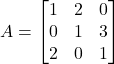
Find:
Solution:
Step 1: Compute by expanding along row 1.
![\[\det A = 1\det\begin{bmatrix}1&3\\0&1\end{bmatrix} - 2\det\begin{bmatrix}0&3\\2&1\end{bmatrix} + 0 = 1(1-0) - 2(0-6) = 1 + 12 = 13\]](https://pinoybix.org/wp-content/ql-cache/quicklatex.com-d39c580fceaa8497100fe009ee4c13a3_l3.png "Rendered by QuickLaTeX.com")
Step 2: Compute all nine cofactors.
![\[C_{11} = 1 \quad C_{12} = 6 \quad C_{13} = -2\]](https://pinoybix.org/wp-content/ql-cache/quicklatex.com-b544b57b7dc122071fd46cf4c68aa2b2_l3.png "Rendered by QuickLaTeX.com")
![\[C_{21} = -2 \quad C_{22} = 1 \quad C_{23} = 4\]](https://pinoybix.org/wp-content/ql-cache/quicklatex.com-1d75d9e18c72dcc8851d6dd3bfae5c14_l3.png "Rendered by QuickLaTeX.com")
![\[C_{31} = 6 \quad C_{32} = -3 \quad C_{33} = 1\]](https://pinoybix.org/wp-content/ql-cache/quicklatex.com-2b4ea23fc8225a3566b402feca8bc641_l3.png "Rendered by QuickLaTeX.com")
Step 3: Transpose the cofactor matrix to get the adjugate.
![\[\text{adj}(A) = \begin{bmatrix}1&-2&6\\6&1&-3\\-2&4&1\end{bmatrix}\]](https://pinoybix.org/wp-content/ql-cache/quicklatex.com-f167797a83c4d02897fb98a0e39d1594_l3.png "Rendered by QuickLaTeX.com")
Step 4: Divide every entry by  .
.
![\[A^{-1} = \dfrac{1}{13}\begin{bmatrix}1&-2&6\\6&1&-3\\-2&4&1\end{bmatrix}\]](https://pinoybix.org/wp-content/ql-cache/quicklatex.com-673e547a286ce7d834e0ed805e052aa4_l3.png "Rendered by QuickLaTeX.com")
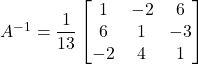
Examiner note: The adjugate is the transpose of the cofactor matrix, not the cofactor matrix itself. Skipping the transpose step gives a completely wrong inverse — write the cofactors in a grid first, then flip across the main diagonal.
Problem 9. Find the inverse of a matrix using Gauss-Jordan elimination.
Given: 
Find: using row operations
Solution:
Step 1: Write the augmented matrix ![[A \mid I]](https://pinoybix.org/wp-content/ql-cache/quicklatex.com-63f4f0a76fdb6e2d6c96049ce23f3c15_l3.png "Rendered by QuickLaTeX.com") .
.
![\[\left[\begin{array}{cc|cc}2&1&1&0\\5&3&0&1\end{array}\right]\]](https://pinoybix.org/wp-content/ql-cache/quicklatex.com-13bf14100a2cff46871e99f013690546_l3.png "Rendered by QuickLaTeX.com")
Step 2: 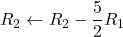 to eliminate the 5 in column 1.
![\[\left[\begin{array}{cc|cc}2&1&1&0\\0&\frac{1}{2}&-\frac{5}{2}&1\end{array}\right]\]](https://pinoybix.org/wp-content/ql-cache/quicklatex.com-1ffa3d87276b13bf0ac3fab86577f98f_l3.png "Rendered by QuickLaTeX.com")
Step 3:  to make the leading entry 1.
![\[\left[\begin{array}{cc|cc}2&1&1&0\\0&1&-5&2\end{array}\right]\]](https://pinoybix.org/wp-content/ql-cache/quicklatex.com-455fd37489962b8a044b1de292c958c5_l3.png "Rendered by QuickLaTeX.com")
Step 4:  , then
  to finish reducing the left side to .
![\[\left[\begin{array}{cc|cc}1&0&3&-1\\0&1&-5&2\end{array}\right]\]](https://pinoybix.org/wp-content/ql-cache/quicklatex.com-43ba412f0a71ee249f29b63cbdde722d_l3.png "Rendered by QuickLaTeX.com")
Step 5: Read the inverse directly from the right side.
![\[A^{-1} = \begin{bmatrix}3&-1\\-5&2\end{bmatrix}\]](https://pinoybix.org/wp-content/ql-cache/quicklatex.com-fa81a1c7439b60740e0ab102e49d1050_l3.png "Rendered by QuickLaTeX.com")
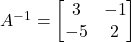
Examiner note: Quick check with the direct formula:  , so
, so 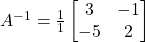 . Matches — Gauss-Jordan and the formula agree, which confirms neither method had an arithmetic slip.
Problem 10. Applied: determinant in circuit analysis.
Given: a two-mesh circuit produces the impedance matrix 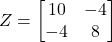 (in ohms)
Find: whether the system has a unique solution for the mesh currents
Solution:
Step 1: Compute  .
.
![\[\det(Z) = (10)(8) - (-4)(-4) = 80 - 16 = 64\]](https://pinoybix.org/wp-content/ql-cache/quicklatex.com-8662f3f1bb0ed7a88555b86661b824c9_l3.png "Rendered by QuickLaTeX.com")
Step 2: Since  , the system has a unique solution.
 — unique solution exists for the mesh currents.
Examiner note: This is exactly how determinants connect to circuit analysis on the ECE and EE board exam. Before solving for mesh currents with Cramer’s rule or the inverse matrix, always compute the determinant of the impedance matrix first. If it comes out zero, either the circuit is genuinely ill-posed or there is an error somewhere in the mesh equations.
Common Mistakes and Examiner Traps
| ❌ Common Mistake | ✅ Correct Approach |
|---|---|
Computing  instead of instead of  for a matrix. for a matrix. |
 . Main diagonal minus cross diagonal. Write the formula before substituting numbers. . Main diagonal minus cross diagonal. Write the formula before substituting numbers. |
| Treating every cofactor as positive, ignoring the sign pattern during expansion. | The sign of is  . Write the checkerboard pattern next to the matrix before you expand. . Write the checkerboard pattern next to the matrix before you expand. |
| Using the cofactor matrix directly as the adjugate, without transposing it first. | The adjugate is the transpose of the cofactor matrix. Compute the cofactors first, then flip the result across the main diagonal. |
Writing  for a or larger matrix. for a or larger matrix. |
. The scalar gets raised to the power  , the size of the matrix — for a , that means , the size of the matrix — for a , that means  , not . , not . |
| Concluding that automatically means the system has no solution. |
means no unique solution. The system could have infinitely many solutions or none at all — which one depends on the constants, not the coefficient matrix alone. |
Writing  without reversing the order. without reversing the order. |
. The order always reverses — the same reversal rule you saw for the transpose of a product in Part 1. |
Board Exam Quick Tips
- Check for zero-determinant conditions before computing anything. Identical rows, proportional rows, or a zero row all guarantee
 . Spotting this takes 5 seconds. Computing a full determinant takes 2 to 3 minutes. Use your time wisely.
 - Expand along the row or column with the most zeros. Each zero eliminates one term entirely. A row or column with two zeros turns a problem into a single computation.
- Check the determinant before you attempt to invert. One second spent computing saves you from wasting two minutes trying to invert a matrix that has no inverse at all.
- Use the inverse formula directly. It is faster than the adjugate method and faster than Gauss-Jordan. Save those two methods for and larger matrices.
- Verify your inverse with a quick check. It takes 30 seconds for a matrix and catches sign errors before you commit to a wrong final answer.
Frequently Asked Questions
Q1. What is the difference between a minor and a cofactor?
A minor is the determinant of the submatrix formed by deleting row and column from the original matrix. A cofactor is the signed minor:  . The sign alternates in a checkerboard pattern starting with
  at position
  . The cofactor is simply the minor with the correct sign already attached.
Q2. Can I use the Sarrus rule for  matrices?
No. The Sarrus rule only works for matrices. For and larger, use cofactor expansion, ideally along whichever row or column has the most zeros. That reduces the problem to a set of determinants, which you can then finish off with Sarrus. Board exam problems rarely go past , but if you see a , cofactor expansion is the method to reach for.
Q3. Why does the adjugate method require transposing the cofactor matrix?
The cofactor sits at position  in the cofactor matrix, but the adjugate needs at position
  instead. That swap is what makes
  produce down the diagonal and zero everywhere else. Skip the transpose and that alignment breaks, giving you a wrong inverse that still looks plausible.
Q4. Which method is faster for finding a inverse on the board exam — adjugate or Gauss-Jordan?
Gauss-Jordan is usually faster under exam conditions, since it is mechanical, row operation by row operation, with fewer opportunities for sign errors than nine separate cofactor calculations. The adjugate method pulls ahead when you already need the cofactors for another part of the same problem, such as computing by expansion first.
Q5. How does the determinant relate to the area of a triangle?
Given three vertices  ,
,  ,
,  , the area works out to:
![\[\text{Area} = \dfrac{1}{2} \left| \begin{vmatrix} x_1 & y_1 & 1 \\ x_2 & y_2 & 1 \\ x_3 & y_3 & 1 \end{vmatrix} \right|\]](https://pinoybix.org/wp-content/ql-cache/quicklatex.com-bb917ea930e26a1baa487a7e18168d7b_l3.png "Rendered by QuickLaTeX.com")
This shows up in CE and GeE board exams under coordinate geometry. The absolute value bars make sure the area comes out positive no matter which order you list the vertices in.
What is Next
You can now evaluate determinants and find inverses using three different methods. Part 3 puts both of those tools to direct use, solving systems of equations with Cramer’s rule and Gaussian elimination — the two techniques tested more often than anything else across all nine Philippine engineering boards.
→ Continue to Part 3 — Systems of Linear Equations
→ Back to the Matrices and Determinants Series Index
Published by PinoyBIX.org — Engineering Education for Every Filipino Student. Electronics · Mathematics · Board Exam Review · Free for Everyone.
Related Content



P inoyBIX educates thousands of reviewers and students a day in preparation for their board examinations. Also provides professionals with materials for their lectures and practice exams. Help me go forward with the same spirit.
“Will you subscribe today via YOUTUBE?”
TIRED OF ADS?
- Become Premium Member and experienced complete ads-free content browsing.
- Full Content Access to Premium Solutions Exclusive for Premium members
- Access to PINOYBIX FREEBIES folder
- Download Reviewers and Learning Materials Free
- Download Content: You can see download/print button at the bottom of each post.
PINOYBIX FREEBIES FOR PREMIUM MEMBERSHIP:
- CIVIL ENGINEERING REVIEWER
- CIVIL SERVICE EXAM REVIEWER
- CRIMINOLOGY REVIEWER
- ELECTRONICS ENGINEERING REVIEWER (ECE/ECT)
- ELECTRICAL ENGINEERING & RME REVIEWER
- FIRE OFFICER EXAMINATION REVIEWER
- LET REVIEWER
- MASTER PLUMBER REVIEWER
- MECHANICAL ENGINEERING REVIEWER
- NAPOLCOM REVIEWER
- Additional upload reviewers and learning materials are also FREE
FOR A LIMITED TIME
If you subscribe for PREMIUM today!
You will receive an additional 1 month of Premium Membership FREE.
For Bronze Membership an additional 2 months of Premium Membership FREE.
For Silver Membership an additional 3 months of Premium Membership FREE.
For Gold Membership an additional 5 months of Premium Membership FREE.
Join the PinoyBIX community.