
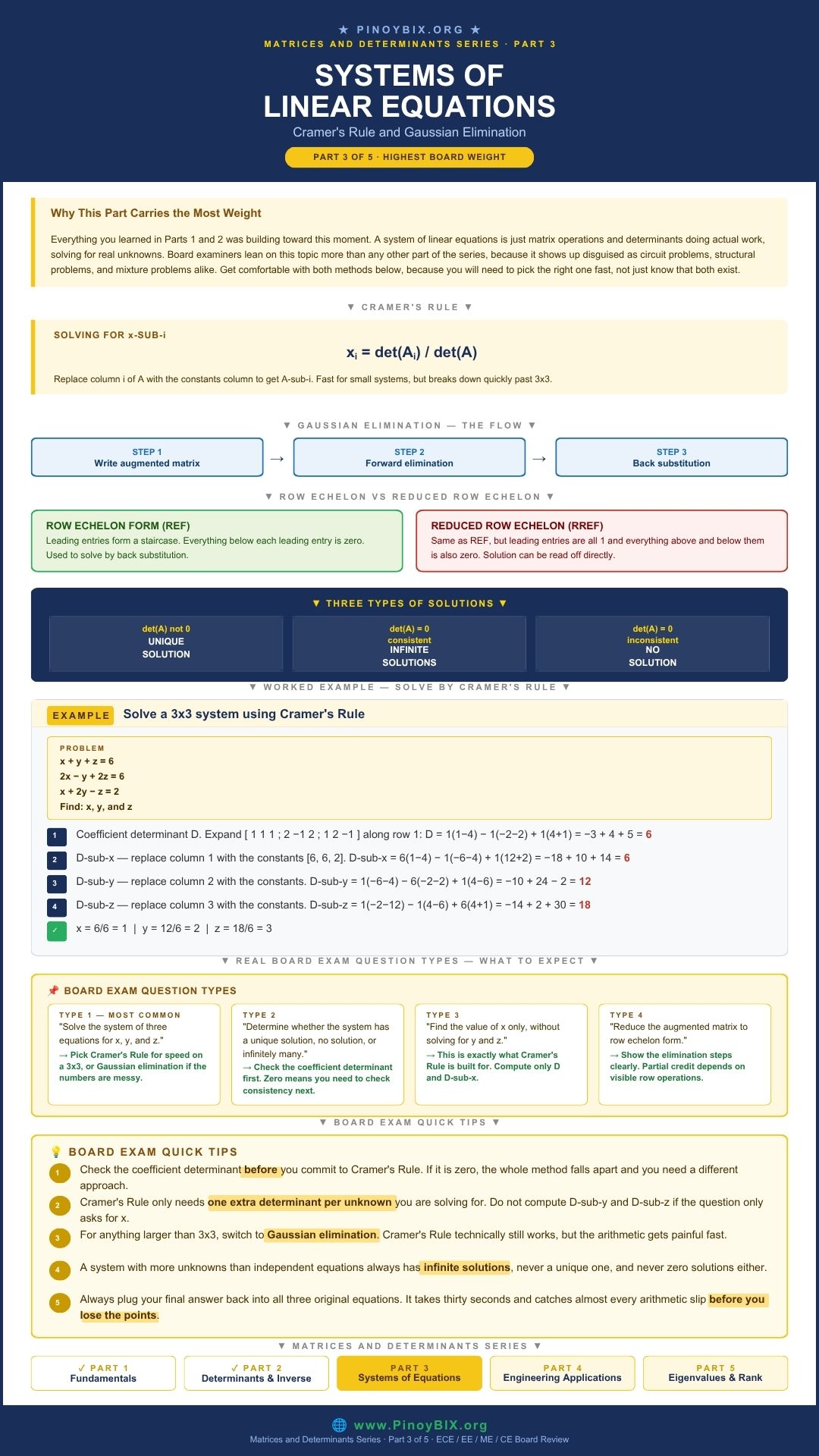
If there is one matrix topic that shows up on every Philippine engineering board exam without fail, it is systems of linear equations. Mesh currents in a three-loop circuit, reactions at the supports of a continuous beam, flow rates in a chemical process stream — they all reduce to the same thing: a set of equations with multiple unknowns that you need to solve simultaneously. This post covers systems of linear equations for the ECE, EE, CE, and ME board exam using Cramer’s rule and Gaussian elimination, with full step-by-step solutions for all 10 problems. This is Part 3 of the Matrices and Determinants Series.
- ECE (Electronics Engineer) — High frequency. Three-loop mesh circuit systems appear almost every testing cycle, solved by Cramer’s rule or Gaussian elimination.
- EE (Electrical Engineer) — Very high frequency. Mesh and nodal analysis reduce directly to
 and
and  systems. This is one of the most heavily tested topics on the EE board.
 - ME (Mechanical Engineer) — High frequency. Static equilibrium problems and thermodynamic cycle analysis both produce simultaneous equations that need matrix methods.
- CE (Civil Engineer) — High frequency. Beam reactions, truss member forces, and retaining wall stability problems are all systems of linear equations in disguise.
- ChE (Chemical Engineer) — Tested in Engineering Mathematics. Material and energy balance problems for multi-stream processes reduce to linear systems.
- GeE (Geodetic Engineer) — Moderate frequency. Coordinate adjustment and least squares problems rely on solving linear systems.
- MetE and MinE — Moderate frequency. Systems of equations appear regularly within Engineering Mathematics.
- Naval Architect and Marine Engineer — Moderate frequency. Load distribution and stability calculations produce linear systems that need solving.
Bottom line: This is not a niche topic for any board — it is one of the highest-frequency problem types across all nine. ECE, EE, CE, and ME examinees in particular should be able to set up and solve a system from a word problem without hesitation, since that skill carries directly into Part 4.
Setting Up the Matrix Equation
Any system of  linear equations with unknowns can be written as a single matrix equation:
![\[Ax = b\]](https://pinoybix.org/wp-content/ql-cache/quicklatex.com-b3c697a0a99d38c81383ae0ddf39d473_l3.png "Rendered by QuickLaTeX.com")
 is the
  coefficient matrix,
  is the column vector of unknowns, and
  is the column vector of constants. Every method in this post starts by writing the system in this form.
The first step for any linear system problem is writing it out properly as  . Students who skip this step and try to work directly from the equations lose their place mid-problem. Write the matrix form, then pick your method.
Method 1 — Cramer’s Rule
Cramer’s rule gives you each unknown directly as a ratio of determinants. It is clean and direct for and systems. Past that it gets slow, and Gaussian elimination takes over.
![\[x_i = \dfrac{\det A_i}{\det A}\]](https://pinoybix.org/wp-content/ql-cache/quicklatex.com-a6456b8e1dc12b188f00e351e82c2813_l3.png "Rendered by QuickLaTeX.com")
 is the matrix formed by replacing column
  of with the constants column . The determinant of the coefficient matrix must be nonzero or Cramer’s rule cannot be applied at all.
Always compute  first. If
  , Cramer’s rule is off the table. The system is either inconsistent or has infinitely many solutions, and you need a different approach to determine which.
Method 2 — Gaussian Elimination
Gaussian elimination is the workhorse method. It works for any size system and tells you not just the solution but also whether the system is consistent, inconsistent, or underdetermined. The process has two phases: forward elimination to reach row echelon form, then back substitution to find the unknowns.
![\[R_i \leftrightarrow R_j \quad \text{(swap two rows)}\]](https://pinoybix.org/wp-content/ql-cache/quicklatex.com-a35a149685d12fa8393f203b5915e214_l3.png "Rendered by QuickLaTeX.com")
![\[kR_i \rightarrow R_i \quad \text{(multiply a row by a nonzero scalar)}\]](https://pinoybix.org/wp-content/ql-cache/quicklatex.com-d9930caef77cd6b5692252307c34d426_l3.png "Rendered by QuickLaTeX.com")
![\[R_i + kR_j \rightarrow R_i \quad \text{(add a multiple of one row to another)}\]](https://pinoybix.org/wp-content/ql-cache/quicklatex.com-8672d2a68738bfd7650b363fab79a8df_l3.png "Rendered by QuickLaTeX.com")
These operations never change the solution set. They only change the appearance of the augmented matrix.
Row Echelon Form vs Reduced Row Echelon Form
Leading entry in each row (called a pivot) is to the right of the pivot in the row above. Everything below each pivot is zero. Use back substitution to read the solution from REF.
REDUCED ROW ECHELON FORM (RREF)
Same as REF, but every pivot is exactly 1 and every entry above and below each pivot is also zero. The solution can be read directly without back substitution. This is the form produced by the Gauss-Jordan method.
Three Types of Solutions
![\[\det A \neq 0 \implies \text{unique solution: } x = A^{-1}b\]](https://pinoybix.org/wp-content/ql-cache/quicklatex.com-a8081a855be341dfbab619c01e1fa196_l3.png "Rendered by QuickLaTeX.com")
![\[\det A = 0, \text{ consistent} \implies \text{infinitely many solutions}\]](https://pinoybix.org/wp-content/ql-cache/quicklatex.com-5b28282ab4e0b00b5edff80c60b752ca_l3.png "Rendered by QuickLaTeX.com")
![\[\det A = 0, \text{ inconsistent} \implies \text{no solution}\]](https://pinoybix.org/wp-content/ql-cache/quicklatex.com-314d62a8feb7c48834af1de906ef0a76_l3.png "Rendered by QuickLaTeX.com")
In the augmented matrix ![[A \mid b]](https://pinoybix.org/wp-content/ql-cache/quicklatex.com-915b65ad60daa479bc5a7da2520c0017_l3.png "Rendered by QuickLaTeX.com") , a row of the form
, a row of the form ![[0\ 0\ \cdots\ 0 \mid c]](https://pinoybix.org/wp-content/ql-cache/quicklatex.com-e583c5fba6075a6d88452f1045cdea10_l3.png "Rendered by QuickLaTeX.com") where
where  means the system is inconsistent. No solution exists.
10 Worked Board Exam Problems
Problem 1. Solve a 2×2 system using Cramer’s rule.
Given:
![\[2x + 3y = 8\]](https://pinoybix.org/wp-content/ql-cache/quicklatex.com-2e380ac338f6fdb2f3f1fc53e8c271dc_l3.png "Rendered by QuickLaTeX.com")
![\[x - y = 1\]](https://pinoybix.org/wp-content/ql-cache/quicklatex.com-c92889cb22dbe0de2b16ee54453b131c_l3.png "Rendered by QuickLaTeX.com")
Find: and  using Cramer’s rule.
Solution:
Step 1: Write the coefficient matrix and constants vector.
![\[A = \begin{bmatrix}2&3\\1&-1\end{bmatrix} \qquad b = \begin{bmatrix}8\\1\end{bmatrix}\]](https://pinoybix.org/wp-content/ql-cache/quicklatex.com-aae4f83b2f366f5c2fa374eec163f0af_l3.png "Rendered by QuickLaTeX.com")
Step 2: Compute .
![\[\det A = (2)(-1) - (3)(1) = -2 - 3 = -5\]](https://pinoybix.org/wp-content/ql-cache/quicklatex.com-cc7c07abd0ac3f9ea40634a8713bd96e_l3.png "Rendered by QuickLaTeX.com")
Step 3: Form  by replacing column 1 with . Compute
  .
.
![\[A_1 = \begin{bmatrix}8&3\\1&-1\end{bmatrix} \implies \det A_1 = (8)(-1)-(3)(1) = -11\]](https://pinoybix.org/wp-content/ql-cache/quicklatex.com-4f2d482dcca5e97a156c15b6188ae965_l3.png "Rendered by QuickLaTeX.com")
Step 4: Form  by replacing column 2 with . Compute
  .
.
![\[A_2 = \begin{bmatrix}2&8\\1&1\end{bmatrix} \implies \det A_2 = (2)(1)-(8)(1) = -6\]](https://pinoybix.org/wp-content/ql-cache/quicklatex.com-cc0e0318769886ff85c1cc671960b9af_l3.png "Rendered by QuickLaTeX.com")
Step 5: Apply Cramer’s rule.
![\[x = \dfrac{\det A_1}{\det A} = \dfrac{-11}{-5} = \dfrac{11}{5} \qquad y = \dfrac{\det A_2}{\det A} = \dfrac{-6}{-5} = \dfrac{6}{5}\]](https://pinoybix.org/wp-content/ql-cache/quicklatex.com-b126e988d4f4d0d3f9509c8e6ce5c719_l3.png "Rendered by QuickLaTeX.com")
 ,
, 
Examiner note: Replace the correct column with . Column 1 gives , column 2 gives . Mixing up which column to replace is the most common Cramer’s rule error on board exams.
Problem 2. Determine if a system has a unique solution before solving.
Given:
![\[3x - 6y = 9\]](https://pinoybix.org/wp-content/ql-cache/quicklatex.com-f726c032c79138516f0d9ffc44325235_l3.png "Rendered by QuickLaTeX.com")
![\[-x + 2y = -3\]](https://pinoybix.org/wp-content/ql-cache/quicklatex.com-25306fffc80f92116f605e4ac499f30b_l3.png "Rendered by QuickLaTeX.com")
Find: Does this system have a unique solution?
Solution:
Step 1: Write the coefficient matrix.
![\[A = \begin{bmatrix}3&-6\\-1&2\end{bmatrix}\]](https://pinoybix.org/wp-content/ql-cache/quicklatex.com-3e3add5ddafa4f9c0dd73b8433ce2ee3_l3.png "Rendered by QuickLaTeX.com")
Step 2: Compute .
![\[\det A = (3)(2) - (-6)(-1) = 6 - 6 = 0\]](https://pinoybix.org/wp-content/ql-cache/quicklatex.com-2630f9f3122d3e9d1a714cdc46256c6b_l3.png "Rendered by QuickLaTeX.com")
Step 3: means no unique solution. Check consistency by examining the equations.
Equation 2 multiplied by  :
:  , which is exactly equation 1. The equations are dependent.
Examiner note: Zero determinant does not automatically mean no solution. It means either infinitely many solutions (dependent equations) or no solution at all (contradictory equations). You have to check which one it is.
Problem 3. Identify an inconsistent system.
Given:
![\[x + 2y = 5\]](https://pinoybix.org/wp-content/ql-cache/quicklatex.com-7359356575d9ed0b5ab1df7fbd621934_l3.png "Rendered by QuickLaTeX.com")
![\[2x + 4y = 7\]](https://pinoybix.org/wp-content/ql-cache/quicklatex.com-360389549d0f0a2ea3dcaea072e8f2dd_l3.png "Rendered by QuickLaTeX.com")
Find: Classify this system.
Solution:
Step 1: Check the coefficient matrix determinant.
![\[A = \begin{bmatrix}1&2\\2&4\end{bmatrix} \implies \det A = (1)(4)-(2)(2) = 0\]](https://pinoybix.org/wp-content/ql-cache/quicklatex.com-3718e82177227ebcd5f52721819d209c_l3.png "Rendered by QuickLaTeX.com")
Step 2: Write the augmented matrix and row reduce.
![\[\left[\begin{array}{cc|c}1&2&5\\2&4&7\end{array}\right] \xrightarrow{R_2 - 2R_1} \left[\begin{array}{cc|c}1&2&5\\0&0&-3\end{array}\right]\]](https://pinoybix.org/wp-content/ql-cache/quicklatex.com-2ae8b25515df2adc82f12db8139b0072_l3.png "Rendered by QuickLaTeX.com")
Step 3: Row 2 reads  . This is a contradiction.
Examiner note: A row of all zeros on the left and a nonzero constant on the right is the exact signature of an inconsistent system. If you see ![[0\ 0 \mid c]](https://pinoybix.org/wp-content/ql-cache/quicklatex.com-5086486d78ca788c2074332d21654c12_l3.png "Rendered by QuickLaTeX.com") where anywhere in your augmented matrix, stop. The system has no solution.
where anywhere in your augmented matrix, stop. The system has no solution.
Problem 4. Solve a 2×2 system using Gaussian elimination.
Given:
![\[3x + 2y = 13\]](https://pinoybix.org/wp-content/ql-cache/quicklatex.com-83df3a13249c1202942746208772b31e_l3.png "Rendered by QuickLaTeX.com")
Find: and .
Solution:
Step 1: Write the augmented matrix.
![\[\left[\begin{array}{cc|c}3&2&13\\1&-1&1\end{array}\right]\]](https://pinoybix.org/wp-content/ql-cache/quicklatex.com-14222b1ac7cbc0bdb6c9c30a472b07ff_l3.png "Rendered by QuickLaTeX.com")
Step 2: Swap  and
and  to put the simpler row on top.
![\[\left[\begin{array}{cc|c}1&-1&1\\3&2&13\end{array}\right]\]](https://pinoybix.org/wp-content/ql-cache/quicklatex.com-bb1aa109476c360a165d96ca511f5113_l3.png "Rendered by QuickLaTeX.com")
Step 3:  .
.
![\[\left[\begin{array}{cc|c}1&-1&1\\0&5&10\end{array}\right]\]](https://pinoybix.org/wp-content/ql-cache/quicklatex.com-b887541294eb314f221d0e8d947711fa_l3.png "Rendered by QuickLaTeX.com")
Step 4:  .
.
![\[\left[\begin{array}{cc|c}1&-1&1\\0&1&2\end{array}\right]\]](https://pinoybix.org/wp-content/ql-cache/quicklatex.com-7ab0b7a43cd59240b7f0295d9786aa0a_l3.png "Rendered by QuickLaTeX.com")
Step 5: Back substitution. From row 2:  . Substitute into row 1.
![\[x - 2 = 1 \implies x = 3\]](https://pinoybix.org/wp-content/ql-cache/quicklatex.com-f17861b17324d15ad670d8a92a55a311_l3.png "Rendered by QuickLaTeX.com")
 ,
,
Examiner note: Swapping rows to get a 1 in the pivot position first is not required, but it avoids fraction arithmetic during elimination. When you have a choice, put the cleanest row on top.
Problem 5. Solve a 3×3 system using Cramer’s rule.
Given:
![\[x + y + z = 6\]](https://pinoybix.org/wp-content/ql-cache/quicklatex.com-6852378a38ca6c8f9d3dbb584ea5c1f9_l3.png "Rendered by QuickLaTeX.com")
![\[2x - y + z = 3\]](https://pinoybix.org/wp-content/ql-cache/quicklatex.com-ce65d0ccdd5eb845afc1bc55c8ce8d55_l3.png "Rendered by QuickLaTeX.com")
![\[x + 2y - z = 2\]](https://pinoybix.org/wp-content/ql-cache/quicklatex.com-73345b9cde6a3dbe7ee2fb661540d035_l3.png "Rendered by QuickLaTeX.com")
Find: , , and  .
.
Solution:
Step 1: Write the coefficient matrix and compute .
![\[A = \begin{bmatrix}1&1&1\\2&-1&1\\1&2&-1\end{bmatrix}\]](https://pinoybix.org/wp-content/ql-cache/quicklatex.com-830c09cda5bfd7b93f698d6cefcd89ce_l3.png "Rendered by QuickLaTeX.com")
Expanding along row 1:
![\[\det A = 1\det\begin{bmatrix}-1&1\\2&-1\end{bmatrix} - 1\det\begin{bmatrix}2&1\\1&-1\end{bmatrix} + 1\det\begin{bmatrix}2&-1\\1&2\end{bmatrix}\]](https://pinoybix.org/wp-content/ql-cache/quicklatex.com-d95cf3c95763d081ce2f179f0566b7a0_l3.png "Rendered by QuickLaTeX.com")
![\[= 1(1-2) - 1(-2-1) + 1(4+1) = -1+3+5 = 7\]](https://pinoybix.org/wp-content/ql-cache/quicklatex.com-47f3066a44cd06cf207596c4445b9f15_l3.png "Rendered by QuickLaTeX.com")
Step 2: Form , replace column 1 with ![b = [6,3,2]^T](https://pinoybix.org/wp-content/ql-cache/quicklatex.com-8b2057ef9713ecd14b62fde1f1eedf51_l3.png "Rendered by QuickLaTeX.com") .
.
![\[A_1 = \begin{bmatrix}6&1&1\\3&-1&1\\2&2&-1\end{bmatrix}\]](https://pinoybix.org/wp-content/ql-cache/quicklatex.com-5b315fb8852b24b3ddb49a2738ba3bdf_l3.png "Rendered by QuickLaTeX.com")
![\[\det A_1 = 6(1-2) - 1(-3-2) + 1(6+2) = -6+5+8 = 7\]](https://pinoybix.org/wp-content/ql-cache/quicklatex.com-05858eff929b8a63b643af11f4bdee32_l3.png "Rendered by QuickLaTeX.com")
Step 3: Form , replace column 2 with .
![\[A_2 = \begin{bmatrix}1&6&1\\2&3&1\\1&2&-1\end{bmatrix}\]](https://pinoybix.org/wp-content/ql-cache/quicklatex.com-953083800d72615b5811ba53c8fca310_l3.png "Rendered by QuickLaTeX.com")
![\[\det A_2 = 1(-3-2) - 6(-2-1) + 1(4-3) = -5+18+1 = 14\]](https://pinoybix.org/wp-content/ql-cache/quicklatex.com-c562e0c9742e294a0bfc87930b71f708_l3.png "Rendered by QuickLaTeX.com")
Step 4: Form  , replace column 3 with .
![\[A_3 = \begin{bmatrix}1&1&6\\2&-1&3\\1&2&2\end{bmatrix}\]](https://pinoybix.org/wp-content/ql-cache/quicklatex.com-0859d4ab53e9496defa0d88cda1b2cfc_l3.png "Rendered by QuickLaTeX.com")
![\[\det A_3 = 1(-2-6) - 1(4-3) + 6(4+1) = -8-1+30 = 21\]](https://pinoybix.org/wp-content/ql-cache/quicklatex.com-a0234072913e243415c9fb379a6f31aa_l3.png "Rendered by QuickLaTeX.com")
Step 5: Apply Cramer’s rule.
![\[x = \dfrac{7}{7} = 1 \qquad y = \dfrac{14}{7} = 2 \qquad z = \dfrac{21}{7} = 3\]](https://pinoybix.org/wp-content/ql-cache/quicklatex.com-fca76cece407c8ff817e0cf9c3b0c185_l3.png "Rendered by QuickLaTeX.com")
 , ,
, , 
Examiner note: Always verify by substituting back:  ✓,
✓,  ✓,
✓,  ✓. A quick back-check on a 3-unknown system takes 20 seconds and catches arithmetic errors before they cost you the full item.
Problem 6. Solve a 3×3 system using Gaussian elimination.
Given:
![\[2x + y - z = 8\]](https://pinoybix.org/wp-content/ql-cache/quicklatex.com-c58072e36701ef07aea6b960f69e272d_l3.png "Rendered by QuickLaTeX.com")
![\[-3x - y + 2z = -11\]](https://pinoybix.org/wp-content/ql-cache/quicklatex.com-cd3309ad06feda570c023c9a3fc4a36d_l3.png "Rendered by QuickLaTeX.com")
![\[-2x + y + 2z = -3\]](https://pinoybix.org/wp-content/ql-cache/quicklatex.com-f9c1b91d494805889202c5cb7c32fda3_l3.png "Rendered by QuickLaTeX.com")
Find: , , and .
Solution:
Step 1: Write the augmented matrix.
![\[\left[\begin{array}{ccc|c}2&1&-1&8\\-3&-1&2&-11\\-2&1&2&-3\end{array}\right]\]](https://pinoybix.org/wp-content/ql-cache/quicklatex.com-8a52445ae7c9da4711ab3976123019b4_l3.png "Rendered by QuickLaTeX.com")
Step 2:  ,
,  .
.
![\[\left[\begin{array}{ccc|c}2&1&-1&8\\0&\frac{1}{2}&\frac{1}{2}&1\\0&2&1&5\end{array}\right]\]](https://pinoybix.org/wp-content/ql-cache/quicklatex.com-e4d73f3632e145adcb659c0e37709efd_l3.png "Rendered by QuickLaTeX.com")
Step 3:  .
.
![\[\left[\begin{array}{ccc|c}2&1&-1&8\\0&\frac{1}{2}&\frac{1}{2}&1\\0&0&-1&1\end{array}\right]\]](https://pinoybix.org/wp-content/ql-cache/quicklatex.com-6e3aacb3ff920874cce6409f44a69333_l3.png "Rendered by QuickLaTeX.com")
Step 4: Back substitution. From row 3:  .
.
Step 5: From row 2:  .
.
Step 6: From row 1:  .
.
 ,
,  ,
, 
Examiner note: Back substitution goes from the bottom row up. Do not jump to row 1 before resolving rows 3 and 2 first. Solving out of order is the most common step sequence error in Gaussian elimination.
Problem 7. Cramer’s rule — truss force analysis.
Given: The forces  and
and  in a two-member truss satisfy:
![\[0.6F_1 + 0.8F_2 = 1000\]](https://pinoybix.org/wp-content/ql-cache/quicklatex.com-e19cfa0782280d8e2aaff8d3dc89b18b_l3.png "Rendered by QuickLaTeX.com")
![\[0.8F_1 - 0.6F_2 = 500\]](https://pinoybix.org/wp-content/ql-cache/quicklatex.com-4959779fa50ef55767996e4cf9cfb33b_l3.png "Rendered by QuickLaTeX.com")
Find: and in Newtons.
Solution:
Step 1: Write the coefficient matrix and compute .
![\[A = \begin{bmatrix} 0.6 & 0.8 \\ 0.8 & -0.6 \end{bmatrix}\]](https://pinoybix.org/wp-content/ql-cache/quicklatex.com-d8f6bb67999d97136bd17d9874d33fbe_l3.png "Rendered by QuickLaTeX.com")
![\[\det(A) = (0.6)(-0.6) - (0.8)(0.8) = -0.36 - 0.64 = -1\]](https://pinoybix.org/wp-content/ql-cache/quicklatex.com-5b30f88797bb747b26bf69cbb63c39e5_l3.png "Rendered by QuickLaTeX.com")
Step 2: Form by replacing column 1 with the constants. Compute .
![\[A_1 = \begin{bmatrix} 1000 & 0.8 \\ 500 & -0.6 \end{bmatrix} \implies \det(A_1) = (1000)(-0.6) - (0.8)(500) = -600 - 400 = -1000\]](https://pinoybix.org/wp-content/ql-cache/quicklatex.com-8e277d51b4dd05bcc6875611d18d52f2_l3.png "Rendered by QuickLaTeX.com")
Step 3: Form by replacing column 2 with the constants. Compute .
![\[A_2 = \begin{bmatrix} 0.6 & 1000 \\ 0.8 & 500 \end{bmatrix} \implies \det(A_2) = (0.6)(500) - (1000)(0.8) = 300 - 800 = -500\]](https://pinoybix.org/wp-content/ql-cache/quicklatex.com-bfd383ada624383d152120f848519f11_l3.png "Rendered by QuickLaTeX.com")
Step 4: Apply Cramer’s rule.
![\[F_1 = \dfrac{-1000}{-1} = 1000\,\text{N} \qquad F_2 = \dfrac{-500}{-1} = 500\,\text{N}\]](https://pinoybix.org/wp-content/ql-cache/quicklatex.com-321276d828de9e108e07075efa11c73f_l3.png "Rendered by QuickLaTeX.com")
 N,
N,  N
N
Examiner note: The coefficients  and
and  are
are  and
and  — the 3-4-5 triangle again. Recognizing Pythagorean triples in the coefficients (
 ) tells you the matrix rows are orthogonal, which guarantees
  . This shortcut is common in CE and ME truss problems, where member angles are frequently 30°, 37°, 45°, 53°, or 60°.
Problem 8. Reduce a system to RREF and read the solution directly.
Given:
![\[x + 2y + z = 9\]](https://pinoybix.org/wp-content/ql-cache/quicklatex.com-447e960f4a2c3a9f4565cab381aeda6f_l3.png "Rendered by QuickLaTeX.com")
![\[2x + 5y + 2z = 19\]](https://pinoybix.org/wp-content/ql-cache/quicklatex.com-55ec740a4d123e802f41a92fb4f51cb9_l3.png "Rendered by QuickLaTeX.com")
![\[3x + y + 4z = 22\]](https://pinoybix.org/wp-content/ql-cache/quicklatex.com-625d1f6aa900b80b5853a9bb8d10eeb4_l3.png "Rendered by QuickLaTeX.com")
Find: Solve by reducing to RREF.
Solution:
Step 1: Write the augmented matrix.
![\[\left[\begin{array}{ccc|c}1&2&1&9\\2&5&2&19\\3&1&4&22\end{array}\right]\]](https://pinoybix.org/wp-content/ql-cache/quicklatex.com-d01d6df8ee2a8eea34a88ff72ee36319_l3.png "Rendered by QuickLaTeX.com")
Step 2:  ,
,  .
.
![\[\left[\begin{array}{ccc|c}1&2&1&9\\0&1&0&1\\0&-5&1&-5\end{array}\right]\]](https://pinoybix.org/wp-content/ql-cache/quicklatex.com-b3074b43edd481256ee766c9fbf27205_l3.png "Rendered by QuickLaTeX.com")
Step 3:  .
.
![\[\left[\begin{array}{ccc|c}1&2&1&9\\0&1&0&1\\0&0&1&0\end{array}\right]\]](https://pinoybix.org/wp-content/ql-cache/quicklatex.com-d229a214c100b5588ab38dafcb76d071_l3.png "Rendered by QuickLaTeX.com")
Step 4: Continue to RREF.  , then
  .
.
![\[\left[\begin{array}{ccc|c}1&0&0&7\\0&1&0&1\\0&0&1&0\end{array}\right]\]](https://pinoybix.org/wp-content/ql-cache/quicklatex.com-dc73ef104e349fc0c19e3b717440822e_l3.png "Rendered by QuickLaTeX.com")
Step 5: Read directly from RREF:  ,
,  ,
,  .
.
, ,
Examiner note: RREF gives you the solution by inspection — no back substitution needed. The extra steps to go from REF to RREF take slightly more time, but they eliminate the chance of a back substitution arithmetic error, which is a fair trade on a high-stakes exam.
Problem 9. Solve a circuit mesh analysis system.
Given: A two-mesh circuit produces the following equations where  and
and  are mesh currents in amperes:
![\[5I_1 - 2I_2 = 12\]](https://pinoybix.org/wp-content/ql-cache/quicklatex.com-b171d50f478c496c889d50f31426e54a_l3.png "Rendered by QuickLaTeX.com")
![\[-2I_1 + 7I_2 = 8\]](https://pinoybix.org/wp-content/ql-cache/quicklatex.com-f887e0430c50e39bd216a79e1cec8c56_l3.png "Rendered by QuickLaTeX.com")
Find: and using Cramer’s rule.
Solution:
Step 1: Identify and .
![\[A = \begin{bmatrix}5&-2\\-2&7\end{bmatrix} \qquad b = \begin{bmatrix}12\\8\end{bmatrix}\]](https://pinoybix.org/wp-content/ql-cache/quicklatex.com-24c189756afdd59a1c382b7844dd5714_l3.png "Rendered by QuickLaTeX.com")
Step 2: Compute .
![\[\det A = (5)(7)-(-2)(-2) = 35-4 = 31\]](https://pinoybix.org/wp-content/ql-cache/quicklatex.com-b1e39733d3ee2b800811da560c69bb57_l3.png "Rendered by QuickLaTeX.com")
Step 3: Compute and .
![\[\det A_1 = \det\begin{bmatrix}12&-2\\8&7\end{bmatrix} = 84+16 = 100\]](https://pinoybix.org/wp-content/ql-cache/quicklatex.com-7075eafc02a2910f6a4d16af28789bf0_l3.png "Rendered by QuickLaTeX.com")
![\[\det A_2 = \det\begin{bmatrix}5&12\\-2&8\end{bmatrix} = 40+24 = 64\]](https://pinoybix.org/wp-content/ql-cache/quicklatex.com-a7bb11844a0c921dcb17b761b4172250_l3.png "Rendered by QuickLaTeX.com")
Step 4: Apply Cramer’s rule.
![\[I_1 = \dfrac{100}{31} \approx 3.23\,\text{A} \qquad I_2 = \dfrac{64}{31} \approx 2.06\,\text{A}\]](https://pinoybix.org/wp-content/ql-cache/quicklatex.com-ebed1ba8193d275883711fb3f283fae3_l3.png "Rendered by QuickLaTeX.com")
 A,
A,  A
A
Examiner note: Circuit mesh equations always follow the same pattern — positive self-impedance on the diagonal, negative mutual terms off the diagonal. Once you recognize that structure, writing the coefficient matrix takes about 10 seconds.
Problem 10. Determine the solution type without fully solving.
Given:
![\[2x - y + 3z = 5\]](https://pinoybix.org/wp-content/ql-cache/quicklatex.com-e8899515a04a45753c1fa7f4e1de59f3_l3.png "Rendered by QuickLaTeX.com")
![\[4x - 2y + 6z = 10\]](https://pinoybix.org/wp-content/ql-cache/quicklatex.com-0c06a4b63757beebc826454f34b08ed1_l3.png "Rendered by QuickLaTeX.com")
![\[6x - 3y + 9z = 15\]](https://pinoybix.org/wp-content/ql-cache/quicklatex.com-0793d92835fbef66d752aafc02b6f80e_l3.png "Rendered by QuickLaTeX.com")
Find: Classify the system without solving.
Solution:
Step 1: Write the coefficient matrix.
![\[A = \begin{bmatrix}2&-1&3\\4&-2&6\\6&-3&9\end{bmatrix}\]](https://pinoybix.org/wp-content/ql-cache/quicklatex.com-50d5b90cb53d4fad01ad677d42c95fa3_l3.png "Rendered by QuickLaTeX.com")
Step 2: Notice that row 2 is exactly  row 1, and row 3 is exactly
  row 1. All three equations are scalar multiples of the first equation.
Step 3: Row reduce the augmented matrix.
![\[\left[\begin{array}{ccc|c}2&-1&3&5\\4&-2&6&10\\6&-3&9&15\end{array}\right] \xrightarrow{R_2-2R_1,\, R_3-3R_1} \left[\begin{array}{ccc|c}2&-1&3&5\\0&0&0&0\\0&0&0&0\end{array}\right]\]](https://pinoybix.org/wp-content/ql-cache/quicklatex.com-d054f2f56529b058edf5222508c880bf_l3.png "Rendered by QuickLaTeX.com")
Step 4: Two zero rows with zero constants — consistent but underdetermined. The system has infinitely many solutions.
Examiner note: When all equations reduce to multiples of one another, the system is consistent but has free variables. In this case, and are free variables and can be expressed in terms of them. Board exams test this as a classification item — you rarely need to write out the full parametric solution.
Common Mistakes and Examiner Traps
| ❌ Common Mistake | ✅ Correct Approach |
|---|---|
| Applying Cramer’s rule when |
Check first. Cramer’s rule only applies when  . A zero determinant means the rule breaks down entirely. . A zero determinant means the rule breaks down entirely. |
| Replacing the wrong column when building for Cramer’s rule |
To solve for  , replace column of with the constants column . Column 1 for , replace column of with the constants column . Column 1 for  , column 2 for , column 2 for  , and so on. , and so on. |
| Concluding no solution exists whenever |
means either infinitely many solutions or no solution. Row reduce the augmented matrix to determine which case applies. |
| Performing back substitution from the top row down instead of from the bottom row up | Back substitution always starts at the last row and works upward. The last row gives the last variable directly; substitute it into the row above to get the next variable. |
| Forgetting to apply the same row operation to both the coefficient side and the constants column of the augmented matrix | Any row operation applied to the left side must be applied to the full augmented row, including the constant on the right. Always work with the augmented matrix, not just the coefficient side. |
| Seeing a row of all zeros in the augmented matrix and immediately calling the system inconsistent | A row of all zeros means that equation is redundant, not contradictory. Inconsistency only occurs when the left side is all zeros but the right side constant is nonzero: ![[0\ 0\ \cdots\ 0 \mid c \neq 0]](https://pinoybix.org/wp-content/ql-cache/quicklatex.com-d520eb8193b071d97838456bd2010249_l3.png "Rendered by QuickLaTeX.com") . . |
Board Exam Quick Tips
- Compute before doing anything else. It takes five seconds for a 2×2 and about a minute for a 3×3. It immediately tells you whether a unique solution exists and whether Cramer’s rule is usable.
- Use Cramer’s rule for 2×2 and 3×3, Gaussian elimination for larger. Cramer’s rule is clean and fast for small systems. For four unknowns or more, the determinant computations pile up and elimination is faster and less error-prone.
- Write the augmented matrix immediately. Do not try to track row operations on the original equations. The augmented matrix keeps everything organized and reduces transcription errors by half.
- A row of zeros on both sides means a redundant equation, not a contradiction. A row
![[0\ 0\ \mid\ 0]](https://pinoybix.org/wp-content/ql-cache/quicklatex.com-9e66a3b8ac5f46436502527de5cb0d99_l3.png "Rendered by QuickLaTeX.com") means you have a free variable and infinitely many solutions. Only
means you have a free variable and infinitely many solutions. Only ![[0\ 0\ \mid\ c \neq 0]](https://pinoybix.org/wp-content/ql-cache/quicklatex.com-5e05cdfe7c885f8be074021067dfe342_l3.png "Rendered by QuickLaTeX.com") means no solution.
means no solution. - Always back-check your solution. Substitute your answers into all original equations. On a 3×3 system this takes about 30 seconds and confirms whether your elimination was clean. If one equation fails, you know exactly where to look.
Frequently Asked Questions
Q1. When should I use Cramer’s rule versus Gaussian elimination?
Use Cramer’s rule when the system is 2×2 or 3×3, you need only one or two of the unknowns, or the problem specifically tests determinant computation. Use Gaussian elimination when the system is larger than 3×3, when you need all unknowns, or when the determinant is zero and you need to classify the solution type. Both methods give identical answers for consistent systems with unique solutions.
Q2. What happens if two equations in a system are identical?
Identical equations make the coefficient matrix singular, so . The system becomes underdetermined — you have fewer independent equations than unknowns. The result is infinitely many solutions with at least one free variable. Row reduction will show one or more zero rows, confirming the dependency.
Q3. How do you know how many free variables a system has?
After row reduction, count the number of pivot columns (columns with a leading entry). Free variables equal the number of unknowns minus the number of pivots. A system with only two pivots has one free variable and therefore infinitely many solutions.
Q4. Can Gaussian elimination handle inconsistent systems?
Yes, and this is one of its advantages over Cramer’s rule. Gaussian elimination will produce a row of the form where when the system is inconsistent. Cramer’s rule cannot detect inconsistency directly — it just fails when and leaves you without information about which failure case you are in.
Q5. Is the matrix inverse method the same as Gaussian elimination?
Not exactly. The inverse method solves  by computing the full inverse first, then multiplying. Gauss-Jordan elimination computes the inverse and applies it in one pass by augmenting with
  . Both give the same result, but Gauss-Jordan is generally more efficient because it does not require storing the intermediate inverse matrix separately before multiplying. If you need a refresher on finding
  itself, that is covered in full in Part 2.
What is Next
You have now covered the core computation toolkit: matrix operations from Part 1, determinants and inverses from Part 2, and linear systems from Part 3. In Part 4, all three of those tools get applied to the actual problems you will see on the board exam — circuit mesh and nodal analysis reduced to matrix equations, structural stiffness systems, and network flow problems. That is where the theory becomes exam points.
→ Continue to Part 4 — Engineering Applications
→ Back to the Matrices and Determinants Series Index
Published by PinoyBIX.org — Engineering Education for Every Filipino Student. Electronics · Mathematics · Board Exam Review · Free for Everyone.
Related Content




P inoyBIX educates thousands of reviewers and students a day in preparation for their board examinations. Also provides professionals with materials for their lectures and practice exams. Help me go forward with the same spirit.
“Will you subscribe today via YOUTUBE?”
TIRED OF ADS?
- Become Premium Member and experienced complete ads-free content browsing.
- Full Content Access to Premium Solutions Exclusive for Premium members
- Access to PINOYBIX FREEBIES folder
- Download Reviewers and Learning Materials Free
- Download Content: You can see download/print button at the bottom of each post.
PINOYBIX FREEBIES FOR PREMIUM MEMBERSHIP:
- CIVIL ENGINEERING REVIEWER
- CIVIL SERVICE EXAM REVIEWER
- CRIMINOLOGY REVIEWER
- ELECTRONICS ENGINEERING REVIEWER (ECE/ECT)
- ELECTRICAL ENGINEERING & RME REVIEWER
- FIRE OFFICER EXAMINATION REVIEWER
- LET REVIEWER
- MASTER PLUMBER REVIEWER
- MECHANICAL ENGINEERING REVIEWER
- NAPOLCOM REVIEWER
- Additional upload reviewers and learning materials are also FREE
FOR A LIMITED TIME
If you subscribe for PREMIUM today!
You will receive an additional 1 month of Premium Membership FREE.
For Bronze Membership an additional 2 months of Premium Membership FREE.
For Silver Membership an additional 3 months of Premium Membership FREE.
For Gold Membership an additional 5 months of Premium Membership FREE.
Join the PinoyBIX community.