
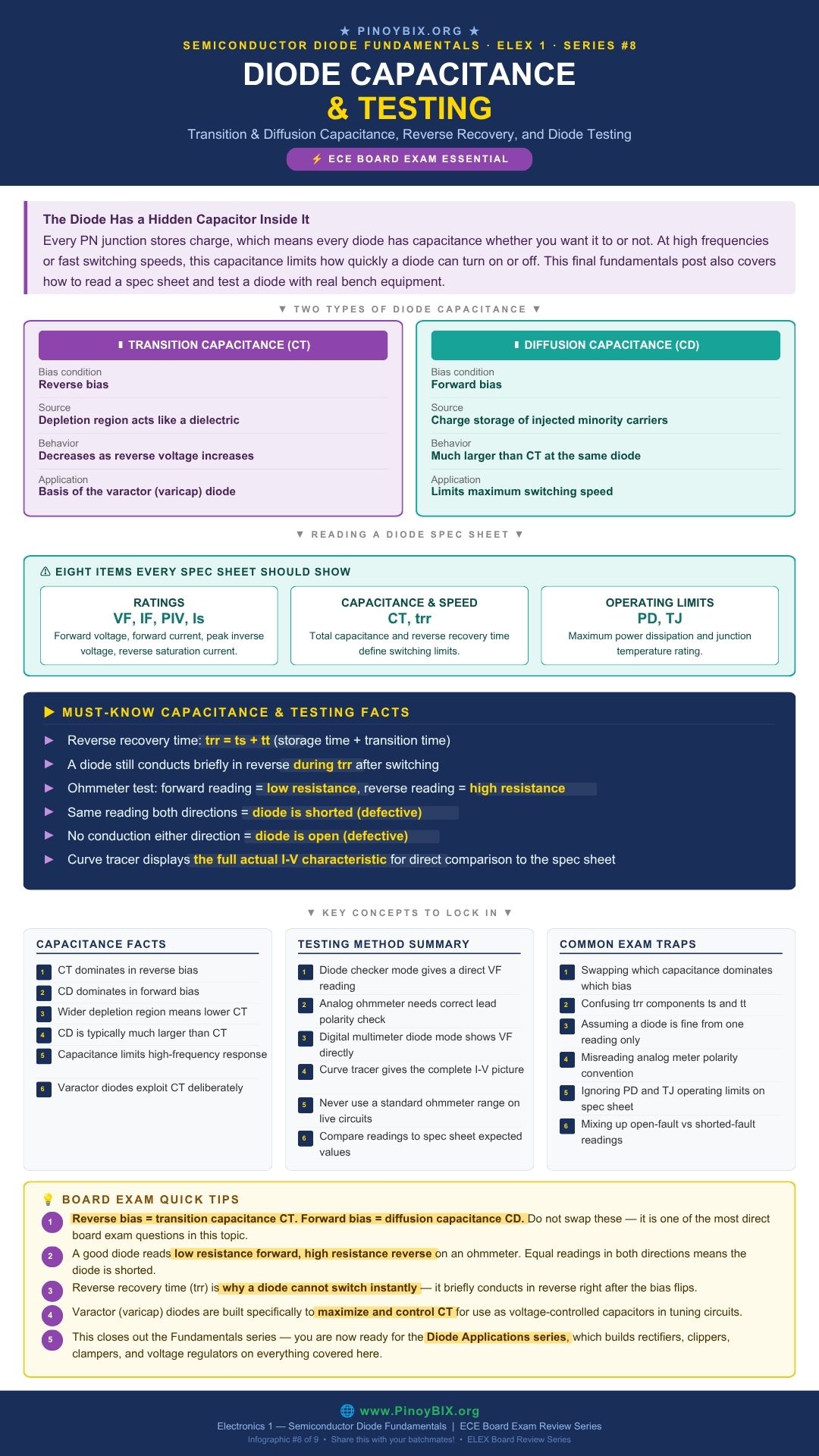
Every PN junction stores charge, which means every diode has capacitance whether you want it to or not. At high frequencies or fast switching speeds, this hidden capacitance limits how quickly a diode can turn on or off. This final post in the series covers diode capacitance, reverse recovery time, how to read a manufacturer’s spec sheet, and how to test a diode with real bench equipment.
This is Part 8, the final post, of the Semiconductor Diode Fundamentals ECE Board Exam Reviewer Series on PinoyBIX.org. Part 7 covered diode equivalent circuits and approximation levels. Once you finish this post, you will have completed the full foundation needed for the Diode Applications series. If you are reviewing for the ECE or EE board exam or currently enrolled in Electronics 1, save this page.
- ECE (Electronics Engineer) — Transition versus diffusion capacitance, reverse recovery time, spec sheet interpretation, and diode testing methods appear regularly in Electronic Devices and Circuits items. Expect 2 to 4 items testing capacitance-bias pairing and fault diagnosis from ohmmeter readings.
- EE (Electrical Engineer) — Appears with lower frequency, mostly limited to basic diode testing and fault identification concepts.
Bottom line: ECE examinees must know which capacitance dominates in which bias condition and how to interpret basic testing results. EE examinees need practical fault diagnosis skills.
Transition Capacitance (CT): Reverse Bias
Under reverse bias, the depletion region acts like the dielectric of a capacitor, with the p-type and n-type regions acting as the two plates. This is called transition capacitance,  . As reverse voltage increases, the depletion region widens, which decreases — a wider dielectric gap always means lower capacitance.
Dominant under reverse bias. Decreases as reverse voltage increases. This behavior is deliberately exploited in varactor (varicap) diodes, used as voltage-controlled capacitors in tuning circuits.
Diffusion Capacitance (CD): Forward Bias
Under forward bias, injected minority carriers are stored near the junction before they recombine. This stored charge creates diffusion capacitance,  , which is typically much larger than transition capacitance in the same diode.
Dominant under forward bias. Much larger than at the same diode. Limits how quickly a forward biased diode can switch off, since this stored charge must first be removed.
Reverse Recovery Time (trr)
A diode cannot switch instantly from forward conduction to reverse blocking. When the bias direction flips, the diode briefly continues conducting in reverse while the stored charge from diffusion capacitance clears out. This delay is called reverse recovery time,  .
.
![\[t_{rr} = t_s + t_t\]](https://pinoybix.org/wp-content/ql-cache/quicklatex.com-7d4a8eb1ebf38c20b299964958011659_l3.png "Rendered by QuickLaTeX.com")
Where  is storage time (time for stored minority carriers to be removed) and
  is transition time (time for the diode to fully reach its blocking state).
Reading a Diode Spec Sheet
A typical manufacturer spec sheet lists several rating categories that summarize everything covered across this series.
Ratings:  ,
,  , PIV,
  — forward voltage, forward current, peak inverse voltage, reverse saturation current.
Capacitance and speed: , — total capacitance and reverse recovery time define switching limits.
Operating limits:  ,
,  — maximum power dissipation and junction temperature rating.
Diode Testing Methods
A good diode reads low resistance in the forward direction and high resistance in the reverse direction on an ohmmeter or a multimeter’s diode-check mode. Equal readings in both directions usually indicate a shorted diode. No conduction in either direction usually indicates an open diode. A curve tracer goes further, displaying the diode’s complete actual I-V characteristic for direct comparison against spec sheet values.
Worked Problems — Board Exam Type Questions
The following 10 problems are representative of actual ECE and EE board exam questions on diode capacitance, switching time, and testing. Work each problem by hand before reading the solution.
Problem 1 — ECE Board Exam Type
A diode is under reverse bias. Which capacitance dominates: transition or diffusion?
Given: Reverse bias condition
Find: Dominant capacitance type
Solution:
Step 1: Under reverse bias, the depletion region widens and acts as a capacitor dielectric.
Step 2: This is the definition of transition capacitance.
Examiner note: Reverse bias pairs with CT, forward bias pairs with CD — do not swap these.
Problem 2 — ECE Board Exam Type
A diode is under forward bias. Which capacitance dominates: transition or diffusion?
Given: Forward bias condition
Find: Dominant capacitance type
Solution:
Step 1: Under forward bias, injected minority carriers accumulate near the junction before recombining.
Step 2: This stored charge is the definition of diffusion capacitance.
Examiner note: This is one of the most direct board exam questions in this entire topic — a simple bias-to-capacitance pairing.
Problem 3 — ECE Board Exam Type
A diode has  ns and
  ns. Find the reverse recovery time.
Given: ns, ns
Find:
Solution:
Step 1: Apply the reverse recovery time formula.
![\[t_{rr} = t_s + t_t = 4 + 2 = 6\text{ ns}\]](https://pinoybix.org/wp-content/ql-cache/quicklatex.com-c2ba656865ee12eb66649e61287a3df8_l3.png "Rendered by QuickLaTeX.com")
 ns
ns
Examiner note: A smaller means a faster-switching diode, which matters directly in high-frequency rectifier and switching applications.
Problem 4 — ECE Board Exam Type
A technician measures a diode with an ohmmeter and gets a low resistance reading in both directions. What is the likely fault?
Given: Equal low resistance readings in both directions
Find: Likely fault
Solution:
Step 1: A good diode should show low resistance forward and high resistance reverse.
Step 2: Equal low readings in both directions indicate the junction is shorted.
Examiner note: A shorted diode conducts in both directions, defeating its one-way conduction purpose entirely.
Problem 5 — ECE Board Exam Type
A technician measures a diode with an ohmmeter and gets no conduction (infinite resistance) in both directions. What is the likely fault?
Given: No conduction in either direction
Find: Likely fault
Solution:
Step 1: A good diode should conduct in the forward direction.
Step 2: No conduction in either direction indicates a broken internal connection — the diode is open.
Examiner note: Open and shorted are the two classic diode failure modes tested on the board exam — know both readings and both conclusions.
Problem 6 — ECE Board Exam Type
An engineer needs a diode for a high-frequency switching application requiring minimal delay when the bias direction reverses. Which spec sheet parameter is most relevant?
Given: High-frequency switching requirement
Find: Most relevant spec sheet parameter
Solution:
Step 1: Switching speed is limited primarily by how quickly stored charge clears when bias reverses.
Step 2: This is directly described by the reverse recovery time, .
Examiner note: A lower rating should be prioritized when selecting a diode for fast-switching or high-frequency circuits.
Problem 7 — ECE Board Exam Type
A varactor (varicap) diode is used as a voltage-controlled capacitor in a tuning circuit. Which capacitance type is being exploited, and under which bias condition?
Given: Varactor diode application
Find: Capacitance type and bias condition
Solution:
Step 1: Varactor diodes are designed to maximize and control the depletion-region capacitance.
Step 2: This is transition capacitance, operating under reverse bias.
Examiner note: This is a direct, practical application question tying the abstract capacitance concept to a real device you may encounter elsewhere in your coursework.
Problem 8 — ECE Board Exam Type
As reverse voltage across a diode increases, what happens to , and how does this affect high-frequency response?
Given: Increasing reverse voltage
Find: Effect on and high-frequency response
Solution:
Step 1: Increasing reverse voltage widens the depletion region, which decreases .
Step 2: A lower capacitance generally improves high-frequency response, since capacitive reactance decreases circuit responsiveness at high frequency when capacitance is large.
Examiner note: This inverse relationship between reverse voltage and CT is exactly what makes varactor diodes tunable — adjusting the bias voltage adjusts the capacitance.
Problem 9 — ECE Board Exam Type
What advantage does a curve tracer offer over a simple ohmmeter check when testing a diode?
Given: Comparison of testing methods
Find: Advantage of curve tracer
Solution:
Step 1: An ohmmeter only gives a simple high or low resistance reading in each direction.
Step 2: A curve tracer displays the diode’s complete I-V characteristic, allowing direct comparison to spec sheet values across the full operating range.
Examiner note: Curve tracers are used in more detailed diagnostic or quality-control settings, while ohmmeter checks are faster for basic field troubleshooting.
Problem 10 — EE Board Exam Type
An EE board item describes a diode that tests as open on an ohmmeter. What practical conclusion should the engineer draw?
Given: Diode tests as open
Find: Practical conclusion
Solution:
Step 1: An open diode conducts in neither direction, meaning it cannot perform its intended rectifying or switching function.
Step 2: The diode is defective and must be replaced before the circuit can function correctly.
Examiner note: EE-level items on this topic usually test practical troubleshooting conclusions rather than the deeper physics of capacitance behavior.
Common Mistakes and Examiner Traps
| ❌ Mistake | ✅ Correction |
|---|---|
| Swapping which capacitance dominates which bias condition | Reverse bias pairs with CT; forward bias pairs with CD — this bias-to-capacitance pairing is the most direct board exam question in this topic. |
| Confusing the two components of trr | Storage time (ts) plus transition time (tt) equals trr — keep the two components distinct when a problem asks for either one individually. |
| Assuming a diode is fine from one ohmmeter reading only | Always check both directions — a single reading cannot distinguish a good diode from a shorted or open one. |
| Misreading analog meter polarity convention | Confirm which lead is positive on your specific meter before interpreting forward versus reverse readings, since this varies by meter type. |
| Ignoring PD and TJ operating limits on a spec sheet | Check power dissipation and junction temperature ratings in addition to voltage and current ratings when selecting a diode for a design. |
Board Exam Quick Tips
- Reverse bias equals transition capacitance CT. Forward bias equals diffusion capacitance CD. Do not swap these — it is one of the most direct board exam questions in this topic.
- A good diode reads low resistance forward, high resistance reverse on an ohmmeter. Equal readings in both directions means the diode is shorted.
- Reverse recovery time (trr) is why a diode cannot switch instantly — it briefly conducts in reverse right after the bias flips.
- Varactor (varicap) diodes are built specifically to maximize and control CT for use as voltage-controlled capacitors in tuning circuits.
- This closes out the Fundamentals series — you are now ready for the Diode Applications series, which builds rectifiers, clippers, clampers, and voltage regulators on everything covered here.
Frequently Asked Questions
Q1. Why does a diode have capacitance at all if it is not built as a capacitor?
Any structure that separates charge across a gap behaves like a capacitor to some degree. The depletion region under reverse bias and the stored minority carriers under forward bias both create this effect naturally as byproducts of normal PN junction behavior.
Q2. Is diffusion capacitance always larger than transition capacitance?
In the same diode, yes, typically. Diffusion capacitance depends on the much larger population of injected minority carriers under forward bias, compared to the smaller charge separation across the depletion region under reverse bias.
Q3. Can reverse recovery time be reduced through diode design?
Yes. Certain diode types, such as fast-recovery and Schottky diodes, are specifically engineered to minimize stored charge and therefore reduce trr for high-speed switching applications.
Q4. What should an engineer do if a curve tracer is not available for testing?
A basic ohmmeter or multimeter diode-check mode is sufficient for confirming general forward and reverse behavior and identifying obvious open or shorted faults, even without the detailed I-V picture a curve tracer provides.
Q5. What comes after finishing this Fundamentals series?
The Diode Applications series builds directly on everything covered across these eight posts, starting with rectifier circuits and continuing through clippers, clampers, Zener voltage regulators, and voltage multipliers.
What Is Next
This completes the Semiconductor Diode Fundamentals series. Every concept from the ideal diode model through capacitance and testing now supports the circuit-level analysis covered in the Diode Applications series, starting with rectification.
→ Continue to the Diode Applications Series — Part 1: Rectification
→ Back to the Semiconductor Diode Fundamentals Series Index
Published by PinoyBIX.org — Engineering Education for Every Filipino Student. Electronics · Mathematics · Board Exam Review · Free for Everyone.
Related Content

P inoyBIX educates thousands of reviewers and students a day in preparation for their board examinations. Also provides professionals with materials for their lectures and practice exams. Help me go forward with the same spirit.
“Will you subscribe today via YOUTUBE?”
TIRED OF ADS?
- Become Premium Member and experienced complete ads-free content browsing.
- Full Content Access to Premium Solutions Exclusive for Premium members
- Access to PINOYBIX FREEBIES folder
- Download Reviewers and Learning Materials Free
- Download Content: You can see download/print button at the bottom of each post.
PINOYBIX FREEBIES FOR PREMIUM MEMBERSHIP:
- CIVIL ENGINEERING REVIEWER
- CIVIL SERVICE EXAM REVIEWER
- CRIMINOLOGY REVIEWER
- ELECTRONICS ENGINEERING REVIEWER (ECE/ECT)
- ELECTRICAL ENGINEERING & RME REVIEWER
- FIRE OFFICER EXAMINATION REVIEWER
- LET REVIEWER
- MASTER PLUMBER REVIEWER
- MECHANICAL ENGINEERING REVIEWER
- NAPOLCOM REVIEWER
- Additional upload reviewers and learning materials are also FREE
FOR A LIMITED TIME
If you subscribe for PREMIUM today!
You will receive an additional 1 month of Premium Membership FREE.
For Bronze Membership an additional 2 months of Premium Membership FREE.
For Silver Membership an additional 3 months of Premium Membership FREE.
For Gold Membership an additional 5 months of Premium Membership FREE.
Join the PinoyBIX community.