
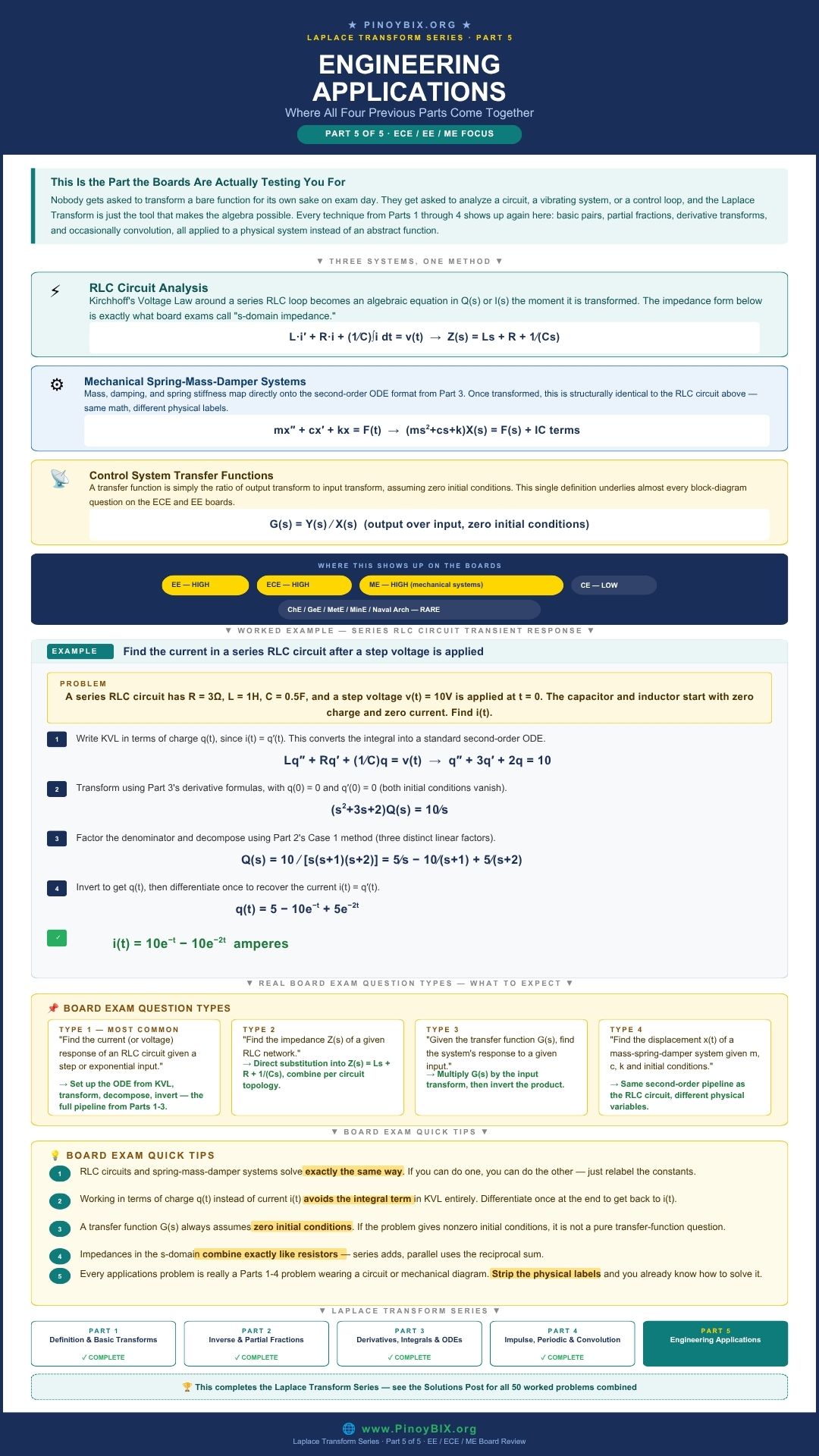
This is where everything from Parts 1 through 4 comes together in the format board examiners actually use. Nobody gets asked to transform a bare function for its own sake on exam day. They get asked to analyze a circuit, a vibrating beam, or a control loop — and the Laplace Transform is the computational engine that makes the algebra possible. This post covers the three physical system types that dominate EE, ECE, and ME board questions involving Laplace Transform: RLC circuits, spring-mass-damper mechanical systems, and control system transfer functions. All 10 worked problems are written in the style of actual board questions, complete with physical context, system equations, and full solutions. This is Part 5 of the Laplace Transform Series.
- EE (Electrical Engineer) — Very high frequency. RLC circuit transient analysis and s-domain impedance problems appear almost every exam cycle. This post’s RLC problems represent the exact type and difficulty of what the Professional Regulation Commission tests.
- ECE (Electronics Engineer) — Very high frequency. Transfer functions and system response questions are core ECE board content. Every block diagram problem that asks “find the output given this input” is solved by the method in this post.
- ME (Mechanical Engineer) — High frequency for the spring-mass-damper problems specifically. Vibration analysis, damping classification, and natural frequency extraction from the characteristic polynomial of the ODE are standard ME board items.
- CE (Civil Engineer) — Low frequency. Structural dynamics electives cover spring-mass systems, but the core CE board rarely asks for a full Laplace-based solution.
- ChE, GeE, MetE, MinE, Naval Architect and Marine Engineer — Low to rare. Process control in ChE touches transfer functions, but it is not a primary board exam topic for the other boards.
Bottom line: This part completes the series. Every technique you learned in Parts 1 through 4 — pairs table, partial fractions, derivative transforms, and shifting theorems — gets used again here, now dressed in an engineering context. Master the pattern once and it applies across all three system types.
The Three Systems and Their Governing Equations
![\[L\ddot{q} + R\dot{q} + \dfrac{1}{C}q = v(t)\]](https://pinoybix.org/wp-content/ql-cache/quicklatex.com-b3f8e43595fb2f2d20cc68283f19aae1_l3.png "Rendered by QuickLaTeX.com")
![\[\text{s-domain impedance: } Z(s) = Ls + R + \dfrac{1}{Cs}\]](https://pinoybix.org/wp-content/ql-cache/quicklatex.com-1f02108b33e7673ab7ba3a2f74f9b890_l3.png "Rendered by QuickLaTeX.com")
Kirchhoff’s Voltage Law around the loop. Working in charge  rather than current
  eliminates the integral term in KVL — differentiate once at the end to recover
  if needed.
![\[m\ddot{x} + c\dot{x} + kx = F(t)\]](https://pinoybix.org/wp-content/ql-cache/quicklatex.com-4a2f10196f96788192fdf854f138dc77_l3.png "Rendered by QuickLaTeX.com")
![\[(ms^2 + cs + k)X(s) = F(s) + \text{IC terms}\]](https://pinoybix.org/wp-content/ql-cache/quicklatex.com-e8c64631d3954321210ac47416469fe7_l3.png "Rendered by QuickLaTeX.com")
Newton’s second law applied to the mass. The structure is identical to the RLC circuit above — same second-order ODE, same solution method, just with different physical labels. Underdamped when  , critically damped when
  , overdamped when
  .
.
![\[G(s) = \dfrac{Y(s)}{X(s)} \quad \text{(zero initial conditions)}\]](https://pinoybix.org/wp-content/ql-cache/quicklatex.com-e21b914415f6dbca187a54537db3f4ca_l3.png "Rendered by QuickLaTeX.com")
The ratio of the output transform to the input transform, assuming all initial conditions are zero. This definition underlies every block diagram problem on the ECE and EE boards. The output to any given input is simply  , then invert to get
  .
.
10 Worked Board Exam Problems
Problem 1. Find the s-Domain Impedance of a Series RLC Circuit
Problem: A series RLC circuit has resistance  , inductance
  , and capacitance
  . Find the total s-domain impedance
  .
.
Given: , ,
Find:
Solution:
Step 1: Apply the s-domain impedance formula for a series RLC circuit.
![\[Z(s) = Ls + R + \dfrac{1}{Cs}\]](https://pinoybix.org/wp-content/ql-cache/quicklatex.com-6941fd6efc5a079e81f80ed45fce4379_l3.png "Rendered by QuickLaTeX.com")
Step 2: Substitute the given values.
![\[Z(s) = 2s + 4 + \dfrac{1}{0.25s} = 2s + 4 + \dfrac{4}{s}\]](https://pinoybix.org/wp-content/ql-cache/quicklatex.com-4bac50e164e0c669b10fb081f375ccb1_l3.png "Rendered by QuickLaTeX.com")
Step 3: Write as a single rational expression over a common denominator.
![\[Z(s) = \dfrac{2s^2 + 4s + 4}{s}\]](https://pinoybix.org/wp-content/ql-cache/quicklatex.com-050f5443b44d495bc90f16f347f11069_l3.png "Rendered by QuickLaTeX.com")

Examiner note: In the s-domain, an inductor  becomes
  (increases with
  ), a resistor stays
  , and a capacitor
  becomes
  (decreases with ). Series combination adds all three impedances exactly like series resistors in DC circuits.
Problem 2. Find the Current Response of a Series RL Circuit With Step Input
Problem: A series RL circuit has  and
and  . A step voltage of
  is applied at
  with zero initial current. Find .
Given:  ,
,  ,
,  ,
, 
Find:
Solution:
Step 1: Write KVL in terms of current:  .
.
![\[\dot{i} + 3i = 12\]](https://pinoybix.org/wp-content/ql-cache/quicklatex.com-800488c4e45c94c8b2a1e1f35fd3c7ae_l3.png "Rendered by QuickLaTeX.com")
Step 2: Transform. The right-hand side  transforms to
  .
.
![\[[sI - i(0)] + 3I = \dfrac{12}{s} \implies (s+3)I = \dfrac{12}{s}\]](https://pinoybix.org/wp-content/ql-cache/quicklatex.com-eb567fa6c12661e780a1459edb0b88d1_l3.png "Rendered by QuickLaTeX.com")
Step 3: Solve for  and decompose.
![\[I(s) = \dfrac{12}{s(s+3)} = \dfrac{A}{s} + \dfrac{B}{s+3}\]](https://pinoybix.org/wp-content/ql-cache/quicklatex.com-a6b82da700d1f25a9b0fae46747d4be8_l3.png "Rendered by QuickLaTeX.com")
![\[s=0: A = 4, \quad s=-3: B = -4\]](https://pinoybix.org/wp-content/ql-cache/quicklatex.com-4c1927b51ccc3f93ec69e64434f13e79_l3.png "Rendered by QuickLaTeX.com")
Step 4: Invert.
![\[I(s) = \dfrac{4}{s} - \dfrac{4}{s+3}\]](https://pinoybix.org/wp-content/ql-cache/quicklatex.com-b73b94872ae94f1bf2c89c2d37337f46_l3.png "Rendered by QuickLaTeX.com")

Examiner note: The constant term  is the steady-state current — what the circuit settles to as
  , which checks out:
  . The
. The  term is the transient that decays with time constant
  \,s.
\,s.
Problem 3. Find the Charge Response of a Series RLC Circuit With Step Voltage
Problem: A series RLC circuit has , ,  . A step voltage
  is applied at with
  and
and  . Find .
Given: , ,  ,
,  , ,
, ,
Find:
Solution:
Step 1: Write KVL in terms of  :
:  .
.
Step 2: Transform. All initial conditions are zero.
![\[(s^2 + 3s + 2)Q(s) = \dfrac{10}{s}\]](https://pinoybix.org/wp-content/ql-cache/quicklatex.com-aea2735e405d2d4d8c711d6c1360e307_l3.png "Rendered by QuickLaTeX.com")
Step 3: Solve for  and factor the denominator.
![\[Q(s) = \dfrac{10}{s(s+1)(s+2)}\]](https://pinoybix.org/wp-content/ql-cache/quicklatex.com-e38df6c46d73917b191bb2a0a21b05e3_l3.png "Rendered by QuickLaTeX.com")
Step 4: Decompose using Case 1.
![\[s=0: A = 5, \quad s=-1: B = -10, \quad s=-2: C = 5\]](https://pinoybix.org/wp-content/ql-cache/quicklatex.com-bf941edd785495109bd183f55a336625_l3.png "Rendered by QuickLaTeX.com")
Step 5: Invert.

Examiner note: Both roots  and
and  are real and negative, meaning the circuit is overdamped — no oscillations in the response. If the roots had been complex conjugates, the response would contain exponentially decaying sine and cosine terms instead.
Problem 4. Find the Transient Current From Charge Response
Problem: Using the charge  found in Problem 3, find the current .
Given:
Find:
Solution:
Step 1: Differentiate since .
![\[i(t) = \dfrac{dq}{dt} = 0 - 10(-1)e^{-t} + 5(-2)e^{-2t}\]](https://pinoybix.org/wp-content/ql-cache/quicklatex.com-57124ebd9a2012e735c86e493a0e3afa_l3.png "Rendered by QuickLaTeX.com")

Examiner note: Working in first eliminates the integral term in KVL and reduces the circuit ODE to a standard second-order form. Differentiation at the end to get is always cleaner than carrying the integral through the entire transform process.
Problem 5. Classify the Damping of a Mechanical System
Problem: A spring-mass-damper system has mass  , damping coefficient
  , and spring stiffness
  . Classify the damping and find the characteristic roots.
Given:  ,
,  ,
, 
Find: Damping classification and characteristic roots
Solution:
Step 1: Write the governing ODE:  .
.
Step 2: Check the discriminant:  .
.
Step 3: Since the discriminant equals zero, the system is critically damped. The characteristic polynomial  gives a repeated root.
(repeated).
Examiner note: Critically damped is the boundary case between overdamped and underdamped. It produces the fastest return to equilibrium without oscillation, which is why it is the design target for door dampers, vehicle suspension systems, and many control systems.
Problem 6. Solve an Underdamped Mechanical System IVP
Problem: A spring-mass-damper system has ,  ,
,  . The mass is displaced
  with
with  . No external force is applied. Find
  .
.
Given:  ,
,  ,
,  ,
,  ,
,  ,
, 
Find:
Solution:
Step 1: Check discriminant:  . Underdamped — complex roots.
Step 2: Write and transform the ODE  .
.
![\[[s^2X - s(1) - 0] + 2[sX - 1] + 5X = 0\]](https://pinoybix.org/wp-content/ql-cache/quicklatex.com-4dadceb61581e280caa7666cbdd6a1d2_l3.png "Rendered by QuickLaTeX.com")
![\[(s^2+2s+5)X = s+2\]](https://pinoybix.org/wp-content/ql-cache/quicklatex.com-5b5b4ac1ceca2827839d19c195b2845d_l3.png "Rendered by QuickLaTeX.com")
Step 3: Solve for  and complete the square in the denominator.
![\[X(s) = \dfrac{s+2}{(s+1)^2+4}\]](https://pinoybix.org/wp-content/ql-cache/quicklatex.com-d65b3a72df4c9ee21d7879079359d8f7_l3.png "Rendered by QuickLaTeX.com")
Step 4: Split the numerator to match shifted cosine and sine pairs.
![\[X(s) = \dfrac{(s+1)+1}{(s+1)^2+4} = \dfrac{s+1}{(s+1)^2+4} + \dfrac{1}{2}\cdot\dfrac{2}{(s+1)^2+4}\]](https://pinoybix.org/wp-content/ql-cache/quicklatex.com-c8a981a246cac06ccd3934a21de47243_l3.png "Rendered by QuickLaTeX.com")
Step 5: Invert using the first shifting theorem in reverse ( ,
,  ).
).

Examiner note: The  envelope decays exponentially while the
  and
and  oscillate at the damped natural frequency
  . This decaying oscillation is the defining signature of an underdamped system.
Problem 7. Find the Transfer Function of a Mass-Spring-Damper System
Problem: A mass-spring-damper system has ,  ,
,  . Find the transfer function
  assuming zero initial conditions.
Given: ,  ,
,  , zero initial conditions
Find:
Solution:
Step 1: Write the governing ODE:  .
.
Step 2: Transform with zero initial conditions.
![\[(s^2 + 3s + 2)X(s) = F(s)\]](https://pinoybix.org/wp-content/ql-cache/quicklatex.com-56aab0ae6e40c3e500255fcc78c93cd7_l3.png "Rendered by QuickLaTeX.com")
Step 3: Divide both sides by  to get the transfer function.
![\[G(s) = \dfrac{X(s)}{F(s)} = \dfrac{1}{s^2+3s+2}\]](https://pinoybix.org/wp-content/ql-cache/quicklatex.com-c4498ad2f07ddd90284050fc1347aa8c_l3.png "Rendered by QuickLaTeX.com")

Examiner note: The transfer function is always evaluated at zero initial conditions. If initial conditions are not zero, the transfer function alone cannot describe the full response — you need the complete IVP solution from Part 3 instead.
Problem 8. Find the System Response to a Ramp Input Using a Transfer Function
Problem: A system has transfer function  . The input is
  (a ramp). Find the output assuming zero initial conditions.
Given: , input
Find:
Solution:
Step 1: Find  .
.
Step 2: Multiply in the s-domain.
![\[Y(s) = G(s) \cdot X(s) = \dfrac{1}{s+2} \cdot \dfrac{1}{s^2} = \dfrac{1}{s^2(s+2)}\]](https://pinoybix.org/wp-content/ql-cache/quicklatex.com-57675f96a073771fc18b98cac8c522fe_l3.png "Rendered by QuickLaTeX.com")
Step 3: Decompose — repeated linear  and simple linear
  .
.
![\[\dfrac{1}{s^2(s+2)} = \dfrac{A}{s} + \dfrac{B}{s^2} + \dfrac{C}{s+2}\]](https://pinoybix.org/wp-content/ql-cache/quicklatex.com-4d1aeb64ee36905310030f89b0e0ad02_l3.png "Rendered by QuickLaTeX.com")
![\[s=0: 1 = 2B \implies B = \dfrac{1}{2}\]](https://pinoybix.org/wp-content/ql-cache/quicklatex.com-ccad8815ae3728239ae5a953d420d81c_l3.png "Rendered by QuickLaTeX.com")
![\[s=-2: 1 = 4C \implies C = \dfrac{1}{4}\]](https://pinoybix.org/wp-content/ql-cache/quicklatex.com-a3b872ad761936525ccde9a7ad2b48b6_l3.png "Rendered by QuickLaTeX.com")
![\[s^2 \text{ coeff}: 0 = A + C \implies A = -\dfrac{1}{4}\]](https://pinoybix.org/wp-content/ql-cache/quicklatex.com-a62abb7db66e76ad5e8abd0b7645bf2d_l3.png "Rendered by QuickLaTeX.com")
Step 4: Invert each term.

Examiner note: For a ramp input to a first-order system, the steady-state response eventually tracks the ramp with a constant error (the  term). The
  transient decays and the output converges to
  as .
as .
Problem 9. Find the Response of a Second-Order Control System to a Step Input
Problem: A control system has transfer function  . A unit step input is applied. Find the output .
Given: , 
Find:
Solution:
Step 1: Transform the unit step:  .
.
Step 2: Multiply in the s-domain.
![\[Y(s) = \dfrac{4}{s(s^2+4s+4)} = \dfrac{4}{s(s+2)^2}\]](https://pinoybix.org/wp-content/ql-cache/quicklatex.com-25a2da90e14637953d1326745cbe54fe_l3.png "Rendered by QuickLaTeX.com")
Step 3: Decompose — simple factor and repeated factor  .
.
![\[\dfrac{4}{s(s+2)^2} = \dfrac{A}{s} + \dfrac{B}{s+2} + \dfrac{C}{(s+2)^2}\]](https://pinoybix.org/wp-content/ql-cache/quicklatex.com-c087ce3f2b4ab93dedd96d1c3cddd574_l3.png "Rendered by QuickLaTeX.com")
![\[s=0: A = 1, \quad s=-2: C = -2\]](https://pinoybix.org/wp-content/ql-cache/quicklatex.com-0017c7fff392b80c90d42ca408d0a626_l3.png "Rendered by QuickLaTeX.com")
![\[s^2 \text{ coeff}: 0 = A + B \implies B = -1\]](https://pinoybix.org/wp-content/ql-cache/quicklatex.com-f219ca7858b310cf71fb1225e1e1feb9_l3.png "Rendered by QuickLaTeX.com")
Step 4: Invert all three terms.
![\[Y(s) = \dfrac{1}{s} - \dfrac{1}{s+2} - \dfrac{2}{(s+2)^2}\]](https://pinoybix.org/wp-content/ql-cache/quicklatex.com-09c27720bcf886df09f4d12ac2684ca5_l3.png "Rendered by QuickLaTeX.com")

Examiner note: The repeated root at means this is a critically damped second-order system. The  term is the signature of critical damping. As , the output settles to 1 — the steady-state equals the input magnitude, as expected for a unit step into a unity-gain system.
Problem 10. Full RLC Circuit Analysis With Underdamped Response (EE Board Style)
Problem: A series RLC circuit has  , ,
, ,  . A constant EMF of
  is applied at with and
  . Find the charge and classify the circuit response.
Given:  , ,
, ,  ,
,  , ,
, , 
Find: and damping classification
Solution:
Step 1: Write KVL in terms of :  .
.
Step 2: Check discriminant:  . Underdamped.
Step 3: Transform with zero initial conditions.
![\[(s^2 + 2s + 5)Q(s) = \dfrac{5}{s}\]](https://pinoybix.org/wp-content/ql-cache/quicklatex.com-c0bde48b17939eab48a53f2daed2a159_l3.png "Rendered by QuickLaTeX.com")
Step 4: Solve for .
![\[Q(s) = \dfrac{5}{s(s^2+2s+5)}\]](https://pinoybix.org/wp-content/ql-cache/quicklatex.com-0176e57478ca55bc8842ecfc3d36392f_l3.png "Rendered by QuickLaTeX.com")
Step 5: Complete the square:  . Decompose.
![\[\dfrac{5}{s((s+1)^2+4)} = \dfrac{A}{s} + \dfrac{Bs+C}{(s+1)^2+4}\]](https://pinoybix.org/wp-content/ql-cache/quicklatex.com-b177fafb057e8c21fd505d6c13d575cd_l3.png "Rendered by QuickLaTeX.com")
![\[s=0: A = 1, \quad s^2 \text{ coeff}: 0 = A+B \implies B=-1, \quad s^1 \text{ coeff}: 0 = 2A+C \implies C=-2\]](https://pinoybix.org/wp-content/ql-cache/quicklatex.com-50af5107c368cfaa8a39e942713c92e4_l3.png "Rendered by QuickLaTeX.com")
Step 6: Rewrite and match to shifted pairs.
![\[Q(s) = \dfrac{1}{s} - \dfrac{s+2}{(s+1)^2+4} = \dfrac{1}{s} - \dfrac{(s+1)+1}{(s+1)^2+4}\]](https://pinoybix.org/wp-content/ql-cache/quicklatex.com-ad8d6f71e6696b0d0d1a1fb1d8ff3822_l3.png "Rendered by QuickLaTeX.com")
![\[= \dfrac{1}{s} - \dfrac{s+1}{(s+1)^2+4} - \dfrac{1}{2}\cdot\dfrac{2}{(s+1)^2+4}\]](https://pinoybix.org/wp-content/ql-cache/quicklatex.com-fe06ec69213fdfda3658980cdba20143_l3.png "Rendered by QuickLaTeX.com")
Step 7: Invert using the first shifting theorem (, ).
 — Underdamped circuit response.
Examiner note: The steady-state charge  checks out:
  . When the answer gives a constant plus decaying oscillatory terms, always verify the steady state from the circuit parameters directly — it is a fast integrity check that catches sign errors before you finalize.
Common Mistakes and Examiner Traps
| ❌ Common Mistake | ✅ Correct Approach |
|---|---|
| Writing KVL with current and carrying the capacitor integral through the transform |
Work in charge — KVL in produces a standard second-order ODE with no integral term. Differentiate once at the end to recover if needed. |
| Using the transfer function formula when initial conditions are nonzero |  only holds for zero initial conditions. If only holds for zero initial conditions. If  or or  , use the full IVP method from Part 3 — the transfer function alone cannot capture those effects. , use the full IVP method from Part 3 — the transfer function alone cannot capture those effects. |
| Misclassifying damping by checking only one condition | Use the discriminant  (or (or  ). Negative means underdamped, zero means critically damped, positive means overdamped. Check it before solving — it tells you what form the final answer will take. ). Negative means underdamped, zero means critically damped, positive means overdamped. Check it before solving — it tells you what form the final answer will take. |
| Treating parallel impedances the same as series impedances | Series impedances add:  . Parallel impedances use the reciprocal rule: . Parallel impedances use the reciprocal rule:  . The s-domain rules are identical to DC resistor rules. . The s-domain rules are identical to DC resistor rules. |
| Forgetting to complete the square when the characteristic polynomial has complex roots | If the discriminant is negative, the quadratic in the denominator must be put in  form before inversion. Trying to invert form before inversion. Trying to invert  directly, without completing the square, will not match any basic pair. directly, without completing the square, will not match any basic pair. |
| Not verifying the steady-state value from physical parameters | For a constant input, the steady-state output can always be checked from the physical parameters. For the RLC circuit:  . For the mechanical system: . For the mechanical system:  . This is a fast cross-check that catches sign errors before finalizing. . This is a fast cross-check that catches sign errors before finalizing. |
Board Exam Quick Tips
- RLC circuits and spring-mass-damper systems solve exactly the same way. The ODE structure is identical —
 ,
,  ,
,  . Master the method once and you have both.
 - Work in charge
 for RLC circuits, not current
  . This eliminates the integral term in KVL and converts the circuit equation to a standard second-order ODE.
 - Check the discriminant before solving. Negative discriminant means complex roots, complete the square, expect
 and
and  in the answer. Positive discriminant means real distinct roots, expect exponentials only.
 - A transfer function assumes zero initial conditions. If the problem gives nonzero initial conditions alongside a transfer function question, it is asking for the full response, not just the forced response — use the complete IVP method.
- Every applications problem is a Parts 1–4 problem in disguise. Strip the physical labels, identify the ODE, apply the four-step pattern from Part 3. The engineering context does not add any new math.
 ,
,  ,
,  . Master the method once and you have both.
 and
and  in the answer. Positive discriminant means real distinct roots, expect exponentials only.
Frequently Asked Questions
Q1. How do I convert between circuit parameters and the standard second-order ODE form?
The series RLC KVL equation is  . Divide through by to get the standard form
  . The natural frequency is
  and the damping ratio is
  . These two parameters fully characterize the circuit response type.
Q2. What is the steady-state value of the response for a constant input?
For a constant input applied to a stable system, the steady-state value can be found by setting  in the transfer function:
  . For the RLC circuit with constant voltage
  :
:  . For the mechanical system with constant force
  : . These steady-state checks should always be used to verify the final time-domain answer.
Q3. Why does the critically damped case have  terms in the response?
Critically damped means the characteristic polynomial has a repeated root  . From Part 2,
  . The extra factor of
  comes directly from the repeated root structure — it is not a coincidence but a mathematical consequence of the partial fraction decomposition for a squared factor.
Q4. Can I apply the Laplace method to circuits with multiple loops?
Yes. Apply KVL to each loop separately, transform each equation, then solve the resulting system of algebraic equations for the unknown currents  ,
,  , and so on. This is Mesh Analysis in the -domain, and it works exactly the same as DC mesh analysis but with impedances instead of resistances.
Q5. How is the transfer function used in feedback control systems?
In a feedback control loop, the closed-loop transfer function is  , where
  is the forward path and
  is the feedback path. The denominator
  is the characteristic equation — its roots determine stability and response type using exactly the same discriminant analysis covered in this post.
Series Complete — What You Have Covered
This completes the PinoyBIX Laplace Transform Board Exam Reviewer Series. Across five parts and 50 fully worked problems, you have covered every technique that appears in Laplace Transform questions on the EE, ECE, and ME boards:
- Part 1 — The definition, seven basic transform pairs, linearity, first shifting theorem, and change of scale
- Part 2 — Inverse transforms and all three partial fraction decomposition cases
- Part 3 — Derivative and integration transforms, the second shifting theorem, and the four-step IVP method
- Part 4 — Dirac delta impulse functions, periodic waveform transforms, and the convolution theorem
- Part 5 — RLC circuit analysis, spring-mass-damper systems, and control system transfer functions
→ Visit the Laplace Transform Series — Complete Solutions Post (50 Problems)
→ Back to the Laplace Transform Series Index
Published by PinoyBIX.org — Engineering Education for Every Filipino Student. Electronics · Mathematics · Board Exam Review · Free for Everyone.
Related Content




P inoyBIX educates thousands of reviewers and students a day in preparation for their board examinations. Also provides professionals with materials for their lectures and practice exams. Help me go forward with the same spirit.
“Will you subscribe today via YOUTUBE?”
TIRED OF ADS?
- Become Premium Member and experienced complete ads-free content browsing.
- Full Content Access to Premium Solutions Exclusive for Premium members
- Access to PINOYBIX FREEBIES folder
- Download Reviewers and Learning Materials Free
- Download Content: You can see download/print button at the bottom of each post.
PINOYBIX FREEBIES FOR PREMIUM MEMBERSHIP:
- CIVIL ENGINEERING REVIEWER
- CIVIL SERVICE EXAM REVIEWER
- CRIMINOLOGY REVIEWER
- ELECTRONICS ENGINEERING REVIEWER (ECE/ECT)
- ELECTRICAL ENGINEERING & RME REVIEWER
- FIRE OFFICER EXAMINATION REVIEWER
- LET REVIEWER
- MASTER PLUMBER REVIEWER
- MECHANICAL ENGINEERING REVIEWER
- NAPOLCOM REVIEWER
- Additional upload reviewers and learning materials are also FREE
FOR A LIMITED TIME
If you subscribe for PREMIUM today!
You will receive an additional 1 month of Premium Membership FREE.
For Bronze Membership an additional 2 months of Premium Membership FREE.
For Silver Membership an additional 3 months of Premium Membership FREE.
For Gold Membership an additional 5 months of Premium Membership FREE.
Join the PinoyBIX community.