
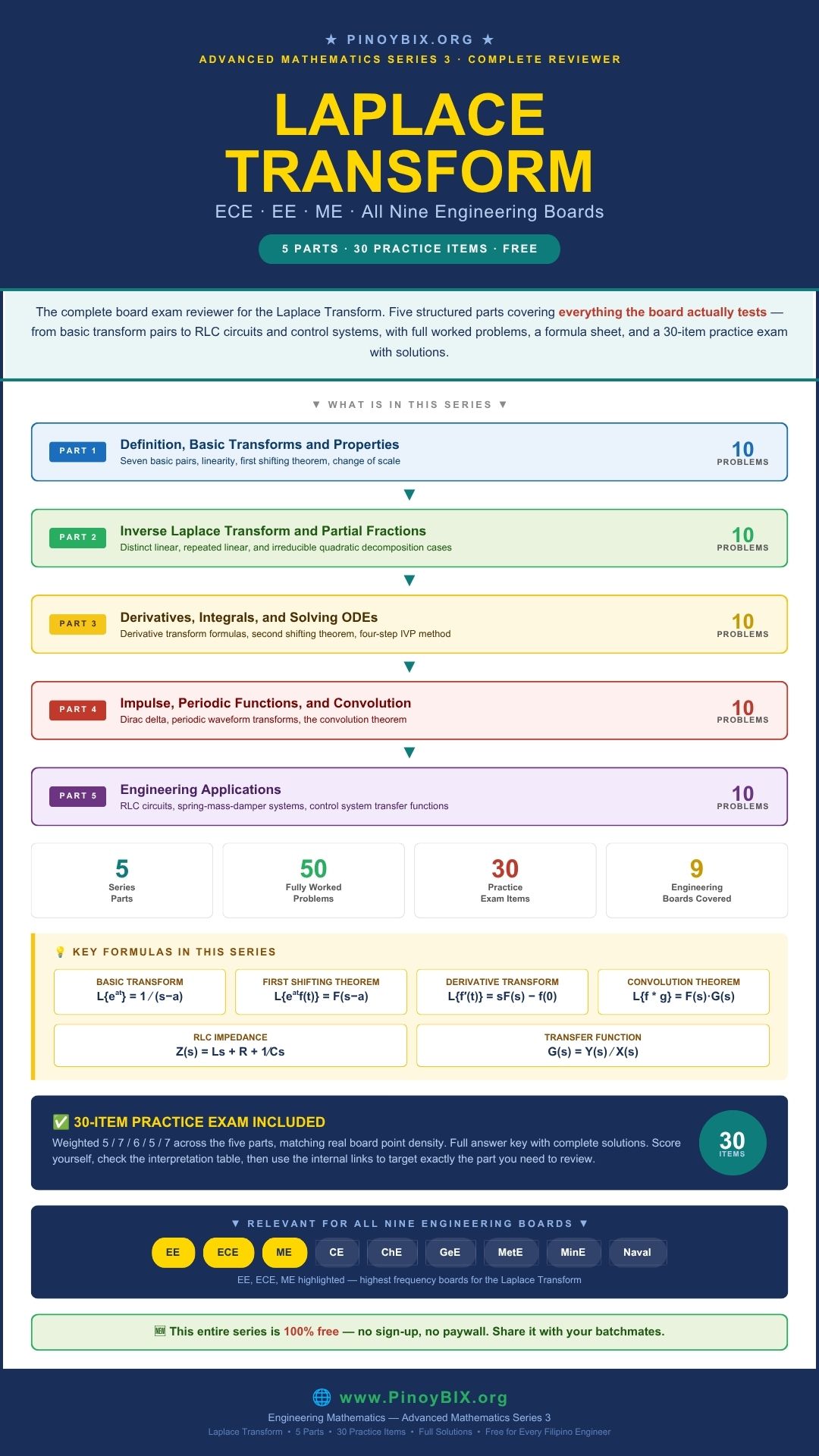
The Laplace Transform is the tool that turns differential equations into algebra, and once you need to analyze a circuit, a vibrating system, or a control loop on the board exam, there is no way around it. Every RLC transient problem on the EE boards, every transfer function question on the ECE boards, and every vibration analysis item on the ME boards eventually comes down to the same five techniques. This is not an optional topic for those three boards. It is one of the highest point-density topics in the entire Advanced Mathematics section.
This page is the complete Laplace Transform board exam reviewer for ECE, EE, and ME — five parts, 50 fully worked problems, a consolidated formula sheet, and a 30-item practice exam weighted toward where the actual point density is, with a four-column answer key and full solutions. Pick your starting point based on how much time you have. If you are three weeks out, start from Part 1. If you are three days out, go straight to the formula sheet and the practice exam. The score will tell you where to focus what little time you have left.
- EE (Electrical Engineer) — Very high frequency. RLC circuit transient analysis and s-domain impedance problems appear almost every exam cycle. This is one of the most heavily tested Advanced Mathematics topics on the EE boards specifically.
- ECE (Electronics Engineer) — Very high frequency. Signals and systems questions lean directly on the transform pairs, partial fractions, and the convolution theorem. Transfer function and block diagram problems are core ECE board content.
- ME (Mechanical Engineer) — High frequency. Vibration analysis, damping classification, and spring-mass-damper systems all reduce to the exact second-order ODE methods covered in this series. Budget real time for Part 5.
- CE (Civil Engineer) — Low frequency. Occasional structural dynamics or instrumentation-adjacent items reference the transform, but it is not a core CE board topic. A light pass through Parts 1 through 3 is enough.
- ChE, GeE, MetE, MinE, Naval Architect and Marine Engineer — Low to rare frequency. Mostly appears in process control electives rather than the core board exam. Prioritize other Advanced Mathematics topics first if you are on a tight schedule.
Bottom line: If you are taking the EE, ECE, or ME boards, this series is not optional review — it is core content. If you are on another board, a lighter pass through Parts 1 to 3 covers what little does get tested.
How to Use This Series
Most students open a reviewer and read from the top. That works if you have time. Here is a more honest breakdown of what to do based on where you actually are.
Three weeks out: Work through all five parts in order. Read the content, work all 10 problems in each part without looking at the solutions first, then compare. Give Part 2 extra time — partial fraction decomposition is where the most points get lost in this entire topic, more than any other single skill in the series. On day 6 of your schedule, take the practice exam at the bottom of this page under real conditions. Use the score to identify your weakest part.
One week out: Follow the seven-day schedule in the table below. Do not skip Day 6 — that is the practice exam day. The exam is the most useful thing on this page for someone reviewing under time pressure, and it is weighted the same way the actual point density is, not spread evenly.
Three days or less: Screenshot the formula sheet. Take the practice exam cold without looking at any part of the series first. Check your score against the answer key. Then read only the series posts for the parts where you missed three or more items — Part 2 and Part 5 carry more items on the exam below because they carry more actual board weight, so a miss cluster there is worth fixing first.
Series Navigation
| Part | Topic | Key Skills | Problems | Best For |
|---|---|---|---|---|
| Part 1 | Definition, Basic Transforms & Properties | Seven basic pairs, linearity, first shifting theorem, change of scale | 10 | All boards — foundation for every other part, read this first |
| Part 2 | Inverse Laplace Transform & Partial Fractions | Distinct linear, repeated linear, and irreducible quadratic decomposition cases | 10 | All boards — highest point-loss part in the entire series |
| Part 3 | Derivatives, Integrals & Solving ODEs | Derivative transform formulas, second shifting theorem, four-step IVP method | 10 | EE, ECE, ME critical — the actual payoff of Parts 1 and 2 |
| Part 4 | Impulse, Periodic Functions & Convolution | Dirac delta, periodic waveform transforms, the convolution theorem | 10 | EE and ECE critical — signals and circuits focus |
| Part 5 | Engineering Applications | RLC circuits, spring-mass-damper systems, control system transfer functions | 10 | EE, ECE, ME — where Parts 1 through 4 all get applied together |
| Day | Activity | Time |
|---|---|---|
| Day 1 | Read Part 1 — Definition and Basic Transforms. Work all 10 problems without looking at solutions first. Before closing the tab, make sure you can write all seven basic pairs from memory. | 90 minutes |
| Day 2 | Read Part 2 — Inverse Transform and Partial Fractions. This is the highest point-loss part in the series. Spend extra time here — work all 10 problems twice if needed, once with the solution visible and once without. | 2 hours |
| Day 3 | Read Part 3 — Derivatives, Integrals, and Solving ODEs. This is where Parts 1 and 2 actually get used. Memorize the four-step IVP pattern before moving on. | 2 hours |
| Day 4 | Read Part 4 — Impulse, Periodic Functions, and Convolution. If you are EE or ECE, give this full attention — the convolution theorem is heavily tested on both boards. | 90 minutes |
| Day 5 | Read Part 5 — Engineering Applications. Work through the RLC and spring-mass-damper problems side by side — notice they are the same math with different labels. | 2 hours |
| Day 6 | Take the 30-item practice exam at the bottom of this page. No notes. No formula sheet. Set a 45-minute timer and treat it like the real thing. Write your answers on paper before you scroll down to the key. | 45 minutes |
| Day 7 | Score your exam. For every item you got wrong, read the full solution in the Complete Solutions Post. If you missed three or more in Part 2 or Part 5, go back to those posts specifically — they carry the most items below for a reason. | 60 to 90 minutes |
Formula Sheet
Everything from all five parts, in one place. On the board exam, none of this will be handed to you. Screenshot it if you want, but the goal is to not need the screenshot by exam day.
![\[\mathcal{L}\{1\} = \dfrac{1}{s}, \quad \mathcal{L}\{t^n\} = \dfrac{n!}{s^{n+1}}, \quad \mathcal{L}\{e^{at}\} = \dfrac{1}{s-a}\]](https://pinoybix.org/wp-content/ql-cache/quicklatex.com-1dc5e87255ab4e95648e02bda4fce197_l3.png "Rendered by QuickLaTeX.com")
![\[\mathcal{L}\{\sin kt\} = \dfrac{k}{s^2+k^2}, \quad \mathcal{L}\{\cos kt\} = \dfrac{s}{s^2+k^2}\]](https://pinoybix.org/wp-content/ql-cache/quicklatex.com-7dde42905a0b26da135361f422fa4e57_l3.png "Rendered by QuickLaTeX.com")
![\[\mathcal{L}\{\sinh kt\} = \dfrac{k}{s^2-k^2}, \quad \mathcal{L}\{\cosh kt\} = \dfrac{s}{s^2-k^2}\]](https://pinoybix.org/wp-content/ql-cache/quicklatex.com-ca6a36ea17c87ef0b177cafca5ebe7d8_l3.png "Rendered by QuickLaTeX.com")
![\[\text{Linearity: } \mathcal{L}\{af+bg\} = aF(s)+bG(s) \qquad \text{First shift: } \mathcal{L}\{e^{at}f(t)\} = F(s-a)\]](https://pinoybix.org/wp-content/ql-cache/quicklatex.com-a6067a7fae114e99c6de66d6e52b903b_l3.png "Rendered by QuickLaTeX.com")
![\[\text{Change of scale: } \mathcal{L}\{f(at)\} = \dfrac{1}{a}F\left(\dfrac{s}{a}\right)\]](https://pinoybix.org/wp-content/ql-cache/quicklatex.com-9914b6e9ac58436fed0cbde6ccab714a_l3.png "Rendered by QuickLaTeX.com")
![\[\text{Case 1 (distinct linear): } \dfrac{N(s)}{(s-a)(s-b)} = \dfrac{A}{s-a}+\dfrac{B}{s-b}\]](https://pinoybix.org/wp-content/ql-cache/quicklatex.com-632dacdd332eefb41ab8948548e245dc_l3.png "Rendered by QuickLaTeX.com")
![\[\text{Case 2 (repeated linear): } \dfrac{N(s)}{(s-a)^2} = \dfrac{A}{s-a}+\dfrac{B}{(s-a)^2}\]](https://pinoybix.org/wp-content/ql-cache/quicklatex.com-0df822011158a832352379d7595419f5_l3.png "Rendered by QuickLaTeX.com")
![\[\text{Case 3 (irreducible quadratic): } \dfrac{N(s)}{s^2+k^2} \rightarrow \dfrac{As+B}{s^2+k^2}\]](https://pinoybix.org/wp-content/ql-cache/quicklatex.com-80626a8b75cef7a4cfd63563acc1eeca_l3.png "Rendered by QuickLaTeX.com")
Always check degree of numerator vs. denominator first — long division before decomposing if the numerator degree is equal or higher.
![\[\mathcal{L}\{f'(t)\} = sF(s)-f(0) \qquad \mathcal{L}\{f''(t)\} = s^2F(s)-sf(0)-f'(0)\]](https://pinoybix.org/wp-content/ql-cache/quicklatex.com-7b538f09878eac9815a221285fc8801b_l3.png "Rendered by QuickLaTeX.com")
![\[\mathcal{L}\left\{\int_0^t f(\tau)\,d\tau\right\} = \dfrac{F(s)}{s} \qquad \mathcal{L}\{f(t-a)u(t-a)\} = e^{-as}F(s)\]](https://pinoybix.org/wp-content/ql-cache/quicklatex.com-beb4986106c68bcf1292c98c6e105b3e_l3.png "Rendered by QuickLaTeX.com")
Four-step IVP method: (1) transform both sides, (2) substitute initial conditions immediately, (3) solve for  , (4) invert using Group 2.
![\[\mathcal{L}\{\delta(t-a)\} = e^{-as} \qquad \mathcal{L}\{\delta(t)\} = 1\]](https://pinoybix.org/wp-content/ql-cache/quicklatex.com-274014bb0a3b859239f7ecb8f67048d1_l3.png "Rendered by QuickLaTeX.com")
![\[F(s) = \dfrac{1}{1-e^{-sT}}\int_0^T f(t)e^{-st}\,dt \quad \text{(periodic, period } T\text{)}\]](https://pinoybix.org/wp-content/ql-cache/quicklatex.com-50e5adec2bb69bfa8098472ef5ed4546_l3.png "Rendered by QuickLaTeX.com")
![\[\mathcal{L}\{f*g\} = F(s)\cdot G(s), \quad (f*g)(t) = \int_0^t f(\tau)g(t-\tau)\,d\tau\]](https://pinoybix.org/wp-content/ql-cache/quicklatex.com-b2a39ef4b3439b4ba38c903cf4995b29_l3.png "Rendered by QuickLaTeX.com")
![\[\text{RLC impedance: } Z(s) = Ls + R + \dfrac{1}{Cs}\]](https://pinoybix.org/wp-content/ql-cache/quicklatex.com-12a2a6a12f969dac7ef780885fe33016_l3.png "Rendered by QuickLaTeX.com")
![\[\text{Spring-mass-damper: } m\ddot{x}+c\dot{x}+kx = F(t) \;\rightarrow\; (ms^2+cs+k)X(s) = F(s) + \text{IC terms}\]](https://pinoybix.org/wp-content/ql-cache/quicklatex.com-ef5123ee0175459e7399b2fc9526877a_l3.png "Rendered by QuickLaTeX.com")
![\[\text{Transfer function: } G(s) = \dfrac{Y(s)}{X(s)} \quad \text{(zero initial conditions)}\]](https://pinoybix.org/wp-content/ql-cache/quicklatex.com-bcd350232e35b61b256ed666a2e6bc4e_l3.png "Rendered by QuickLaTeX.com")
![\[\text{Damping (from } c^2-4mk \text{ or } R^2-4L/C\text{): negative = underdamped, zero = critical, positive = overdamped}\]](https://pinoybix.org/wp-content/ql-cache/quicklatex.com-1eb2a6a9986f241092d6441ff6627793_l3.png "Rendered by QuickLaTeX.com")
30-Item Practice Exam
This exam is weighted, not evenly split. Part 2 and Part 5 carry more items than the other three because that is where the actual board point density sits — Part 2 is the highest point-loss skill in the topic, and Part 5 is where Parts 1 through 4 all get combined and tested together.
- Time allowed: 45 minutes
- 30 items — weighted 5 / 7 / 6 / 5 / 7 across the five parts
- One correct answer per item, four choices each
- No partial credit — right or wrong
- Suggested passing score: 24 out of 30 (80%)
- Write your answers on paper first. Do not scroll to the key until you finish all 30 items.
- No notes, no formula sheet. Treat this like the real board exam.
Part A — Definition, Basic Transforms and Properties (Items 1 to 5)
1. What is  ?
?
(A)  (B)
(B)  (C)
(C)  (D)
(D) 
2. Find  .
.
(A)  (B)
(B)  (C)
(C)  (D)
(D) 
3. Using linearity, find  .
.
(A)  (B)
(B)  (C)
(C)  (D)
(D) 
4. Apply the first shifting theorem to find  .
.
(A)  (B)
(B)  (C)
(C)  (D)
(D) 
5. For what values of  does
does  converge?
(A)  (B)
(B)  (C)
(C)  (D)
(D) 
Part B — Inverse Laplace Transform and Partial Fractions (Items 6 to 12)
6. Which is the correct partial fraction setup for  ?
?
(A)  (B)
(B)  (C)
(C)  (D)
(D) 
7. Find  .
.
(A)  (B)
(B)  (C)
(C)  (D)
(D) 
8. Find  .
.
(A)  (B)
(B)  (C)
(C)  (D)
(D) 
9. How many unknown constants are needed to decompose  ?
?
(A)  (B)
(B)  (C)
(C)  (D)
(D) 
10. Given  , find
  .
.
(A) (B)  (C) (D)
11. Before decomposing  , what must be done first?
(A) Apply Case 1 directly (B) Perform polynomial long division, since the degrees are equal (C) Apply Case 3 (D) Multiply both sides by
12. Which decomposition cases apply to the denominator  ?
?
(A) Two Case 1 factors (B) Case 1 and Case 2 (C) Case 1 and Case 3 (D) Case 2 and Case 3
Part C — Derivatives, Integrals, and Solving ODEs (Items 13 to 18)
13. Given  and
and  , find
  .
.
(A)  (B)
(B)  (C)
(C)  (D)
(D) 
14. Given  and
and  , write
  in terms of .
(A)  (B)
(B)  (C)
(C)  (D)
(D) 
15. Solve  with
with  . Find
  .
.
(A)  (B)
(B)  (C)
(C)  (D)
(D) 
16. Solve  with
with  ,
,  . Find .
(A)  (B)
(B)  (C)
(C)  (D)
(D) 
17. Find  .
.
(A)  (B)
(B)  (C)
(C)  (D)
(D) 
18. Given  , find
  .
.
(A)  (B)
(B)  (C)
(C)  (D)
(D) 
Part D — Impulse, Periodic Functions, and Convolution (Items 19 to 23)
19. Find  .
.
(A)  (B)
(B)  (C)
(C)  (D)
(D) 
20. Find  .
.
(A) (B)  (C)
(C)  (D)
(D) 
21. Given  and
and  , find
  .
.
(A)  (B)
(B)  (C)
(C)  (D)
(D) 
22. A periodic function has period  . What are the integration limits in the periodic transform formula?
(A)  to
to  (B) to (C)
  to (D) to
23. Express  as a convolution integral.
(A)  (B)
(B)  (C)
(C)  , no integral (D)
Part E — Engineering Applications (Items 24 to 30)
24. A series RLC circuit has  ,
,  ,
,  . Find
  .
.
(A)  (B)
(B)  (C)
(C)  (D)
(D) 
25. For a transfer function  , what condition must hold?
(A) Zero initial conditions (B) Nonzero initial conditions (C)  (D)
(D) 
26. A spring-mass-damper system has  ,
,  ,
,  . Classify the damping.
(A) Underdamped (B) Critically damped (C) Overdamped (D) Undamped
27. A series RL circuit has  , , a step voltage of
  is applied,
  . Find the steady-state current.
(A)  (B)
(B)  (C)
(C)  (D)
(D) 
28. A series RLC circuit has  ,
,  ,
,  , with an
  step applied and
  ,
,  . Find the characteristic equation of the resulting ODE in
  .
.
(A)  (B)
(B)  (C)
(C)  (D)
(D) 
29. A control system has  . Find for a unit step input.
(A)  (B)
(B)  (C)
(C)  (D)
(D)
30. For  with zero initial conditions, what is the correct s-domain equation?
(A)  (B)
(B)  (C)
(C)  (D)
(D) 
Answer Key With Explanations
Full step-by-step solutions for every item are in the Complete Solutions Post — all 30 items in Given, Find, Solution format with examiner notes on each one.
| Item | Answer | Topic | Quick Explanation |
|---|---|---|---|
| 1 | B | Basic pairs | A constant  is is  ; ;  , so , so  . . |
| 2 | C | Basic pairs |  . For . For  : :  . . |
| 3 | A | Linearity | Split with linearity:  . Choice B has the wrong sign on the constant term. . Choice B has the wrong sign on the constant term. |
| 4 | B | First shifting theorem |  replaces with replaces with  . Choice A uses the wrong sign. . Choice A uses the wrong sign. |
| 5 | B | Convergence |  converges for converges for  . Here . Here  , so , so  . . |
| 6 | A | Partial fractions — Case 1 | Two distinct linear factors, one constant each. |
| 7 | B | Partial fractions — Case 2 |  , multiplied by the numerator 4 gives . , multiplied by the numerator 4 gives . |
| 8 | B | Partial fractions — Case 3 |  matches the numerator exactly, so matches the numerator exactly, so  inverts directly to inverts directly to  , no rescaling needed. , no rescaling needed. |
| 9 | B | Partial fractions — structure | needs one constant,  needs two — three total. needs two — three total. |
| 10 | A | Partial fractions — substitution | Substitute  : :  . . |
| 11 | B | Improper fractions | Numerator and denominator both degree 2 — long division required before decomposing. |
| 12 | C | Partial fractions — case identification |  is Case 1, is Case 1,  has no real roots and is Case 3. has no real roots and is Case 3. |
| 13 | A | Derivative transform |  . . |
| 14 | A | Second derivative transform |  . . |
| 15 | A | First-order IVP |  . . |
| 16 | A | Second-order IVP | Roots  . . ![Y=(s-5)/[(s-2)(s-3)]](https://pinoybix.org/wp-content/ql-cache/quicklatex.com-60f5b575ce3d8bba3658d9c8c0093ae7_l3.png "Rendered by QuickLaTeX.com") decomposes to decomposes to  , ,  . . |
| 17 | A | Second shifting theorem |  ; shift by ; shift by  gives gives  . . |
| 18 | A | Integration property | Divide  by : by : ![1/[s(s+4)]](https://pinoybix.org/wp-content/ql-cache/quicklatex.com-bf69d8f59c15c0752d76bd1ffc47b41d_l3.png "Rendered by QuickLaTeX.com") . . |
| 19 | A | Dirac delta |  ; here . ; here . |
| 20 | A | Dirac delta |  , scaled by 3 gives . Not — that would be the step function. , scaled by 3 gives . Not — that would be the step function. |
| 21 | A | Convolution theorem | ![\mathcal{L}\{f*g\}=F(s)G(s)=1/[(s+1)(s+3)]](https://pinoybix.org/wp-content/ql-cache/quicklatex.com-cda644f6f7041ade14297a1bfe5e6597_l3.png "Rendered by QuickLaTeX.com") . . |
| 22 | B | Periodic functions | Integration is always over one period, to  . . |
| 23 | A | Convolution — reverse direction |  , ,  , limits to , limits to  for a causal system. for a causal system. |
| 24 | A | RLC impedance |  . . |
| 25 | A | Transfer function definition |  is only valid when all initial conditions are zero. is only valid when all initial conditions are zero. |
| 26 | B | Damping classification |  — critically damped. — critically damped. |
| 27 | B | RL circuit steady state |  . . |
| 28 | A | RLC characteristic equation |  . . |
| 29 | A | Transfer function response |  , , ![Y(s)=G(s)X(s)=2/[s(s+4)]](https://pinoybix.org/wp-content/ql-cache/quicklatex.com-74726e0ec6974d22c2b341b5177b19ee_l3.png "Rendered by QuickLaTeX.com") . . |
| 30 | A | Mechanical transform | Zero initial conditions eliminate all IC terms: . |
Score Interpretation
Match your score out of 30 against the bands below to see where you stand and what to do next.
| Score | Percentage | Reading | What to Do |
|---|---|---|---|
| 27 to 30 | 90% to 100% | Board Exam Ready | Check your missed items. If they cluster in one part, read that post once more. Otherwise move on to the next topic. |
| 21 to 26 | 70% to 87% | Passing Level | Find which parts you missed the most. Go back to those posts and work through the problems again from scratch, no solutions in front of you. |
| 15 to 20 | 50% to 67% | Needs More Work | Reread all five parts from the beginning. Work every problem without peeking. Take this exam again in three days. |
| Below 15 | Below 50% | Start Over | Go back to Part 1 and read it completely before touching any problems. The foundation is not there yet. That is fine — this series fixes that if you work through it properly. |
Frequently Asked Questions
How many Laplace Transform items actually appear on the board exam?
For EE and ECE, expect four to seven direct items in the Advanced Mathematics or Engineering Mathematics portion, plus additional Laplace-based problems disguised inside circuits, signals, or control systems subjects. ME examinees typically see three to five items, concentrated in vibration analysis and control systems. If you are on the EE, ECE, or ME board, treat this as a priority topic, not an optional one.
Which part of this series matters most?
Part 2 — Inverse Laplace Transform and Partial Fractions. It is where the most points get lost across the entire topic, because nearly every downstream part — solving ODEs in Part 3, inverting convolution products in Part 4, and inverting circuit responses in Part 5 — depends on decomposing correctly first. That is also why it carries more items on the practice exam above than any other part.
Do I need to memorize every formula here?
Yes. The Philippine engineering board exam does not hand out formula sheets. The seven basic pairs, the three partial fraction case structures, the derivative transform formulas, and the impedance formulas all have to come from memory. Working through the 50 problems in this series will put most of them there without deliberate memorization. The ones that still feel shaky after that — write them out five times the night before.
Can I skip Part 4 if I am reviewing for ME?
You can deprioritize it — impulse functions and convolution are lighter topics for ME than they are for EE and ECE. But do not skip it entirely. Impulse inputs appear in ME vibration problems as shock-loading scenarios, and periodic functions occasionally appear in rotating machinery analysis. Give Part 4 one focused read-through rather than a full working session.
What is the connection between this series and the Matrices series before it?
Solving for constants during partial fraction decomposition in Part 2 is, underneath, solving a small system of linear equations — the same skill from Part 3 of the Matrices series. If Cramer’s rule or Gaussian elimination felt shaky there, that gap will resurface here. Worth a quick review of that series if partial fractions feel harder than they should.
What is Next
Everything you need to pass the Laplace Transform section of the EE, ECE, or ME board exam is in this series. The practice exam above gives you your score. The Complete Solutions Post gives you the step-by-step answer to every one of the 30 items. The five-series posts give you the detailed worked examples when you need to rebuild a specific skill from the ground up.
Follow PinoyBIX on Facebook to get notified when the next series in the Advanced Mathematics sequence goes live.
Published by PinoyBIX.org — Free Engineering Board Exam Review for Every Filipino Student.
Related Content




P inoyBIX educates thousands of reviewers and students a day in preparation for their board examinations. Also provides professionals with materials for their lectures and practice exams. Help me go forward with the same spirit.
“Will you subscribe today via YOUTUBE?”
TIRED OF ADS?
- Become Premium Member and experienced complete ads-free content browsing.
- Full Content Access to Premium Solutions Exclusive for Premium members
- Access to PINOYBIX FREEBIES folder
- Download Reviewers and Learning Materials Free
- Download Content: You can see download/print button at the bottom of each post.
PINOYBIX FREEBIES FOR PREMIUM MEMBERSHIP:
- CIVIL ENGINEERING REVIEWER
- CIVIL SERVICE EXAM REVIEWER
- CRIMINOLOGY REVIEWER
- ELECTRONICS ENGINEERING REVIEWER (ECE/ECT)
- ELECTRICAL ENGINEERING & RME REVIEWER
- FIRE OFFICER EXAMINATION REVIEWER
- LET REVIEWER
- MASTER PLUMBER REVIEWER
- MECHANICAL ENGINEERING REVIEWER
- NAPOLCOM REVIEWER
- Additional upload reviewers and learning materials are also FREE
FOR A LIMITED TIME
If you subscribe for PREMIUM today!
You will receive an additional 1 month of Premium Membership FREE.
For Bronze Membership an additional 2 months of Premium Membership FREE.
For Silver Membership an additional 3 months of Premium Membership FREE.
For Gold Membership an additional 5 months of Premium Membership FREE.
Join the PinoyBIX community.