
Are you staring at a mountain of engineering textbooks, wondering how you’ll ever memorize all those sensor terms before your board exam? You’re not alone. Every year, thousands of aspiring engineers struggle with the vast terminology of sensor technology, often finding themselves lost in technical jargon when they should be building confidence.
As a former board exam reviewer who’s guided students for over a decade, I’ve seen the same pattern: students waste precious study hours trying to make sense of complex sensor concepts explained in overly academic language. The engineering board exams consistently test these terms, yet most review materials fail to present them in a way that sticks.
That’s why I’ve compiled this no-nonsense, exam-focused guide to sensor terminology. This isn’t just another glossary – it’s a strategic resource designed specifically for the Filipino engineering board exam, organized the way examiners think. Each definition is crafted to help you not just memorize, but truly understand the concept, with emphasis on the exact keywords that frequently appear in exam questions.
Whether you’re pulling all-nighters with coffee as your only friend, or methodically working through your review schedule, this guide will serve as your go-to reference for mastering sensor terminology. Let’s turn what’s typically the most frustrating part of exam preparation into your competitive advantage.
Sensor Fundamentals
1. Sensor: A device that detects and responds to physical stimulus from the environment and converts it into an electrical signal.
2. Transducer: A device that converts energy from one form to another, often used interchangeably with sensors, but specifically refers to the conversion mechanism.
3. Measurand: The physical quantity, property, or condition that a sensor detects or measures.
4. Input Domain: The range of values of the measurand that can be converted by the sensor.
5. Output Domain: The range of electrical signals produced by the sensor corresponding to the input domain.
6. Primary Sensing Element: The component of a sensor that first interacts with the measurand.
7. Transfer Function: Mathematical relationship between the input (measurand) and output (electrical signal) of a sensor.
8. Excitation: The external energy applied to a sensor to make it operational.
9. Stimulus: The specific physical parameter being measured that causes the sensor to produce an output.
10. Active Sensor: A sensor that requires an external power source to operate.
11. Passive Sensor: A sensor that generates an output signal without requiring external power.
12. Direct Sensor: A sensor that converts the measurand directly into an electrical signal without intermediate conversion.
13. Indirect Sensor: A sensor that requires multiple stages of energy conversion before producing an electrical output.
Sensor Characteristics
14. Sensitivity: The ratio of change in sensor output to the change in the value of the measurand.
15. Range: The minimum and maximum values of the measurand that the sensor can measure accurately.
16. Span: The difference between the maximum and minimum values of the measurand that the sensor can measure.
17. Accuracy: The degree of closeness of a measurement to the true value of the measured quantity.
18. Precision: The degree to which repeated measurements under unchanged conditions show the same results.
19. Resolution: The smallest change in the measurand that causes a detectable change in the sensor output.
20. Threshold: The minimum value of the measurand that produces a detectable output from the sensor.
21. Hysteresis: The difference in sensor output when approaching a point from opposite directions.
22. Linearity: The maximum deviation of the actual sensor response from an ideal straight-line relationship.
23. Repeatability: The ability of a sensor to produce the same output when measuring the same input under identical conditions.
24. Reproducibility: The ability of a sensor to produce the same output when measuring the same input under varying conditions.
25. Response Time: The time required for a sensor output to change from its initial state to a final value within a specified percentage of the steady-state value.
26. Time Constant: The time required for a sensor to reach 63.2% of its final value following a step change in input.
27. Bandwidth: The range of frequencies over which the sensor operates within specified performance limits.
28. Drift: The gradual change in sensor output over time when the measurand remains constant.
29. Noise: Random fluctuations in the output signal not related to the measurand.
30. Signal-to-Noise Ratio (SNR): The ratio of the signal power to the noise power, usually expressed in decibels.
31. Dead Band: The range of input values for which the sensor does not produce a change in output.
32. Saturation: The condition where the sensor output no longer changes with increasing input.
Types of Sensors
33. Temperature Sensor: A device that detects and measures temperature changes, converting thermal energy into electrical signals.
34. Thermocouple: A temperature sensor consisting of two dissimilar metals joined together, generating a voltage proportional to temperature difference.
35. Resistance Temperature Detector (RTD): A temperature sensor that operates on the principle that electrical resistance of metals changes with temperature.
36. Thermistor: A temperature-sensitive resistor made from semiconductor materials with a high temperature coefficient of resistance.
37. Pressure Sensor: A device that measures pressure, typically by converting physical deformation to electrical signals.
38. Strain Gauge: A sensor whose electrical resistance varies with applied force, commonly used in pressure sensors and load cells.
39. Piezoelectric Sensor: A device that generates an electrical charge in response to applied mechanical stress.
40. Flow Sensor: A device that measures the rate of fluid flow through a pipe or channel.
41. Level Sensor: A device that determines the level of liquids or solids within a container.
42. Proximity Sensor: A device that detects the presence of objects without physical contact.
43. Photoelectric Sensor: A device that detects changes in light intensity to identify presence or absence of objects.
44. Inductive Sensor: A proximity sensor that detects metallic objects using electromagnetic induction.
45. Capacitive Sensor: A proximity sensor that detects both metallic and non-metallic objects by measuring changes in capacitance.
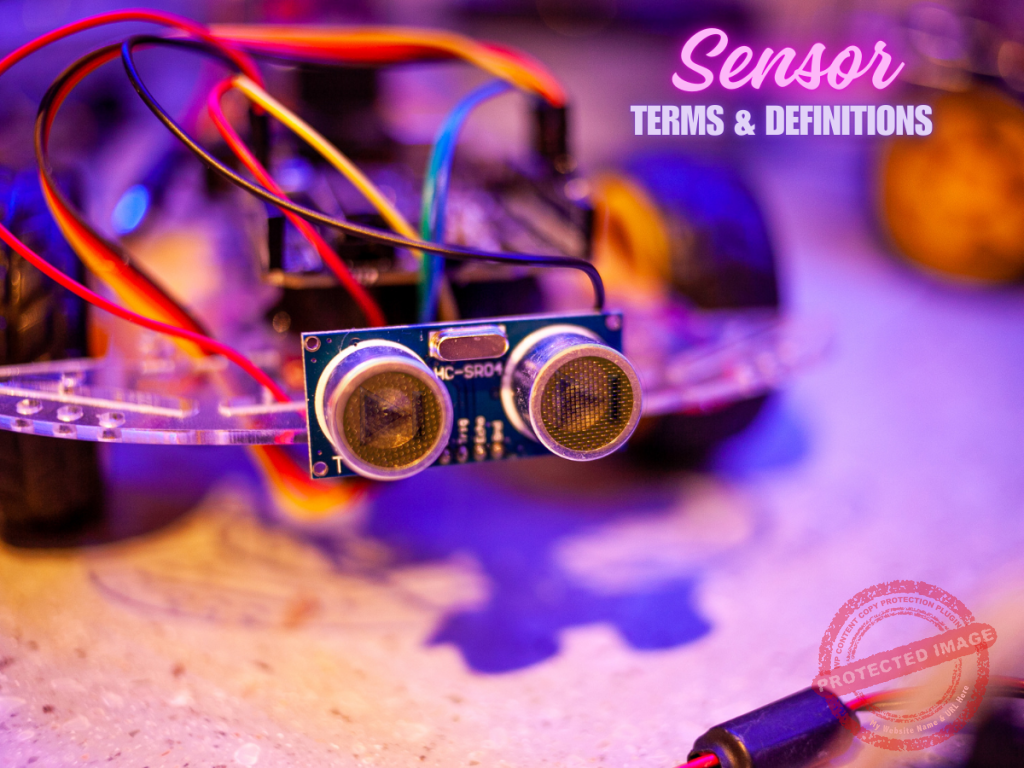
46. Ultrasonic Sensor: A device that measures distance by emitting ultrasonic waves and detecting their reflection.
47. Infrared Sensor: A device that detects infrared radiation, often used for motion detection or temperature measurement.
48. Hall Effect Sensor: A device that varies its output voltage in response to changes in magnetic field.
49. Accelerometer: A sensor that measures proper acceleration (g-force) and can detect orientation and vibration.
50. Gyroscope: A sensor that measures angular velocity or maintains orientation based on the principles of angular momentum.
51. Magnetometer: A device that measures the strength and/or direction of magnetic fields.
52. Humidity Sensor: A device that measures the amount of water vapor in the air or other gases.
53. pH Sensor: A device that measures the acidity or alkalinity of a solution.
54. Biosensor: A device that combines a biological component with a physicochemical detector to detect biological elements.
55. Gas Sensor: A device that detects the presence and concentration of specific gases in the environment.
56. Image Sensor: A device that converts optical images into electronic signals.
57. Tactile Sensor: A device that measures information arising from physical interaction with its environment.
58. MEMS Sensor: Microelectromechanical systems sensors that integrate mechanical elements, sensors, and electronics on a common silicon substrate.
Signal Conditioning and Processing
59. Signal Conditioning: The manipulation of signals to prepare them for further processing or analysis.
60. Amplification: The process of increasing the magnitude of a signal using an amplifier.
61. Attenuation: The reduction of signal strength, typically to prevent overloading of subsequent stages.
62. Filtering: The process of removing unwanted components or features from a signal.
63. Analog-to-Digital Converter (ADC): A device that converts analog signals to digital format.
64. Digital-to-Analog Converter (DAC): A device that converts digital signals to analog format.
65. Multiplexing: The process of combining multiple signals into one signal, allowing them to share a common transmission medium.
66. Demultiplexing: The process of separating a combined signal back into its original components.
67. Linearization: The process of transforming a nonlinear sensor response into a linear relationship.
68. Bridge Circuit: An electrical circuit used to measure unknown electrical resistance, often incorporated in sensor systems.
69. Wheatstone Bridge: A specific type of bridge circuit used to measure unknown resistance by balancing two legs of the bridge.
70. Offset Adjustment: The process of removing unwanted DC components from a sensor signal.
71. Zero Calibration: The adjustment of a measurement system to read zero when no input is present.
72. Span Calibration: The adjustment of a measurement system to provide the correct output at full-scale input.
73. Impedance Matching: The practice of designing the input impedance of an electrical load to maximize power transfer.
74. Isolation Amplifier: A device that transfers a signal from one circuit to another while electrically isolating them.
75. Sample and Hold Circuit: A circuit that captures and holds the analog value of a signal at a specific point in time.
76. Low-Pass Filter: A filter that passes signals with frequencies lower than a cutoff frequency and attenuates higher frequencies.
77. High-Pass Filter: A filter that passes signals with frequencies higher than a cutoff frequency and attenuates lower frequencies.
78. Band-Pass Filter: A filter that passes signals within a certain frequency range and attenuates signals outside that range.
79. Notch Filter: A filter that rejects signals within a narrow frequency band and passes all others.
Sensor Networks and Systems
80. Sensor Network: A group of spatially distributed sensors that monitor physical or environmental conditions and communicate the data to a central location.
81. Sensor Node: An individual device in a sensor network that includes sensing, processing, and communication capabilities.
82. Wireless Sensor Network (WSN): A network of sensors that communicate wirelessly, typically used for monitoring remote or inaccessible locations.
83. Sensor Fusion: The process of combining data from multiple sensors to improve accuracy or derive new information.
84. Data Acquisition System (DAQ): Hardware and software used to measure and record sensor data.
85. Internet of Things (IoT): A network of physical objects embedded with sensors, software, and connectivity to collect and exchange data.
86. Smart Sensor: A sensor that includes signal processing, self-calibration, and communication capabilities.
87. Distributed Sensing: A sensing approach where multiple sensors are deployed across an area to provide broader coverage.
88. Sensor Interface: The hardware and software components that connect sensors to processing systems.
89. Sensor Gateway: A device that connects a sensor network to external networks or the internet.
90. Energy Harvesting: The process of capturing and storing energy from the environment to power sensor nodes.
Advanced Sensor Concepts
91. Quantum Sensor: A sensor that exploits quantum mechanical effects to achieve higher sensitivity or precision than classical sensors.
92. Fibre Optic Sensor: A sensor that uses optical fibers as sensing elements or to transmit signals from remote sensors.
93. Chemical Sensor: A device that transforms chemical information into an analytically useful signal.
94. Resonant Sensor: A sensor that utilizes the resonant frequency of a structure, which changes in response to the measurand.
95. Self-Calibrating Sensor: A sensor capable of automatically adjusting its calibration parameters to maintain accuracy.
96. Virtual Sensor: A software algorithm that estimates a measurand based on indirect measurements from other sensors.
97. Miniaturized Sensor: A sensor designed to be very small, often for use in confined spaces or for minimal invasiveness.
98. Robustness: The ability of a sensor to withstand harsh environmental conditions while maintaining performance.
99. Redundancy: The inclusion of multiple sensors measuring the same parameter to improve reliability and fault tolerance.
100. Sensor Calibration Curve: A plot showing the relationship between sensor input and output over its operating range.
101. Cross-Sensitivity: The sensitivity of a sensor to measurands other than the one it is primarily designed to detect.
102. Environmental Compensation: Techniques to correct for environmental factors that affect sensor readings, such as temperature or pressure.
103. Sensor Aging: The degradation of sensor performance over time due to physical or chemical changes.
104. Ratiometric Measurement: A measurement technique where the sensor output is referenced to its supply voltage to improve accuracy.
105. Smart Dust: Miniature wireless sensor nodes that can be scattered or suspended in the environment.
106. Sensor Characterization: The process of determining the performance parameters of a sensor under various conditions.
107. Embedded Sensor: A sensor that is integrated directly into a structure or material.
108. Bio-inspired Sensor: A sensor designed to mimic sensing capabilities found in biological systems.
109. Soft Sensor: A computational algorithm that uses available measurements to estimate variables that are difficult to measure directly.
110. Sensor Array: A group of similar sensors arranged in a specific pattern to provide spatial information or improved performance.
111. Digital Sensor: A sensor that outputs digital signals directly, without requiring external analog-to-digital conversion.
Mastering these 101+ sensor terms puts you significantly ahead in your board exam preparation. After reviewing thousands of past exams and guiding hundreds of students through successful board exam journeys, I can confidently say these definitions cover what examiners consistently test.
But remember – understanding beats memorization every time. Use this guide as your foundation, but strengthen your knowledge by connecting these concepts to real-world applications. Try explaining each term to a classmate. Create your own examples. Sketch the relationships between related terms. These active learning techniques solidify your understanding far better than passive reading.
Keep this guide handy during your review sessions. Reference it when solving practice problems. Return to it in those final days before the exam when you need to refresh critical concepts. The engineers who consistently top the board exams aren’t necessarily the brightest – they’re the ones who approach their preparation strategically.
For more exam-focused engineering resources, practice questions, and review materials tailored specifically for Filipino engineering students, bookmark Pinoybix.org and visit regularly. We’re continuously updating our content based on the latest exam trends and student feedback.
Goodluck, future engineer. The board exam is just the beginning of your journey, but with the right preparation, it’s a challenge you’re more than equipped to overcome.
Related Content



P inoyBIX educates thousands of reviewers and students a day in preparation for their board examinations. Also provides professionals with materials for their lectures and practice exams. Help me go forward with the same spirit.
“Will you subscribe today via YOUTUBE?”
TIRED OF ADS?
- Become Premium Member and experienced complete ads-free content browsing.
- Full Content Access to Premium Solutions Exclusive for Premium members
- Access to PINOYBIX FREEBIES folder
- Download Reviewers and Learning Materials Free
- Download Content: You can see download/print button at the bottom of each post.
PINOYBIX FREEBIES FOR PREMIUM MEMBERSHIP:
- CIVIL ENGINEERING REVIEWER
- CIVIL SERVICE EXAM REVIEWER
- CRIMINOLOGY REVIEWER
- ELECTRONICS ENGINEERING REVIEWER (ECE/ECT)
- ELECTRICAL ENGINEERING & RME REVIEWER
- FIRE OFFICER EXAMINATION REVIEWER
- LET REVIEWER
- MASTER PLUMBER REVIEWER
- MECHANICAL ENGINEERING REVIEWER
- NAPOLCOM REVIEWER
- Additional upload reviewers and learning materials are also FREE
FOR A LIMITED TIME
If you subscribe for PREMIUM today!
You will receive an additional 1 month of Premium Membership FREE.
For Bronze Membership an additional 2 months of Premium Membership FREE.
For Silver Membership an additional 3 months of Premium Membership FREE.
For Gold Membership an additional 5 months of Premium Membership FREE.
Join the PinoyBIX community.