
Every semiconductor device starts with a material choice, and that choice comes down to one number: how much energy it takes to free an electron. Silicon, germanium, and gallium arsenide all sit in a narrow conductivity range between conductors and insulators, and the exact position each one occupies is what makes diode action possible in the first place. Understanding semiconductor materials and energy levels is not background trivia — it is the physical reason every formula in the rest of this series works the way it does.
This is Part 2 of the Semiconductor Diode Fundamentals ECE Board Exam Reviewer Series on PinoyBIX.org. Part 1 covered the ideal diode model. This part goes back a step further, covering the conductivity spectrum, the energy band gap, and why temperature affects semiconductors and conductors in opposite ways. If you are reviewing for the ECE or EE board exam or currently enrolled in Electronics 1, save this page.
- ECE (Electronics Engineer) — Energy gap values, conductivity classification, and temperature coefficient behavior appear regularly in Electronic Devices and Circuits items. Expect 2 to 4 items testing recall of Eg values for Si, Ge, and GaAs, and comparison-style questions on temperature effects. This material also underpins later topics on breakdown and resistance levels.
- EE (Electrical Engineer) — Appears occasionally as conceptual items on conductor versus semiconductor temperature coefficient behavior. Lower frequency than on the ECE board.
Bottom line: ECE examinees must memorize the three Eg values cold and understand the negative temperature coefficient of semiconductors. EE examinees should understand the conductivity spectrum conceptually.
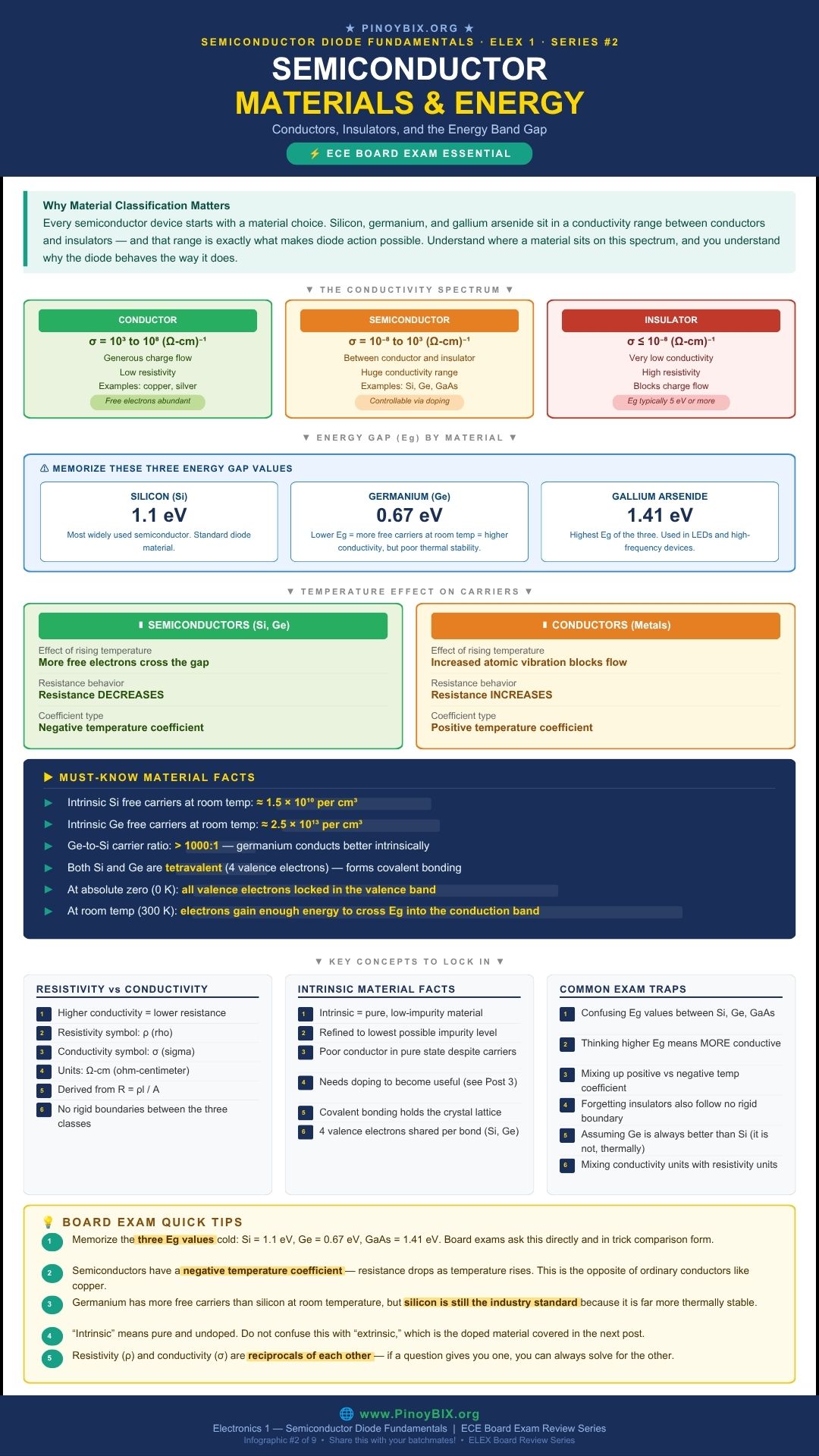
The Conductivity Spectrum: Conductors, Semiconductors, and Insulators
Every material can be classified by how easily it conducts electric current, measured as conductivity ( ) or its reciprocal, resistivity (
 ). Conductors sit at one end with very high conductivity — think copper or silver. Insulators sit at the other end with very low conductivity — think rubber or glass. Semiconductors occupy a wide range in between, and no rigid boundary separates one class from the next.
![\[\text{Conductor: } \sigma \approx 10^3 \text{ to } 10^8\ (\Omega\text{-cm})^{-1}\]](https://pinoybix.org/wp-content/ql-cache/quicklatex.com-a45eb054b4b0d1bb9c56919529b8e4ec_l3.png "Rendered by QuickLaTeX.com")
![\[\text{Semiconductor: } \sigma \approx 10^{-6} \text{ to } 10^3\ (\Omega\text{-cm})^{-1}\]](https://pinoybix.org/wp-content/ql-cache/quicklatex.com-daa7151adf4bddd3ccbb29a8fbc4fb05_l3.png "Rendered by QuickLaTeX.com")
![\[\text{Insulator: } \sigma \leq 10^{-6}\ (\Omega\text{-cm})^{-1}\]](https://pinoybix.org/wp-content/ql-cache/quicklatex.com-9e38c9636bb0e326d807274a2a3b1780_l3.png "Rendered by QuickLaTeX.com")
![\[\rho = \dfrac{1}{\sigma}\]](https://pinoybix.org/wp-content/ql-cache/quicklatex.com-dc7e9376c3d1a2dd051bf56da47691f0_l3.png "Rendered by QuickLaTeX.com")
Notice how wide the semiconductor range is compared to the other two. That range is exactly what makes doping useful later in this series — a semiconductor’s conductivity can be pushed almost anywhere inside that band depending on how it is treated.
The Energy Band Gap (Eg): The Number That Defines a Semiconductor
Electrons in a material occupy the valence band when bound to their atoms and the conduction band when free to move and carry current. Between these two bands sits a gap, measured in electron-volts (eV), that an electron must cross to become a free carrier. This gap is called the energy band gap, or  . A wide gap means a good insulator. A narrow or nonexistent gap means a good conductor. Semiconductors sit in between, with a gap small enough to cross with a reasonable amount of thermal energy at room temperature.
![\[E_g(\text{Si}) = 1.1 \text{ eV} \qquad E_g(\text{Ge}) = 0.67 \text{ eV} \qquad E_g(\text{GaAs}) = 1.41 \text{ eV}\]](https://pinoybix.org/wp-content/ql-cache/quicklatex.com-7a6df6125e7ea2b3d3684ccd7bfd303f_l3.png "Rendered by QuickLaTeX.com")
Germanium has the smallest gap of the three, which means its electrons need the least thermal energy to jump into the conduction band. This is exactly why germanium has more free carriers than silicon at room temperature, even though silicon is the industry standard material.
Intrinsic Material and Covalent Bonding
An intrinsic material is a semiconductor refined to the lowest possible level of impurity — as close to chemically pure as manufacturing allows. Silicon and germanium are both tetravalent, meaning each atom has four valence electrons. In a crystal lattice, each atom shares its four valence electrons with four neighboring atoms, forming covalent bonds that hold the structure together. At absolute zero, every valence electron is locked into a bond. As temperature rises, thermal energy breaks some of these bonds free, creating electron-hole pairs and allowing conduction.
![\[n_i(\text{Si}) \approx 1.5 \times 10^{10} \text{ carriers/cm}^3\]](https://pinoybix.org/wp-content/ql-cache/quicklatex.com-4cd854e805b816f72ddaefb0ab6ba053_l3.png "Rendered by QuickLaTeX.com")
![\[n_i(\text{Ge}) \approx 2.5 \times 10^{13} \text{ carriers/cm}^3\]](https://pinoybix.org/wp-content/ql-cache/quicklatex.com-190e7f84dd9811c4a0bf18bcaaff7bd8_l3.png "Rendered by QuickLaTeX.com")
Germanium has roughly a thousand times more free carriers than silicon at the same temperature, purely because of its smaller energy gap. More free carriers sounds like an advantage, but it comes with a cost covered in the next section.
Temperature Effects: Why Semiconductors and Conductors Behave Oppositely
Raise the temperature of a conductor and its resistance goes up. Raise the temperature of a semiconductor and its resistance goes down. These are opposite behaviors, described by opposite temperature coefficients, and board exams test this contrast directly.
Conductors (metals): positive temperature coefficient. Rising temperature increases atomic vibration, which scatters current-carrying electrons and increases resistance.
Semiconductors (Si, Ge): negative temperature coefficient. Rising temperature breaks more covalent bonds, freeing more carriers and decreasing resistance.
This negative temperature coefficient is also why germanium diodes are more temperature-sensitive than silicon diodes in practice. A smaller Eg means the carrier population — and therefore the leakage current — grows faster as temperature rises.
Worked Problems — Board Exam Type Questions
The following 10 problems are representative of actual ECE and EE board exam questions on semiconductor materials and energy levels. Work each problem by hand before reading the solution.
Problem 1 — ECE Board Exam Type
A material has a conductivity of  . Classify this material.
Given:
Find: Material classification
Solution:
Step 1: Compare against the standard conductivity ranges.
Step 2:  falls within the conductor range (
 to
to  ).
).
Examiner note: Memorize the boundary values, not just the material names, since board items often give a numeric conductivity and ask for classification.
Problem 2 — ECE Board Exam Type
A material has a conductivity of  . Classify this material.
Given:
Find: Material classification
Solution:
Step 1: Compare against the standard conductivity ranges.
Step 2:  falls below the insulator threshold of
  .
.
Examiner note: The lower the conductivity value, the deeper into insulator territory the material sits.
Problem 3 — ECE Board Exam Type
A sample has a resistivity of  . Find its conductivity and classify the material.
Given:
Find: and classification
Solution:
Step 1: Apply the reciprocal relationship.
![\[\sigma = \dfrac{1}{\rho} = \dfrac{1}{500} = 2 \times 10^{-3}\ (\Omega\text{-cm})^{-1}\]](https://pinoybix.org/wp-content/ql-cache/quicklatex.com-dbe603cbe09d1eb4d4563022c0a5e10c_l3.png "Rendered by QuickLaTeX.com")
Step 2: This value falls within the semiconductor range ( to ).
 , a semiconductor
Examiner note: Resistivity and conductivity are reciprocals. If a problem gives you one, you can always solve for the other before classifying.
Problem 4 — ECE Board Exam Type
Compare silicon ( eV) and germanium (
 eV). Which material requires more thermal energy to promote an electron into the conduction band?
Given:  eV,
eV,  eV
eV
Find: Which material needs more energy
Solution:
Step 1: A larger means a wider gap between the valence and conduction bands.
Step 2: Silicon’s gap (1.1 eV) is larger than germanium’s gap (0.67 eV).
Examiner note: This is also why germanium has more free carriers than silicon at the same temperature — its smaller gap is easier to cross.
Problem 5 — ECE Board Exam Type
An engineer needs a diode that remains stable at high operating temperatures, around 150°C. Should silicon or germanium be selected?
Given: High-temperature operating requirement
Find: Material selection
Solution:
Step 1: A larger energy gap means the carrier population grows more slowly as temperature increases.
Step 2: Silicon’s larger (1.1 eV versus 0.67 eV) makes it far more thermally stable than germanium.
Examiner note: This is the practical reason silicon replaced germanium as the industry standard, despite germanium’s lower forward voltage drop.
Problem 6 — ECE Board Exam Type
A copper wire and a silicon sample are both heated from 25°C to 75°C. Describe the resistance change in each material.
Given: Copper (conductor) and silicon (semiconductor), temperature increase
Find: Resistance change direction for each
Solution:
Step 1: Copper is a conductor with a positive temperature coefficient — its resistance increases with temperature.
Step 2: Silicon is a semiconductor with a negative temperature coefficient — its resistance decreases with temperature.
Examiner note: This opposite behavior is one of the most direct comparison questions examiners ask on this topic. Do not assume all materials behave like metals.
Problem 7 — ECE Board Exam Type
A material is identified with  eV. Which of the three common semiconductor materials is this, and what property makes it useful in LEDs?
Given: eV
Find: Material identification and relevant property
Solution:
Step 1: Compare against the known Eg values: Si = 1.1 eV, Ge = 0.67 eV, GaAs = 1.41 eV.
Step 2: The value matches gallium arsenide, whose higher Eg allows it to emit higher-energy (visible) photons, which is why it is common in LED applications.
Examiner note: Reverse-lookup questions like this — giving the Eg and asking for the material — are a common board exam format. Memorize the values, not just the names.
Problem 8 — ECE Board Exam Type
A semiconductor sample has length  cm, cross-sectional area
  , and measured resistance
  . Find its resistivity.
Given: cm, ,
Find:
Solution:
Step 1: Apply the resistivity formula  , solved for .
![\[\rho = \dfrac{R \times A}{L} = \dfrac{200 \times 0.5}{2} = 50\ \Omega\text{-cm}\]](https://pinoybix.org/wp-content/ql-cache/quicklatex.com-096dd7240cb8ab2350c397099426037d_l3.png "Rendered by QuickLaTeX.com")

Examiner note: Keep units consistent — length and area both in centimeters here — before plugging into the formula.
Problem 9 — ECE Board Exam Type
How many valence electrons does a silicon or germanium atom have, and what type of bonding holds the crystal lattice together?
Given: Silicon and germanium atomic structure
Find: Valence electron count and bonding type
Solution:
Step 1: Both silicon and germanium are tetravalent, meaning each atom has four valence electrons.
Step 2: Each atom shares its four valence electrons with four neighbors, forming covalent bonds that build the crystal lattice.
Examiner note: This tetravalent structure is the foundation for understanding doping in the next post — pentavalent and trivalent dopants are defined relative to this four-electron baseline.
Problem 10 — EE Board Exam Type
True or False: Intrinsic silicon at room temperature has more free carriers than intrinsic germanium at the same temperature.
Given: Intrinsic Si and Ge at room temperature
Find: True or False, with reasoning
Solution:
Step 1: Compare intrinsic carrier concentrations:  versus
  .
.
Step 2: Germanium has roughly a thousand times more free carriers than silicon at room temperature.
Examiner note: More free carriers does not automatically mean a “better” material. Silicon’s thermal stability outweighs germanium’s higher intrinsic conductivity for most practical applications.
Common Mistakes and Examiner Traps
| ❌ Mistake | ✅ Correction |
|---|---|
| Confusing the three Eg values between Si, Ge, and GaAs | Memorize them as a set: Si = 1.1 eV, Ge = 0.67 eV, GaAs = 1.41 eV, and always double-check which material a problem refers to. |
| Assuming a higher Eg means a more conductive material | Remember the relationship is inverse — a higher Eg means fewer carriers cross into conduction, meaning lower intrinsic conductivity. |
| Mixing up positive and negative temperature coefficients | Conductors are positive, semiconductors are negative — resistance rises with heat in one, falls with heat in the other. |
| Assuming germanium is always the better semiconductor since it has more carriers | Consider thermal stability, not just carrier count — silicon remains the industry standard because of its larger Eg. |
| Mixing conductivity units with resistivity units | Keep and as reciprocals and always check which one a formula or problem is asking for. |
Board Exam Quick Tips
- Memorize the three Eg values cold: Si = 1.1 eV, Ge = 0.67 eV, GaAs = 1.41 eV. Board exams ask this directly and in comparison form.
- Semiconductors have a negative temperature coefficient — resistance drops as temperature rises. This is the opposite of ordinary conductors.
- Germanium has more free carriers than silicon at room temperature, but silicon remains the industry standard because it is far more thermally stable.
- “Intrinsic” means pure and undoped. Do not confuse this with “extrinsic,” the doped material covered in the next post.
- Resistivity () and conductivity () are reciprocals of each other — if a problem gives you one, you can always solve for the other.
Frequently Asked Questions
Q1. Why is silicon used more often than germanium if germanium conducts better intrinsically?
Silicon has a larger energy gap, which makes it far more thermally stable. Germanium’s smaller gap means its leakage current grows too quickly at higher temperatures for most practical applications.
Q2. What does “intrinsic” mean in the context of semiconductor materials?
Intrinsic means the material has been refined to the lowest possible impurity level — as close to pure as manufacturing allows, with no deliberate doping added.
Q3. Is there a hard boundary between conductors, semiconductors, and insulators?
No. The conductivity ranges overlap in a general sense, and classification is based on where a material’s conductivity typically falls, not on a strict, universally fixed line.
Q4. Why does temperature affect semiconductors and conductors in opposite ways?
In conductors, rising temperature increases atomic vibration, which scatters free electrons and increases resistance. In semiconductors, rising temperature breaks more covalent bonds, freeing more carriers and decreasing resistance.
Q5. Does gallium arsenide behave like silicon or germanium?
It behaves like a semiconductor in the same general family, but its higher Eg (1.41 eV) makes it distinct, especially useful in LEDs and high-frequency devices where silicon and germanium are less suited.
What Is Next
Now that you understand where semiconductors sit on the conductivity spectrum and why their energy gap matters, the next post explains how doping deliberately changes a semiconductor’s carrier population — turning intrinsic material into the n-type and p-type building blocks every diode is made from.
→ Continue to Post 3 — N-Type and P-Type Semiconductors
→ Back to the Semiconductor Diode Fundamentals Series Index
Published by PinoyBIX.org — Engineering Education for Every Filipino Student. Electronics · Mathematics · Board Exam Review · Free for Everyone.
Related Content


P inoyBIX educates thousands of reviewers and students a day in preparation for their board examinations. Also provides professionals with materials for their lectures and practice exams. Help me go forward with the same spirit.
“Will you subscribe today via YOUTUBE?”
TIRED OF ADS?
- Become Premium Member and experienced complete ads-free content browsing.
- Full Content Access to Premium Solutions Exclusive for Premium members
- Access to PINOYBIX FREEBIES folder
- Download Reviewers and Learning Materials Free
- Download Content: You can see download/print button at the bottom of each post.
PINOYBIX FREEBIES FOR PREMIUM MEMBERSHIP:
- CIVIL ENGINEERING REVIEWER
- CIVIL SERVICE EXAM REVIEWER
- CRIMINOLOGY REVIEWER
- ELECTRONICS ENGINEERING REVIEWER (ECE/ECT)
- ELECTRICAL ENGINEERING & RME REVIEWER
- FIRE OFFICER EXAMINATION REVIEWER
- LET REVIEWER
- MASTER PLUMBER REVIEWER
- MECHANICAL ENGINEERING REVIEWER
- NAPOLCOM REVIEWER
- Additional upload reviewers and learning materials are also FREE
FOR A LIMITED TIME
If you subscribe for PREMIUM today!
You will receive an additional 1 month of Premium Membership FREE.
For Bronze Membership an additional 2 months of Premium Membership FREE.
For Silver Membership an additional 3 months of Premium Membership FREE.
For Gold Membership an additional 5 months of Premium Membership FREE.
Join the PinoyBIX community.