
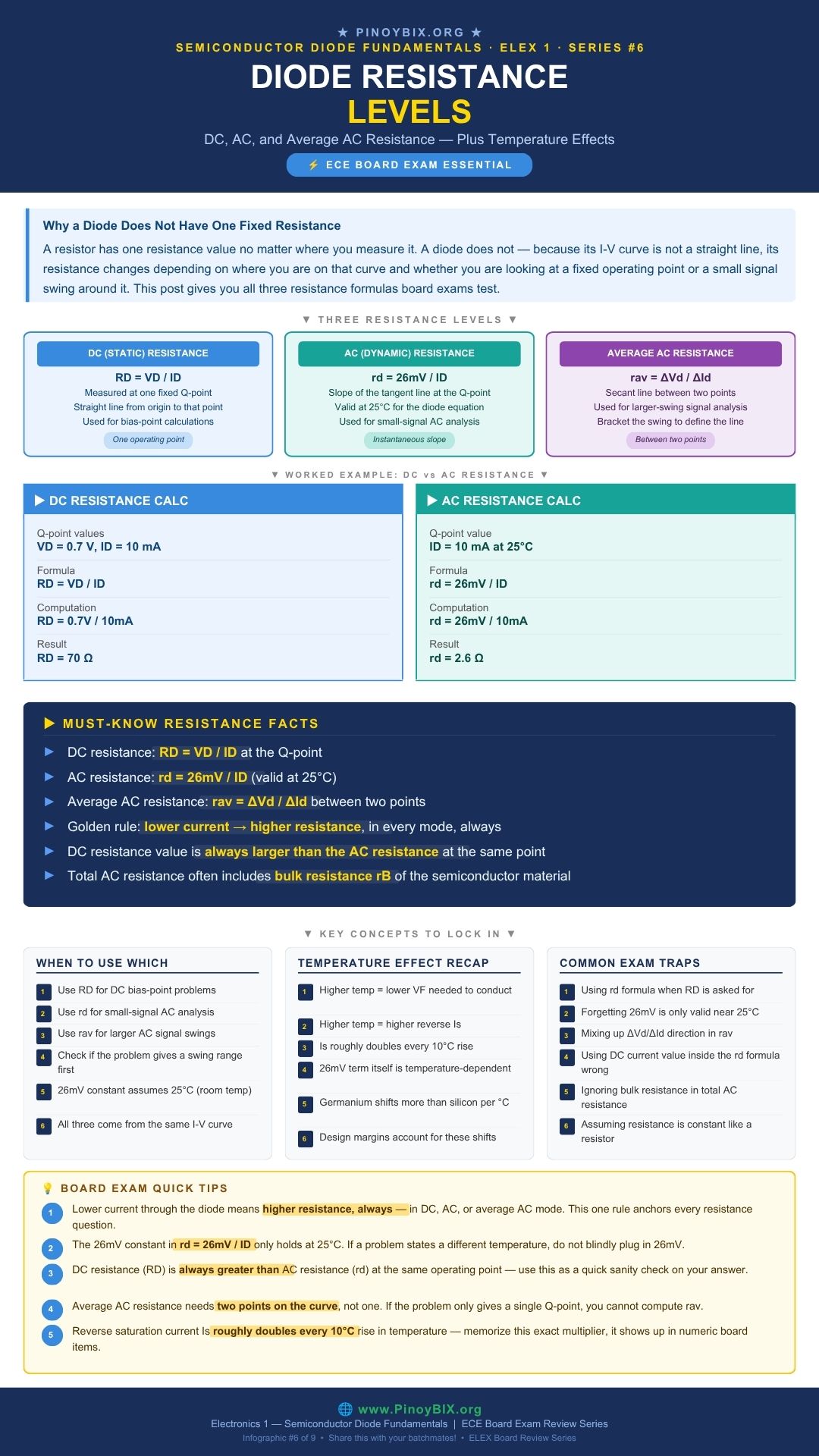
A resistor has one resistance value no matter where you measure it. A diode does not, because its I-V curve is not a straight line — its resistance changes depending on where you are on that curve and whether you are looking at a fixed operating point or a small signal swing around it. This post covers all three diode resistance levels — DC, AC, and average AC — plus how temperature shifts the numbers behind them.
This is Part 6 of the Semiconductor Diode Fundamentals ECE Board Exam Reviewer Series on PinoyBIX.org. Part 5 covered breakdown and the Zener region. This part shifts from voltage behavior to resistance behavior at a given operating point. If you are reviewing for the ECE or EE board exam or currently enrolled in Electronics 1, save this page.
- ECE (Electronics Engineer) — DC, AC, and average AC resistance calculations are a reliable source of numeric board exam items in Electronic Devices and Circuits. Expect 3 to 5 items requiring direct formula application, plus items testing the golden rule that lower current always means higher resistance across all three types.
- EE (Electrical Engineer) — Appears with lower frequency, mostly limited to basic DC resistance and conceptual temperature effect questions.
Bottom line: ECE examinees must be fluent in all three resistance formulas and know which one a given problem calls for. EE examinees need DC resistance and general temperature behavior.
DC (Static) Resistance
DC resistance is measured at a single fixed operating point, called the Q-point, using the actual voltage and current values at that point. Graphically, it is the slope of a straight line drawn from the origin of the I-V curve to the Q-point itself.
![\[R_D = \dfrac{V_D}{I_D}\]](https://pinoybix.org/wp-content/ql-cache/quicklatex.com-49b3e1f87a81bf4a00053c73e4cf1458_l3.png "Rendered by QuickLaTeX.com")
AC (Dynamic) Resistance
AC resistance describes how the diode responds to a small signal riding on top of a DC operating point. Graphically, it is the slope of the tangent line to the I-V curve at the Q-point. At 25°C, this simplifies to a convenient formula using the thermal voltage constant of 26 mV.
![\[r_d = \dfrac{26\text{ mV}}{I_D} \quad \text{(valid at } 25^\circ\text{C)}\]](https://pinoybix.org/wp-content/ql-cache/quicklatex.com-93a612e7ff88e7b939538c4acd9c0c12_l3.png "Rendered by QuickLaTeX.com")
Total AC resistance in practice often adds the bulk resistance  of the semiconductor material itself:
  .
.
Average AC Resistance
Average AC resistance applies when a signal swings across a larger portion of the curve rather than staying close to a single point. It is calculated using two points that bracket the swing, forming a secant line instead of a tangent line.
![\[r_{av} = \dfrac{\Delta V_d}{\Delta I_d}\]](https://pinoybix.org/wp-content/ql-cache/quicklatex.com-85bedf7950cf4e245bea2c56087ad540_l3.png "Rendered by QuickLaTeX.com")
The Golden Rule of Diode Resistance
All three resistance levels follow the same underlying rule: the lower the current through the diode, the higher its resistance, in every mode, always. This makes sense once you remember that a diode’s I-V curve is exponential in the forward region — steep near the top, shallow near the bottom.
At the same operating point, DC resistance ( ) is always larger than AC resistance (
 ). Average AC resistance (
 ) falls between whatever two points define the swing, and depends on how far apart those points are on the curve.
Temperature Effects Recap
Higher temperature lowers the forward voltage needed to reach a given current, and it raises the reverse saturation current  , which roughly doubles for every 10°C rise, as covered in Post 4. The 26 mV thermal voltage constant used in the AC resistance formula is itself temperature-dependent, so the formula’s accuracy assumes operation near 25°C. Germanium shifts more per degree than silicon, which is part of why silicon remains the more thermally stable, industry-standard choice.
Worked Problems — Board Exam Type Questions
The following 10 problems are representative of actual ECE and EE board exam questions on diode resistance levels and temperature effects. Work each problem by hand before reading the solution.
Problem 1 — ECE Board Exam Type
A diode operates at a Q-point of  V,
V,  mA. Find the DC resistance.
Given: V, mA
Find:
Solution:
Step 1: Apply the DC resistance formula.
![\[R_D = \dfrac{V_D}{I_D} = \dfrac{0.7}{0.010} = 70\ \Omega\]](https://pinoybix.org/wp-content/ql-cache/quicklatex.com-43bf8d1058e688e32f0646d723e546b8_l3.png "Rendered by QuickLaTeX.com")

Examiner note: DC resistance is simply Ohm’s law applied at a single fixed point on the curve.
Problem 2 — ECE Board Exam Type
The same diode from Problem 1 operates at 25°C. Find its AC (dynamic) resistance.
Given: mA, 
Find:
Solution:
Step 1: Apply the AC resistance formula.
![\[r_d = \dfrac{26\text{ mV}}{I_D} = \dfrac{26}{10} = 2.6\ \Omega\]](https://pinoybix.org/wp-content/ql-cache/quicklatex.com-26396a364e6d82e252e776e3963e88d7_l3.png "Rendered by QuickLaTeX.com")

Examiner note: Compare this to from Problem 1 — AC resistance is always smaller than DC resistance at the same point.
Problem 3 — ECE Board Exam Type
A diode operates at  mA at 25°C. Find its AC resistance.
Given: mA,
Find:
Solution:
Step 1: Apply the AC resistance formula.
![\[r_d = \dfrac{26\text{ mV}}{5\text{ mA}} = 5.2\ \Omega\]](https://pinoybix.org/wp-content/ql-cache/quicklatex.com-476159245bb1c8f9348546b508a04d13_l3.png "Rendered by QuickLaTeX.com")

Examiner note: Compare this to Problem 2 — halving the current doubled the AC resistance, confirming the golden rule that lower current means higher resistance.
Problem 4 — ECE Board Exam Type
A diode’s I-V curve shows  V corresponding to
  mA across a signal swing. Find the average AC resistance.
Given: V, mA
Find:
Solution:
Step 1: Apply the average AC resistance formula.
![\[r_{av} = \dfrac{\Delta V_d}{\Delta I_d} = \dfrac{0.1}{0.020} = 5\ \Omega\]](https://pinoybix.org/wp-content/ql-cache/quicklatex.com-ed457c4e4b165e8a97f5d386897e1d04_l3.png "Rendered by QuickLaTeX.com")

Examiner note: Average AC resistance requires two points on the curve, not one. If a problem only gives a single Q-point, you cannot compute .
Problem 5 — ECE Board Exam Type
At the same operating point, which is always larger: DC resistance or AC resistance ?
Given: Same Q-point comparison
Find: Which resistance is larger
Solution:
Step 1: is the slope of a line from the origin to the Q-point, while is the slope of the tangent line at that same point.
Step 2: Because the curve is exponential and concave, the origin-to-point slope is always steeper than the tangent slope at that point, making  .
.
is always larger than at the same point
Examiner note: Use this as a quick sanity check on your answers — if your computed comes out larger than at the same point, you have made an arithmetic error.
Problem 6 — ECE Board Exam Type
If the current through a diode is increased, what happens to its AC resistance ?
Given: Increasing diode current
Find: Effect on
Solution:
Step 1:  is inversely proportional to current.
Step 2: As  increases, decreases.
decreases
Examiner note: This is the golden rule in action — higher current always means lower resistance in every diode resistance mode.
Problem 7 — ECE Board Exam Type
Compare the AC resistance of a diode at  mA versus mA, both at 25°C.
Given: mA and mA,
Find: at each current, and the comparison
Solution:
Step 1: At mA: 
Step 2: At mA: 
Examiner note: The AC resistance formula is a direct inverse proportion — multiplying current by 10 always divides resistance by 10.
Problem 8 — ECE Board Exam Type
A diode has and a bulk resistance  . Find the total AC resistance.
Given: ,
Find: 
Solution:
Step 1: Add the bulk resistance to the dynamic resistance.
![\[r'_d = r_d + r_B = 2.6 + 0.5 = 3.1\ \Omega\]](https://pinoybix.org/wp-content/ql-cache/quicklatex.com-0fbaa69a08d7bee217320883152d8f52_l3.png "Rendered by QuickLaTeX.com")

Examiner note: The bulk resistance accounts for the resistance of the actual semiconductor material and contact leads, and is often ignored in simplified problems unless explicitly given.
Problem 9 — ECE Board Exam Type
A diode has  at 25°C. Estimate at 35°C, assuming it roughly doubles every 10°C.
Given: at 25°C, target 35°C
Find: Estimated at 35°C
Solution:
Step 1: The temperature rise is one full 10°C interval.
Step 2: Apply the doubling rule once.
![\[I_s(35^\circ\text{C}) = 3\ \mu\text{A} \times 2 = 6\ \mu\text{A}\]](https://pinoybix.org/wp-content/ql-cache/quicklatex.com-25895b163ba43010b8f8dabaf8d13f34_l3.png "Rendered by QuickLaTeX.com")
 at 35°C
Examiner note: This same doubling relationship from Post 4 continues to apply here — resistance and leakage current calculations are closely linked through temperature.
Problem 10 — EE Board Exam Type
An EE board item describes a diode operating point where only a single voltage and current reading is available. Which resistance type can be computed: DC, AC, or average AC?
Given: Single voltage and current reading only
Find: Which resistance type is computable
Solution:
Step 1: DC resistance only requires one voltage and current pair at a single point.
Step 2: AC resistance requires either the 26 mV formula with a known current, or a slope measurement; average AC resistance requires two points.
Examiner note: Recognizing what data a formula actually requires is as important as knowing the formula itself.
Common Mistakes and Examiner Traps
| ❌ Mistake | ✅ Correction |
|---|---|
| Using the rd formula when RD is asked for | Check which resistance type the problem specifies before selecting a formula — uses actual values at one point, uses the 26 mV constant. |
| Forgetting 26 mV is only valid near 25°C | Confirm the operating temperature before applying the standard formula without adjustment. |
Mixing up  direction in direction in |
Keep voltage change over current change, using two clearly defined points on the curve. |
| Using the wrong current value inside the formula |
Use the DC bias current at the Q-point, not a peak or average signal current, unless the problem specifies otherwise. |
| Ignoring bulk resistance in total AC resistance | Add when given: . |
Board Exam Quick Tips
- Lower current through the diode means higher resistance, always — in DC, AC, or average AC mode. This one rule anchors every resistance question.
- The 26 mV constant in only holds at 25°C. If a problem states a different temperature, do not blindly plug in 26 mV.
- DC resistance () is always greater than AC resistance () at the same operating point — use this as a quick sanity check on your answer.
- Average AC resistance needs two points on the curve, not one. If the problem only gives a single Q-point, you cannot compute .
- Reverse saturation current roughly doubles every 10°C rise in temperature — memorize this exact multiplier; it shows up in numeric board items.
Frequently Asked Questions
Q1. Why does a diode need three different resistance formulas instead of just one?
Because its I-V curve is nonlinear. A single fixed value cannot describe behavior across the whole curve, so DC resistance describes a bias point, AC resistance describes a small-signal response, and average AC resistance describes a larger signal swing.
Q2. Can ever be larger than at the same point?
No, under standard diode curve behavior. is the slope from the origin, always steeper than the tangent slope at the same point on an exponential curve.
Q3. Is the 26 mV value fixed for every diode?
It is a thermal voltage approximation valid near room temperature (25°C) for silicon diodes, derived from fundamental physical constants. It shifts with actual operating temperature.
Q4. When would an engineer use average AC resistance instead of dynamic resistance?
When the signal swing across the diode is large enough that a single tangent-line approximation at one point would not accurately represent the diode’s behavior across the whole swing.
Q5. Does bulk resistance change with current the way does?
No. Bulk resistance is treated as a relatively fixed physical property of the semiconductor material and contacts, unlike , which depends directly on the bias current.
What Is Next
Now that you can compute all three diode resistance levels, the next post ties everything from this series together into three formal approximation levels used to model a diode in circuit analysis — ideal, simplified, and piecewise-linear.
→ Continue to Post 7 — Diode Equivalent Circuits and Approximation Levels
→ Back to the Semiconductor Diode Fundamentals Series Index
Published by PinoyBIX.org — Engineering Education for Every Filipino Student. Electronics · Mathematics · Board Exam Review · Free for Everyone.
Related Content




P inoyBIX educates thousands of reviewers and students a day in preparation for their board examinations. Also provides professionals with materials for their lectures and practice exams. Help me go forward with the same spirit.
“Will you subscribe today via YOUTUBE?”
TIRED OF ADS?
- Become Premium Member and experienced complete ads-free content browsing.
- Full Content Access to Premium Solutions Exclusive for Premium members
- Access to PINOYBIX FREEBIES folder
- Download Reviewers and Learning Materials Free
- Download Content: You can see download/print button at the bottom of each post.
PINOYBIX FREEBIES FOR PREMIUM MEMBERSHIP:
- CIVIL ENGINEERING REVIEWER
- CIVIL SERVICE EXAM REVIEWER
- CRIMINOLOGY REVIEWER
- ELECTRONICS ENGINEERING REVIEWER (ECE/ECT)
- ELECTRICAL ENGINEERING & RME REVIEWER
- FIRE OFFICER EXAMINATION REVIEWER
- LET REVIEWER
- MASTER PLUMBER REVIEWER
- MECHANICAL ENGINEERING REVIEWER
- NAPOLCOM REVIEWER
- Additional upload reviewers and learning materials are also FREE
FOR A LIMITED TIME
If you subscribe for PREMIUM today!
You will receive an additional 1 month of Premium Membership FREE.
For Bronze Membership an additional 2 months of Premium Membership FREE.
For Silver Membership an additional 3 months of Premium Membership FREE.
For Gold Membership an additional 5 months of Premium Membership FREE.
Join the PinoyBIX community.