

Definition of Terms
- Virtual-circuit switching is a data link layer technology in which links are shared.
- A virtual-circuit identifier (VCI) identifies a frame between two switches.
- The three phases in virtual circuit switching are setup, data transfer, and teardown.
- The setup phase can use the permanent virtual circuit (PVC) approach or the switched virtual circuit (SVC) approach.
- Frame Relay is a relatively high-speed, cost-effective technology that can handle bursty data.
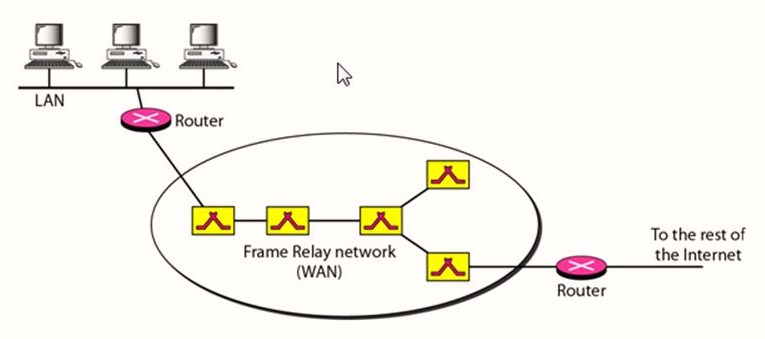
- Frame Relay is a virtual-circuit wide-area network that was designed in response to demands for a new type of WAN in the late 1980s and early 1990s.
- Frame Relay operates only at the physical and data link layers.
- Frame Relay does not provide flow or error control; they must be provided by the upper-layer protocols.
- To handle frames arriving from other protocols, Frame Relay uses a device called a
Frame Relay assembler/disassembler (FRAD). A FRAD assembles and disassembles
frames coming from other protocols to allow them to be carried by Frame Relay frames. - Frame Relay networks offer an option called Voice Over Frame Relay (VOFR) that
sends voice through the network. - Local Management Information (LMI) is a protocol added recently to the Frame Relay protocol to provide more management features.
- One of the nice features of Frame Relay is that it provides congestion control and quality of service (QoS).
- Both PVC and SVC connections are used in Frame Relay.
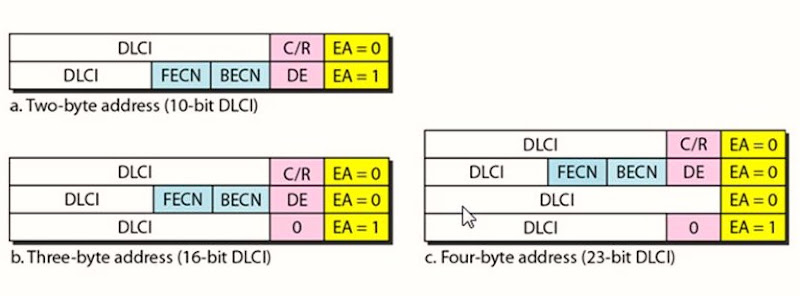
- The data link connection identifier (DLCI) identifies a virtual circuit in Frame Relay.
- VCIs in Frame Relay are called DLCIs.
- Asynchronous Transfer Mode (ATM) is a cell relay protocol that, in combination with SONET, allows high-speed connections.
- A cell is a small, fixed-size block of information.
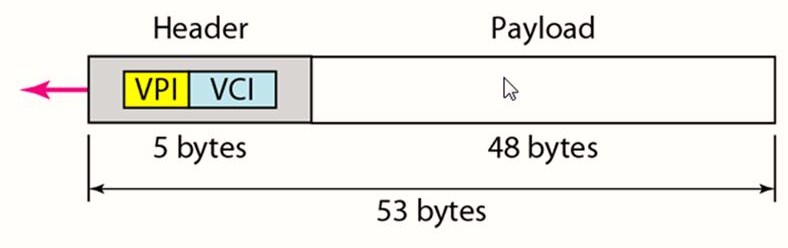
- The ATM data packet is a cell composed of 53 bytes (5 bytes of header and 48 bytes of payload).
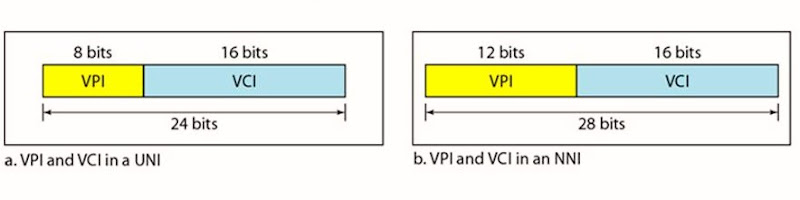
- Note that a virtual connection is defined by a pair of numbers: the VPI and the VCI.
- ATM eliminates the varying delay times associated with different-size packets.
- ATM can handle real-time transmission.
- A user-to-network interface (UNI) is the interface between a user and an ATM switch.
- A network-to-network interface (NNI) is the interface between two ATM switches.
- In ATM, connection between two endpoints is accomplished through transmission paths (TPs), virtual paths (VPs), and virtual circuits (VCs).
- In ATM, a combination of a virtual path identifier (VPI) and a virtual-circuit identifier identifies a virtual connection.
- ATM technology can be adopted for use in a LAN (ATM LAN).
- In a pure ATM LAN, an ATM switch connects stations.
- In a legacy ATM LAN, the backbone that connects traditional LANs uses ATM technology.
- A mixed architecture ATM LAN combines features of a pure ATM LAN and a legacy ATM LAN.
- Local-area network emulation (LANE) is a client/server model that allows the use of ATM technology in LANs.
- LANE software includes LAN emulation client (LECS), LAN emulation configuration server (LECS), LAN emulation server (LES), and broadcast/unknown server (BUS) modules.
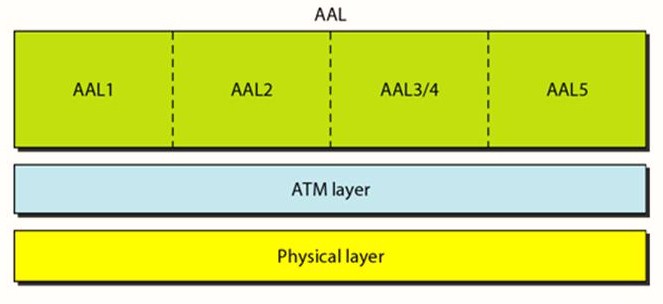
The ATM standard defines three layers:
- a. Application adaptation layer (AAL) accepts transmissions from upper-layer services and maps them into ATM cells. The AAL is divided into two sublayers: convergence sublayer (CS) and segmentation and reassembly (SAR).
- b. ATM layer provides routing, traffic management, switching, and multiplexing services.
- c. Physical layer defines the transmission medium, bit transmission, encoding, and electrical-to-optical transformation.
There are four different AALs, each for a specific data type:
- a. AAL1 for constant-bit-rate stream
- b. AAL2 for short packets.
- c. AAL3/4 for conventional packet switching (virtual-circuit approach or datagram approach).
- d. AAL5 for packets requiring no sequencing and no error control mechanism.
Frame Relay network
Three address formats
Virtual connection identifiers in UNIs and NNIs
An ATM cell
ATM layers
ATM LANs

DaysHoursMinSec
This offer has expired!
Note: You can proceed to take the multiple choice exam regarding this topic. Virtual-Circuit Networks: Frame Relay and ATM – Set 1 MCQs
List of Data Communications Lectures
credit: Behrouz A. Forouzan©2013 www.PinoyBIX.org
Related Content


Please do Subscribe on YouTube!
P inoyBIX educates thousands of reviewers and students a day in preparation for their board examinations. Also provides professionals with materials for their lectures and practice exams. Help me go forward with the same spirit.
“Will you subscribe today via YOUTUBE?”
What You Also Get: FREE ACCESS & DOWNLOAD via GDRIVE
TIRED OF ADS?
- Become Premium Member and experienced complete ads-free content browsing.
- Full Content Access to Premium Solutions Exclusive for Premium members
- Access to PINOYBIX FREEBIES folder
- Download Reviewers and Learning Materials Free
- Download Content: You can see download/print button at the bottom of each post.
PINOYBIX FREEBIES FOR PREMIUM MEMBERSHIP:
- CIVIL ENGINEERING REVIEWER
- CIVIL SERVICE EXAM REVIEWER
- CRIMINOLOGY REVIEWER
- ELECTRONICS ENGINEERING REVIEWER (ECE/ECT)
- ELECTRICAL ENGINEERING & RME REVIEWER
- FIRE OFFICER EXAMINATION REVIEWER
- LET REVIEWER
- MASTER PLUMBER REVIEWER
- MECHANICAL ENGINEERING REVIEWER
- NAPOLCOM REVIEWER
- Additional upload reviewers and learning materials are also FREE
FOR A LIMITED TIME
If you subscribe for PREMIUM today!
You will receive an additional 1 month of Premium Membership FREE.
For Bronze Membership an additional 2 months of Premium Membership FREE.
For Silver Membership an additional 3 months of Premium Membership FREE.
For Gold Membership an additional 5 months of Premium Membership FREE.
Join the PinoyBIX community.
DaysHoursMinSec
This offer has expired!