
Are you feeling overwhelmed by the extensive terminology surrounding DC motors as your engineering board exam approaches? You’re not alone. Many engineering students struggle to master the precise technical language that examiners expect in your answers. The difference between passing with flying colors and falling short often comes down to your command of these critical terms.
DC motors represent one of the most frequently tested topics on electrical engineering board exams, with terminology questions appearing consistently year after year. Missing these “easy points” due to terminology confusion can be the difference between celebration and heartbreak when results are posted.
This comprehensive guide addresses that exact challenge by compiling the 101+ most essential DC motor terms you must know before entering the examination hall. We’ve distilled years of exam patterns from previous board exams to identify the terminology most likely to appear on your test. Each definition is crafted to balance technical accuracy with clarity, giving you the precise language examiners are looking for while ensuring you truly understand the concepts.
Whether you’re struggling to differentiate between armature reaction and commutation or confused about the various types of DC motor configurations, this guide will become your trusted companion during those crucial final weeks of review. Let’s transform terminology from your weakness into your strength and approach your board exam with confidence.
Fundamental DC Motor Concepts
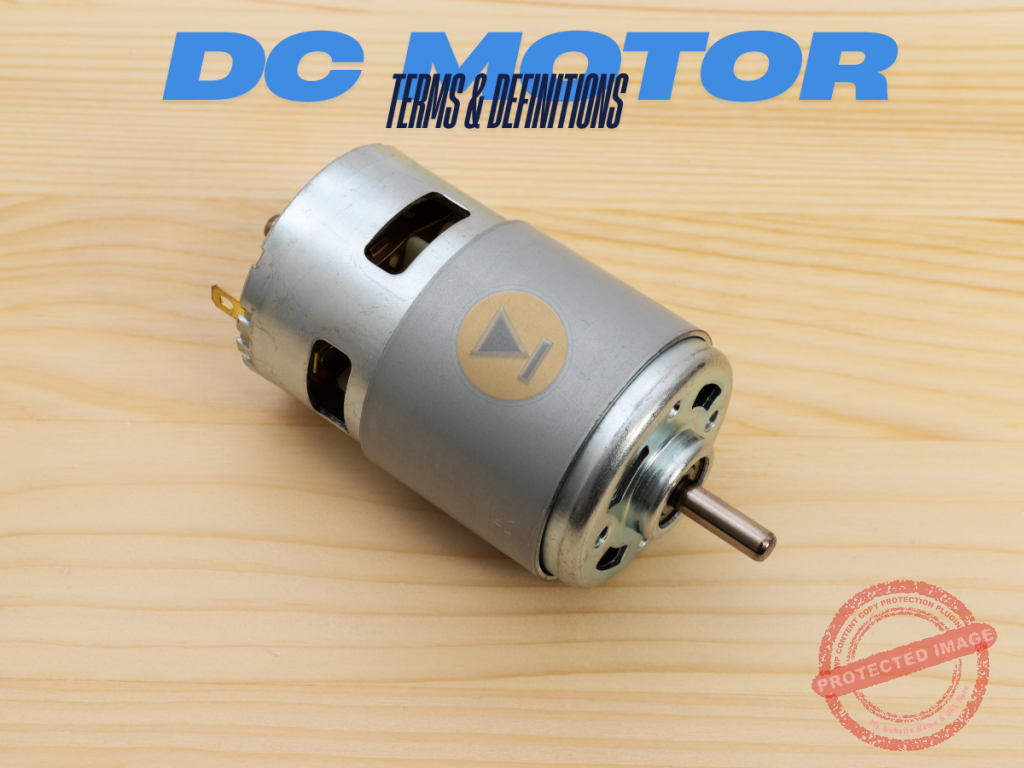
1. DC Motor: An electrical machine that converts direct current electrical energy into mechanical energy through the interaction of magnetic fields and current-carrying conductors.
2. Back EMF: The electromotive force (voltage) generated in the armature that opposes the applied voltage as the armature rotates through the magnetic field.
3. Torque: The rotational force produced by a DC motor, measured in newton-meters (N·m).
4. Armature Reaction: The distortion of the main magnetic field caused by the magnetic field produced by current in the armature windings.
5. Commutation: The process of current reversal in armature coils as they pass from one pole to another, facilitated by the commutator-brush arrangement.
6. Lorentz Force: The force exerted on a current-carrying conductor in a magnetic field, fundamental to DC motor operation.
7. Faraday’s Law: The principle stating that a changing magnetic field induces an electromotive force (EMF) in a conductor.
8. Lenz’s Law: The principle stating that an induced current flows in a direction to oppose the change that produced it.
9. Fleming’s Left-Hand Rule: A rule for determining the direction of force on a current-carrying conductor in a magnetic field.
10. Fleming’s Right-Hand Rule: A rule for determining the direction of induced EMF in a conductor moving in a magnetic field.
11. Magnetic Flux Density: The amount of magnetic flux per unit area, measured in teslas.
12. Magnetic Permeability: A measure of how easily a material can be magnetized.
13. Rotating MMF: The magnetomotive force created by the armature current that rotates with the armature.
14. Demagnetization: The reduction of magnetic field strength in a DC motor, often due to armature reaction.
DC Motor Types and Classifications
15. Shunt Motor: A DC motor with field windings connected in parallel (shunt) with the armature circuit.
16. Series Motor: A DC motor with field windings connected in series with the armature circuit.
17. Compound Motor: A DC motor having both series and shunt field windings.
18. Cumulative Compound Motor: A compound DC motor where the magnetic fields of series and shunt windings act in the same direction.
19. Differential Compound Motor: A compound DC motor where the magnetic fields of series and shunt windings oppose each other.
20. Separately Excited Motor: A DC motor where the field winding is powered from an independent external power source.
21. Permanent Magnet DC Motor: A DC motor using permanent magnets instead of field windings to create the magnetic field.
22. Universal Motor: A motor that can operate on either AC or DC power, structurally similar to a DC series motor.
23. Servo Motor: A DC motor with feedback control used for precise position control.
Motor Construction Elements
24. Armature: The power-producing component of a DC motor consisting of current-carrying coils wound around a laminated, cylindrical iron core.
25. Field Winding: Stationary coils that produce the main magnetic field in a DC motor, typically located on the stator.
26. Commutator: A cylindrical assembly of copper segments connected to armature coils that reverses current direction in the armature windings as it rotates.
27. Brushes: Stationary contacts (typically made of carbon or graphite) that maintain electrical connection with the rotating commutator.
28. Stator: The stationary part of a DC motor, typically containing the field windings that create the main magnetic field.
29. Rotor: The rotating part of a DC motor, typically containing the armature windings.
30. Interpole: Additional small poles placed between main field poles to improve commutation and reduce sparking.
31. Compensating Winding: Conductors embedded in pole faces and connected in series with the armature to neutralize armature reaction.
32. Yoke: The outer frame of a DC motor that provides mechanical support and serves as part of the magnetic circuit.
33. Pole Core: The central part of a field pole that carries the magnetic flux in a DC motor.
34. Pole Shoe: The expanded end of a field pole that spreads the magnetic flux more uniformly across the air gap.
35. Air Gap: The small space between the armature and field poles in a DC motor.
36. Armature Core: The laminated iron core on which armature windings are placed.
37. Commutator Segment: Individual copper bars insulated from each other that make up the commutator.
38. Mica: Insulating material used between commutator segments.
39. Brush Holder: Device that holds the carbon brushes against the commutator with appropriate pressure.
40. Brush Tension: The force with which brushes are pressed against the commutator.
41. Lap Winding: An armature winding where the start and finish of each coil are connected to adjacent commutator segments.
42. Wave Winding: An armature winding where the start and finish of each coil are connected to commutator segments separated by approximately the pole pitch.
43. Frog-Leg Winding: A form of wave winding used in multipolar DC machines.
44. Equalizer Connection: Connections between points of equal potential in lap-wound armatures to improve current distribution.
45. Split-Ring Commutator: The simplest form of commutator, consisting of two half-rings separated by insulation.
46. Armature Skewing: Angling of armature slots to reduce cogging and improve commutation.
47. Counter-Commutating Poles: Interpoles connected to produce a magnetic field opposing the armature field to improve commutation.
48. Frame Size: Standardized physical dimensions of a DC motor housing.
49. Insulation Class: Classification of insulating materials based on their thermal endurance.
50. IP Rating: Ingress Protection rating indicating the degree of protection against solid objects and liquids.
Electrical Characteristics
51. Armature Circuit Resistance: The total electrical resistance of the armature windings, commutator, and brush contacts.
52. Field Circuit Resistance: The electrical resistance of the field windings.
53. Armature Inductance: The self-inductance of armature windings that affects commutation.
54. Critical Resistance: The resistance value at which a shunt motor’s speed becomes unstable.
55. Critical Field Resistance: The minimum field resistance that will cause a shunt motor to run away.
56. Terminal Voltage: The voltage measured at the motor terminals.
57. Voltage Constant (Ke): The ratio of back EMF to angular velocity in a DC motor.
58. Torque Constant (Kt): The ratio of torque to armature current in a DC motor.
59. Time Constant: The time required for a DC motor to reach 63.2% of its final value after a change in input.
60. Magnetic Circuit: The path followed by magnetic flux in a DC motor.
Performance and Operational Parameters
61. Speed Regulation: The ability of a DC motor to maintain a relatively constant speed under varying load conditions.
62. No-Load Speed: The rotational speed of a DC motor when operating without any mechanical load.
63. Full-Load Speed: The rotational speed of a DC motor when operating at rated power output.
64. Base Speed: The speed at which a DC motor operates at rated voltage and rated field current.
65. Critical Speed: The speed at which unstable operation begins in a DC motor.
66. Speed Droop: The decrease in speed that occurs when load is applied to a DC motor.
67. Starting Current: The initial current drawn by a DC motor when voltage is first applied.
68. Starting Torque: The torque produced by a DC motor at zero speed when power is first applied.
69. Pull-Out Torque: The maximum torque a DC motor can develop without stalling.
70. Breakdown Torque: The maximum torque a DC motor can produce before a dramatic drop in speed occurs.
71. Efficiency: The ratio of mechanical power output to electrical power input in a DC motor.
72. Cogging: Uneven rotation or torque pulsations in a DC motor due to the interaction between armature slots and field poles.
73. Hunting: Oscillation of motor speed around the desired value due to overcompensation in the speed control system.
74. Duty Cycle: The operating cycle of a DC motor, including running, idle, and off periods.
75. Power Rating: The maximum continuous power output capability of a DC motor, typically expressed in watts or horsepower.
76. Nameplate Rating: The manufacturer’s specified operating parameters for a DC motor, including voltage, current, speed, and power.
77. Rotor Inertia: The resistance of the rotor to changes in its rotational speed.
78. Runaway Condition: Uncontrolled acceleration of a DC motor, typically due to loss of field current in a shunt motor.
Power Losses and Efficiency
79. Eddy Currents: Circulating currents induced in the armature core that cause power loss and heating.
80. Hysteresis Loss: Power loss in magnetic materials due to magnetic reversal in alternating magnetic fields.
81. Copper Loss: Power loss due to resistive heating in the copper windings of a DC motor.
82. Core Loss: Combined power losses in the magnetic core due to eddy currents and hysteresis.
83. Mechanical Loss: Power losses due to friction and windage in a DC motor.
84. Stray Load Loss: Additional losses that occur when a DC motor is loaded.
85. Magnetic Saturation: The condition where increasing field current produces little or no increase in magnetic flux.
Motor Testing and Analysis
86. Swinburne’s Test: A method for determining the efficiency of a DC machine at any load without actually loading the machine.
87. Hopkinson’s Test: A method for testing DC machines where two identical machines are coupled mechanically.
88. Retardation Test: A test to determine the rotational losses in a DC machine by measuring its deceleration.
89. Speed-Torque Characteristic: A curve showing the relationship between speed and torque in a DC motor.
90. Speed-Current Characteristic: A curve showing the relationship between speed and armature current in a DC motor.
91. Torque-Current Characteristic: A curve showing the relationship between torque and armature current in a DC motor.
Speed Control and Starting Methods
92. Armature Voltage Control: A method of DC motor speed control by varying the voltage applied to the armature.
93. Field Flux Control: A method of DC motor speed control by varying the field current.
94. Field Weakening: Reducing the field current to increase the speed of a DC motor above base speed.
95. Armature Resistance Control: Speed control method that involves adding resistance in series with the armature.
96. Ward Leonard Control: A method of DC motor control using a motor-generator set to provide variable voltage.
97. Ward Leonard System: A method of DC motor speed control using a motor-generator set.
98. Field Rheostat: Variable resistor connected in series with the shunt field to control motor speed.
99. Starting Rheostat: Variable resistor used to limit the initial armature current during motor starting.
Braking Systems
100. Dynamic Braking: A braking method where a DC motor’s armature terminals are connected to a resistor while the field remains energized.
101. Regenerative Braking: A braking method where a DC motor acts as a generator, converting mechanical energy to electrical energy.
102. Plugging: A braking method achieved by reversing the armature voltage polarity.
Modern Control Methods
103. Electronic Drive: Solid-state electronic circuits used to control and power DC motors.
104. PWM Control: Pulse Width Modulation technique for controlling DC motor speed by varying the duty cycle of voltage pulses.
105. Chopper Control: Electronic technique for controlling DC motor speed by rapidly switching the supply voltage on and off.
106. Encoder: A device attached to a DC motor shaft that provides feedback on position and speed.
107. Tachometer: A device that measures the rotational speed of a DC motor shaft.
Performance Issues
108. Sparking: Unwanted electrical arcing at the brushes during commutation.
109. Flashover: A disruptive electric discharge that occurs around or over the surface of the commutator.
110. Interpole Strength: The magnetic field strength of interpoles, typically adjusted to ensure proper commutation.
Mastering these 101+ DC motor terms represents a significant milestone in your board exam preparation journey. Remember that examiners are specifically looking for precision in your terminology usage – it signals to them that you truly understand the underlying engineering concepts, not just memorized facts.
Many students who’ve come before you have turned around their exam performance by focusing specifically on terminology mastery in the final stretch. By investing time in these definitions now, you’re addressing one of the most common reasons why otherwise knowledgeable students lose points unnecessarily.
We recommend creating flashcards from these terms, testing yourself regularly, and explaining concepts to classmates using the proper terminology. This active approach embeds these definitions more deeply than passive reading ever could.
As your exam date approaches, know that thousands of Pinoybix.org readers have used resources like this to transform anxiety into confidence. The comprehensive nature of this list means you now have a complete reference for any DC motor term that might appear on your board exam.
Take a deep breath, trust in your preparation, and walk into that examination room knowing you’ve mastered one of the most challenging aspects of electrical engineering terminology. Your future self – the one holding that professional engineering license – will thank you for the diligent work you’re doing today.
Good luck on your upcoming board exam! We’d love to hear about your success story in the comments below.
Related Content




P inoyBIX educates thousands of reviewers and students a day in preparation for their board examinations. Also provides professionals with materials for their lectures and practice exams. Help me go forward with the same spirit.
“Will you subscribe today via YOUTUBE?”
TIRED OF ADS?
- Become Premium Member and experienced complete ads-free content browsing.
- Full Content Access to Premium Solutions Exclusive for Premium members
- Access to PINOYBIX FREEBIES folder
- Download Reviewers and Learning Materials Free
- Download Content: You can see download/print button at the bottom of each post.
PINOYBIX FREEBIES FOR PREMIUM MEMBERSHIP:
- CIVIL ENGINEERING REVIEWER
- CIVIL SERVICE EXAM REVIEWER
- CRIMINOLOGY REVIEWER
- ELECTRONICS ENGINEERING REVIEWER (ECE/ECT)
- ELECTRICAL ENGINEERING & RME REVIEWER
- FIRE OFFICER EXAMINATION REVIEWER
- LET REVIEWER
- MASTER PLUMBER REVIEWER
- MECHANICAL ENGINEERING REVIEWER
- NAPOLCOM REVIEWER
- Additional upload reviewers and learning materials are also FREE
FOR A LIMITED TIME
If you subscribe for PREMIUM today!
You will receive an additional 1 month of Premium Membership FREE.
For Bronze Membership an additional 2 months of Premium Membership FREE.
For Silver Membership an additional 3 months of Premium Membership FREE.
For Gold Membership an additional 5 months of Premium Membership FREE.
Join the PinoyBIX community.