
Are you breaking into a cold sweat every time you think about rectifiers on your upcoming board exam? You’re not alone. For many engineering students, power electronics concepts like rectifiers represent one of the most challenging and heavily tested areas on the board exam. The problem isn’t just understanding these concepts – it’s remembering all those technical terms when exam pressure hits.
Let’s face it – most textbooks explain rectifiers with complicated language that leaves you more confused than before. Professors often rush through these topics, assuming you’ll “figure it out” during lab work. Meanwhile, the clock keeps ticking toward exam day.
This comprehensive guide was built by an engineer who remembers the frustration of late-night study sessions with confusing materials. I’ve compiled 101+ essential rectifier terms – organized logically from basic concepts to cutting-edge developments – specifically formatted for quick reference and knowledge retention. Each definition is crafted to be concise yet complete, using language that actually makes sense.
Whether you struggle with understanding half-wave vs. full-wave configurations, get confused about ripple factors, or can’t keep track of the different filter types, this guide provides clear, exam-focused explanations. I’ve highlighted the exact terminology examiners look for in your answers.
Bookmark this page. Print it out. Keep it with you during those crucial final weeks of review. Let’s turn rectifiers from your biggest weakness into your strongest section on the exam.
Introduction to Rectifiers
1. Rectifier: An electrical device that converts alternating current (AC) to direct current (DC) by allowing current flow in only one direction.
2. Rectification: The process of converting alternating current (AC) to direct current (DC) using semiconductor devices like diodes.
3. Forward Bias: The condition where a diode allows current to flow when the anode voltage is more positive than the cathode voltage.
4. Reverse Bias: The condition where a diode blocks current flow when the cathode voltage is more positive than the anode voltage.
5. Breakdown Voltage: The minimum reverse voltage that causes a diode to conduct substantially in the reverse direction, potentially damaging the device.
6. Junction Diode: A semiconductor device with a P-N junction that allows current flow primarily in one direction, used as the basic element in rectifiers.
7. Forward Voltage Drop: The voltage difference across a diode when it conducts current in the forward direction, typically 0.7V for silicon diodes.
Basic Rectifier Circuits
8. Half-Wave Rectifier: A circuit that converts AC to pulsating DC by allowing only positive or negative half-cycles of the input waveform to pass.
9. Full-Wave Rectifier: A circuit that converts both positive and negative half-cycles of AC into pulsating DC flowing in the same direction.
10. Center-Tapped Rectifier: A full-wave rectifier using a center-tapped transformer and two diodes to convert AC to DC.
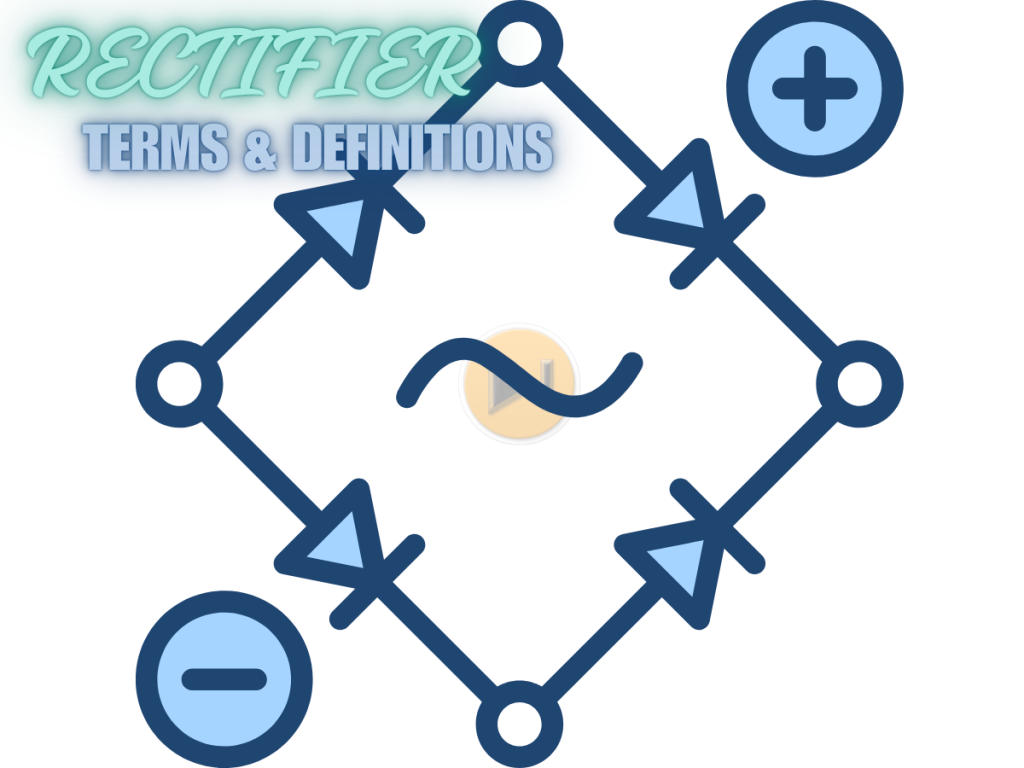
11. Bridge Rectifier: A full-wave rectifier consisting of four diodes arranged in a bridge configuration that doesn’t require a center-tapped transformer.
12. Single-Phase Rectifier: A rectifier circuit designed to convert single-phase AC power to DC power.
13. Three-Phase Rectifier: A rectifier circuit designed to convert three-phase AC power to DC power, providing smoother output than single-phase rectifiers.
14. Six-Pulse Rectifier: A three-phase rectifier configuration producing six pulses per cycle, commonly used in industrial applications.
15. Twelve-Pulse Rectifier: A rectifier configuration combining two six-pulse rectifiers phase-shifted by 30 degrees, reducing harmonics and providing smoother DC output.
Rectifier Performance Metrics
16. Rectifier Efficiency: The ratio of DC output power to AC input power, expressed as a percentage, indicating energy conversion effectiveness.
17. Form Factor: The ratio of the RMS value to the average value of a rectified waveform, indicating the quality of rectification.
18. Ripple Factor: A measure of the AC component remaining in the rectified output, calculated as the ratio of RMS value of AC component to the DC component.
19. Transformer Utilization Factor (TUF): The ratio of DC power output to the VA rating of the transformer, indicating transformer usage efficiency.
20. Regulation: The change in DC output voltage from no-load to full-load conditions, expressed as a percentage of full-load voltage.
21. Peak Inverse Voltage (PIV): The maximum reverse voltage a diode must withstand when it’s not conducting in a rectifier circuit.
22. Total Harmonic Distortion (THD): A measure of the harmonic content in a rectifier’s input current waveform relative to the fundamental frequency.
Filtering and Smoothing
23. Filter: A circuit element used after rectification to reduce ripple voltage and produce smoother DC output.
24. Capacitor Filter: A capacitor connected across the output of a rectifier to reduce voltage ripple by storing energy during peaks and releasing it during dips.
25. Inductor Filter: A series inductor (choke) used after rectification to resist changes in current, thereby reducing ripple.
26. LC Filter: A combination of series inductor and parallel capacitor providing superior ripple reduction compared to either component alone.
27. RC Filter: A combination of a series resistor and parallel capacitor used for ripple reduction in low-current applications.
28. Pi Filter: A filter configuration consisting of two capacitors and an inductor arranged in a π shape, providing excellent ripple reduction.
29. Ripple Voltage: The AC component remaining in the DC output of a rectifier after filtering.
30. Bleeder Resistor: A resistor connected across the filter capacitor to discharge it when the power is turned off, enhancing safety.
Advanced Rectifier Concepts
31. Controlled Rectifier: A rectifier circuit using thyristors or other controllable switches to regulate the average DC output voltage.
32. Uncontrolled Rectifier: A rectifier circuit using diodes that cannot control the output voltage level except through transformer turns ratio.
33. Half-Controlled Bridge: A bridge rectifier where two diodes are replaced with SCRs, allowing partial control of the output.
34. Fully-Controlled Bridge: A bridge rectifier where all diodes are replaced with SCRs, allowing complete control of the output.
35. Firing Angle: The phase angle at which a thyristor in a controlled rectifier is triggered into conduction, controlling output voltage.
36. Power Factor: The ratio of real power to apparent power in a rectifier circuit, affected by the firing angle in controlled rectifiers.
37. Displacement Factor: The cosine of the phase angle between the fundamental component of current and voltage in rectifier circuits.
38. Distortion Factor: A measure of current distortion due to harmonics in a rectifier’s input current waveform.
Semiconductor Devices in Rectifiers
39. Power Diode: A semiconductor diode designed to handle high currents and voltages in rectifier applications.
40. Silicon Controlled Rectifier (SCR): A four-layer semiconductor device used in controlled rectifiers that can be triggered to conduct.
41. Triac: A bidirectional three-terminal semiconductor device similar to two SCRs connected in inverse parallel, used in AC power control.
42. Schottky Diode: A metal-semiconductor junction diode with lower forward voltage drop and faster switching than conventional P-N junction diodes.
43. Fast Recovery Diode: A diode designed to switch quickly from forward to reverse bias, important in high-frequency rectifier applications.
44. Avalanche Diode: A diode designed to operate in the breakdown region for voltage regulation or protection functions.
45. Zener Diode: A diode that allows current to flow in the reverse direction when the voltage reaches the breakdown voltage, used for voltage regulation.
46. Power MOSFET: A voltage-controlled field-effect transistor capable of handling high power levels, used in synchronous rectifiers.
Specialized Rectifier Types
47. Synchronous Rectifier: A rectifier that uses actively controlled switches (typically MOSFETs) instead of diodes to reduce forward voltage drop.
48. Precision Rectifier: A circuit using operational amplifiers and diodes to rectify small signals with minimal distortion and voltage drop.
49. Instrumentation Rectifier: A high-precision rectifier designed for measurement applications requiring accurate conversion of AC to DC.
50. Peak Rectifier: A circuit that captures and holds the peak value of an AC waveform, also known as a peak detector.
51. Voltage Multiplier: A rectifier circuit that produces an output voltage higher than the peak input voltage through charge pumping.
52. Voltage Doubler: A specific voltage multiplier circuit that produces approximately twice the peak input voltage.
53. Active Rectifier: A rectifier circuit using operational amplifiers to compensate for diode voltage drops, providing more accurate rectification.
54. Zero-Crossing Detector: A circuit that detects when an AC waveform crosses zero, often used in controlled rectifier triggering circuits.
Three-Phase Rectifier Configurations
55. Three-Phase Half-Wave Rectifier: A circuit using three diodes to rectify a three-phase AC supply, producing a DC output with three pulses per cycle.
56. Three-Phase Full-Wave Rectifier: A circuit that rectifies all halves of all phases of a three-phase supply, typically using six diodes.
57. Three-Phase Bridge Rectifier: A six-diode configuration arranged in a bridge to convert three-phase AC to DC.
58. Delta Connection: A three-phase connection method where the three phases form a triangle (delta), affecting rectifier performance and characteristics.
59. Star (Wye) Connection: A three-phase connection method where the three phases connect at a common point, affecting rectifier performance.
60. Interphase Transformer: A transformer used in some three-phase rectifier circuits to reduce ripple by balancing the outputs of different phases.
61. Phase-Shift Transformer: A transformer configuration used in multipulse rectifiers to create phase shifts between multiple rectifier bridges.
Protection and Reliability
62. Snubber Circuit: A network of resistors and capacitors connected across semiconductor devices to protect against voltage spikes during switching.
63. Freewheel Diode: A diode connected across an inductive load to provide a path for current when the main switching device turns off.
64. Surge Current: A temporary current much higher than normal operating current, often occurring at startup in rectifier circuits.
65. Thermal Runaway: A destructive condition where increased temperature causes increased current flow, which further increases temperature.
66. Heat Sink: A device that absorbs and dissipates heat generated by power semiconductors in rectifier circuits.
67. Junction Temperature: The temperature at the P-N junction of a semiconductor device, critical for reliability in power rectifiers.
68. Derating: The practice of operating components below their maximum ratings to improve reliability and lifespan.
69. Avalanche Breakdown: A breakdown mechanism in semiconductor devices where impact ionization creates a cumulative increase in charge carriers.
Filter Design Parameters
70. Ripple Current: The AC component in the current flowing through a filter capacitor in a rectifier circuit.
71. Capacitor ESR: Equivalent Series Resistance in capacitors that causes power dissipation and heating under ripple current conditions.
72. Filter Resonant Frequency: The frequency at which an LC filter presents the lowest impedance, important for filter design.
73. Filter Cutoff Frequency: The frequency at which a filter’s output power is reduced to half of its input power.
74. Filter Quality Factor (Q): A parameter describing how underdamped a filter is, affecting its frequency response.
75. Critical Inductance: The minimum inductance value in a filter that ensures continuous current flow in a rectifier with inductive load.
76. Hold-up Time: The time a power supply’s output remains within specification after input power is removed, determined by filter capacitance.
Applications and System Integration
77. Power Supply: An electronic device converting available power into the type needed by load equipment, typically using rectifiers.
78. Linear Power Supply: A power supply using a transformer, rectifier, and linear regulator to produce a stable DC output.
79. Switched-Mode Power Supply (SMPS): A power supply using high-frequency switching and rectification to achieve higher efficiency and smaller size.
80. Uninterruptible Power Supply (UPS): A power supply system incorporating rectifiers and inverters to provide continuous power during outages.
81. Battery Charger: A device using rectifiers to convert AC to DC for charging batteries at controlled voltage and current.
82. DC Link: The DC stage between rectifiers and inverters in power conversion systems, often including large filter capacitors.
83. Regenerative Rectifier: A bidirectional power converter capable of returning energy from a DC load back to the AC supply.
84. Active Front End: A controlled rectifier with power factor correction capabilities, reducing harmonic distortion in the AC supply.
Power Quality Issues
85. Line Commutation: The natural commutation of thyristors in a controlled rectifier due to AC source voltage reversal.
86. Harmonic Distortion: The presence of frequencies that are multiples of the fundamental frequency, caused by rectifier non-linear behavior.
87. Displacement Power Factor: The cosine of the angle between voltage and the fundamental component of current in a rectifier circuit.
88. Power Factor Correction (PFC): Techniques used to improve the power factor of rectifier circuits, reducing reactive power demand.
89. Active PFC: Power factor correction using active switching circuits to shape the input current waveform of a rectifier.
90. Passive PFC: Power factor correction using passive components like inductors and capacitors to improve a rectifier’s power factor.
91. Input Filter: A filter at the AC input of a rectifier to reduce electromagnetic interference and improve power quality.
92. Electromagnetic Interference (EMI): Unwanted electromagnetic emissions from rectifier circuits that can disrupt other electronic equipment.
Troubleshooting and Testing
93. Voltage Regulation Curve: A graph showing how output voltage varies with load current in a rectifier circuit.
94. Load Regulation: The change in output voltage when the load current changes from minimum to maximum, expressed as a percentage.
95. Line Regulation: The change in output voltage when the input voltage varies over its specified range, expressed as a percentage.
96. Short-Circuit Protection: Features designed to protect a rectifier from damage during output short-circuit conditions.
97. Open-Load Protection: Features designed to protect a rectifier from damage during open-circuit load conditions.
98. Ripple Measurement: The process of measuring the AC component in a rectifier’s DC output, typically using an oscilloscope.
99. Temperature Coefficient: The rate at which a parameter changes with temperature, important for understanding rectifier stability.
100. X-Ray Testing: A non-destructive testing method used to inspect internal connections in power rectifier modules.
101. Pulse Testing: Testing rectifiers with short pulses to evaluate performance without causing thermal damage.
102. Reverse Recovery Time: The time required for a diode to stop conducting after changing from forward to reverse bias, critical in high-frequency rectifiers.
103. Forward Recovery Time: The time required for a diode to reach a stable forward voltage after changing from reverse to forward bias.
104. Power Cycling: Repeatedly turning a rectifier on and off to evaluate its reliability under thermal stress conditions.
105. Diode Recovery Charge: The amount of charge that must be removed from a diode during turn-off before it can block reverse voltage.
Recent Developments and Trends
106. Silicon Carbide (SiC) Rectifier: A rectifier using silicon carbide semiconductor devices offering higher temperature operation and efficiency.
107. Gallium Nitride (GaN) Rectifier: A rectifier using gallium nitride semiconductor devices offering higher switching speeds and efficiency.
108. Digital Control: The use of microcontrollers or digital signal processors to control and optimize rectifier operation.
109. Interleaved Rectifier: Multiple rectifier stages operating in parallel with phase-shifted switching to reduce ripple and improve power density.
110. Wireless Power Transfer Rectifier: A rectifier used in wireless power systems to convert received AC power to usable DC.
111. Energy Harvesting Rectifier: A specialized rectifier designed to convert small amounts of ambient energy into usable electrical power.
112. IoT Power Rectifier: A low-power rectifier optimized for Internet of Things devices with emphasis on efficiency at light loads.
If you’ve made it this far, you’ve just armed yourself with one of the most powerful weapons for your engineering board exam – comprehensive knowledge of rectifier concepts that examiners consistently test. Remember when rectifiers seemed like an impossible topic to master? Look at you now.
The board exam isn’t just testing whether you’ve memorized definitions – it’s checking if you understand how these concepts connect to form complete power electronic systems. That’s exactly what we’ve covered here – from basic diode behavior to advanced three-phase systems and cutting-edge semiconductor technologies.
What separates passing students from topnotchers is often their ability to quickly recall key terms under pressure and apply them correctly. Print this guide. Highlight the terms you struggle with most. Create flashcards for the performance metrics and formulas. Test yourself by trying to explain each concept to a classmate.
When exam day arrives and you see that rectifier question (and trust me, there will be rectifier questions), take a deep breath. You’ve got this. The knowledge is now firmly in your toolbox. No more panicking or second-guessing yourself when you see terms like “form factor” or “interphase transformer.”
The journey to becoming a licensed engineer is challenging, but it’s challenges like mastering rectifiers that make the final victory so sweet. Keep this guide handy during your final review days. Reference it whenever you tackle practice problems. And when you pass that exam, remember to share your knowledge with the next generation of engineers struggling with the same concepts.
Good luck on your board exam. I’m confident you’ll make yourself proud.
Related Content




P inoyBIX educates thousands of reviewers and students a day in preparation for their board examinations. Also provides professionals with materials for their lectures and practice exams. Help me go forward with the same spirit.
“Will you subscribe today via YOUTUBE?”
TIRED OF ADS?
- Become Premium Member and experienced complete ads-free content browsing.
- Full Content Access to Premium Solutions Exclusive for Premium members
- Access to PINOYBIX FREEBIES folder
- Download Reviewers and Learning Materials Free
- Download Content: You can see download/print button at the bottom of each post.
PINOYBIX FREEBIES FOR PREMIUM MEMBERSHIP:
- CIVIL ENGINEERING REVIEWER
- CIVIL SERVICE EXAM REVIEWER
- CRIMINOLOGY REVIEWER
- ELECTRONICS ENGINEERING REVIEWER (ECE/ECT)
- ELECTRICAL ENGINEERING & RME REVIEWER
- FIRE OFFICER EXAMINATION REVIEWER
- LET REVIEWER
- MASTER PLUMBER REVIEWER
- MECHANICAL ENGINEERING REVIEWER
- NAPOLCOM REVIEWER
- Additional upload reviewers and learning materials are also FREE
FOR A LIMITED TIME
If you subscribe for PREMIUM today!
You will receive an additional 1 month of Premium Membership FREE.
For Bronze Membership an additional 2 months of Premium Membership FREE.
For Silver Membership an additional 3 months of Premium Membership FREE.
For Gold Membership an additional 5 months of Premium Membership FREE.
Join the PinoyBIX community.