
This is the Multiple Choice Questions in pnpn and Other Devices from the book Electronic Devices and Circuit Theory 10th Edition by Robert L. Boylestad. If you are looking for a reviewer in Electronics Engineering this will definitely help. I can assure you that this will be a great help in reviewing the book in preparation for your Board Exam. Make sure to familiarize each and every questions to increase the chance of passing the ECE Board Exam.
Online Questions and Answers Topic Outline
- MCQ in Introduction to pnpn and Other Devices | MCQ in Silicon-Controlled Rectifier (SCR) | MCQ in SCR Applications | MCQ in SCR Characteristics and Rating | MCQ in SCR Operation | MCQ in Silicon-Controlled Switch (SCS)| MCQ in Gate Turn-Off Switch (GTO) | MCQ in Light-Activated SCR (LASCR) | MCQ in Shockley Diode | MCQ in DIAC | MCQ in TRIAC | MCQ in Unijunction Transistor | MCQ in Phototransistors | MCQ in Opto-Isolators | MCQ in Programmable Unijunction Transistors (PUT)
Practice Exam Test Questions
Choose the letter of the best answer in each questions.
1. How many layers of semiconductor materials does a silicon-controlled rectifier (SCR) have?
A. 2
B. 3
C. 4
D. 5
Answer: Option C
Solution:
2. Which of the following devices has (have) four layers of semiconductor materials?
A. Silicon-controlled switch (SCS)
B. Gate turn-off switch (GTO)
C. Light-activated silicon-controlled rectifier (LASCR)
D. All of the above
Answer: Option D
Solution:
3. A thyristor is a _____-layer semiconductor material device.
A. 2
B. 3
C. 4
D. 5
Answer: Option C
Solution:
4. Which of the following devices is unquestionably of the greatest interest today?
A. SCR
B. GTO
C. LASCR
D. SCS
Answer: Option A
Solution:
5. What is the frequency range of application of SCRs?
A. About 10 kHz
B. About 50 kHz
C. About 250 kHz
D. About 1 mHz
Answer: Option B
Solution:
6. Which one of the SCR terminals fires the SCR?
A. Anode
B. Cathode
C. Gate
D. All of the above
Answer: Option C
Solution:
7. What is the typical value of the reverse resistance of SCRs?
A. 1 Ω to 10 Ω
B. 100 Ω to 1 kΩ
C. 1 k Ω to 50 kΩ
D. 100 kΩ or more
Answer: Option D
Solution:
8. Which of the following transistors is an SCR composed of?
A. npn, pnp
B. npn, npn
C. pnp, pnp
D. None of the above
Answer: Option A
Solution:
9. Which of the transistors of an SCR are conducting when the SCR is fired and is in the conduction mode?
A. npn
B. pnp
C. Both npn and pnp
D. Neither npn nor pnp
Answer: Option C
Solution:
10. What is the range of the turn-on times in high-power SCR devices?
A. 30 µs to 100 µs
B. 10 µs to 25 µs
C. 5 µs to 8 µs
D. 1 µs to 5 µs
Answer: Option B
Solution:
11. What is the typical range of turn-off times for SCRs?
A. 5 µs to 30 µs
B. 1 µs to 5 µs
C. 0.1 µs to 1 µs
D. 0.01 µs to 0.1 µs
Answer: Option A
Solution:
12. This symbol is an example of a(n) ______.

A. SCR
B. SCS
C. GTO
D. DIAC
Answer: Option A
Solution:
13. Which of the following parameters are usually provided by the manufacturer on the specification sheet for SCRs?
A. Turn-on time (ton )
B. Turn-off time (toff )
C. Junction and case temperatures (tj and tc )
D. All of the above
Answer: Option D
Solution:
14. How many terminals does a silicon-controlled switch (SCS) device have?
A. 2
B. 3
C. 4
D. 5
Answer: Option C
Solution:
15. What is the typical value of the triggering anode gate for SCS devices?
A. 1.5 mA
B. 150 A
C. 15 A
D. 1 A
Answer: Option A
Solution:
16. Which of the following is (are) the advantages of the SCS over a corresponding SCR?
A. Reduced turn-off time
B. Increased control and triggering sensitivity
C. More predictable firing situation
D. All of the above
Answer: Option D
Solution:
17. Which of the following areas is (are) applications of an SCS?
A. Counters
B. Pulse generators
C. Voltage sensors
D. All of the above
Answer: Option D
Solution:
18. This symbol is an example of a(n)______.
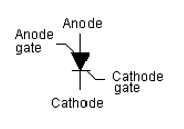
A. SCR
B. SCS
C. GTO
D. DIAC
Answer: Option B
Solution:
19. For an SCS, a ______ pulse at the anode gate turns the device on, while a ______ pulse will turn it off.
A. negative, positive
B. positive, negative
Answer: Option A
Solution:
20. An advantage of the SCR over the SCS is the reduced turn-off time.
A. True
B. False
Answer: Option B
Solution:
21. Which of the following devices has the smallest turn-off time?
A. SCR
B. GTO
C. SCS
D. LASCR
Answer: Option B
Solution:
22. Which of the following devices has nearly the same turn-on time as turn-off time?
A. SCR
B. GTO
C. SCS
D. LASCR
Answer: Option B
Solution:
23. This symbol is an example of a(n) _____.
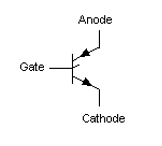
A. SCR
B. SCS
C. GTO
D. diac
Answer: Option C
Solution:
24. What is the maximum current (rms) rating for commercially available LASCRs today?
A. 3 A
B. 15 A
C. 20 A
D. 25 A
Answer: Option A
Solution:
25. How many terminals does a Shockley diode have?
A. 5
B. 4
C. 3
D. 2
Answer: Option D
Solution:
26. This symbol is an example of a(n) _____.
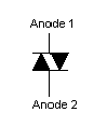
A. SCR
B. SCS
C. GTO
D. DIAC
Answer: Option D
Solution:
27. Which of the following devices does not have a cathode terminal?
A. SCR
B. SCS
C. Triac
D. Shockley diode
Answer: Option C
Solution:
28. Today, the SCR is more widely used than the TRIAC.
A. True
B. False
Answer: Option B
Solution:
29. Which of the following devices has a negative-resistance region in its characteristics curve?
A. SCR
B. SCS
C. Unijunction transistor
D. Phototransistor
Answer: Option C
Solution:
30. What is the range of the variable resistor in the equivalent circuit of a unijunction transistor?
A. 50 Ω to 5 kΩ
B. 6 kΩ to 10 kΩ
C. 5 Ω to 50 Ω
D. 1 Ω to 5 Ω
Answer: Option A
Solution:
31. This is an example of a high-isolation _____ gate.
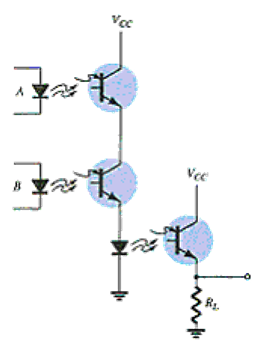
A. OR
B. NOT
C. AND
D. NAND
Answer: Option C
Solution:
32. The ISO-LIT Q1 16-pin Litronix opto-isolator DIP contains _____ opto-isolators.
A. 4
B. 8
C. 12
D. 6
Answer: Option A
Solution:
33. How many terminals does a programmable unijunction transistor (PUT) have?
A. 4
B. 3
C. 2
D. 1
Answer: Option B
Solution:
34. Determine RB1 for a silicon PUT if it is determined that h = 0.84, VP = 11.2 V, and RB2 = 5 kΩ.
A. 12.65 kΩ
B. 16.25 kΩ
C. 20.00 kΩ
D. 26.25 kΩ
Answer: Option B
Solution:
FILL-IN-THE-BLANKS
1. The two-layer semiconductor diode has led to ______ layer devices.
A. three-
B. four-
C. five-
D. All of the above
Answer: Option D
Solution:
2. The four-layer devices with a control mechanism are commonly referred to as ______.
A. thyristors
B. transistors
C. diodes
D. None of the above
Answer: Option A
Solution:
3. ______ are areas of application for SCRs.
A. Relay controls
B. Time-delay circuits
C. Motor controls
D. All of the above
Answer: Option D
Solution:
4. SCRs have been designed to control powers as high as _____, with individual ratings as high as _____ at _____.
A. 1800 MW, 10 A, 2000 V
B. 1800 MW, 2000 A, 10 V
C. 10 MW, 2000 A, 1800 V
D. 2000 MW, 10 A, 1800 V
Answer: Option C
Solution:
5. The _____ are the terminals of SCRs.
A. anode and cathode
B. anode, gate, and cathode
C. base, anode, and cathode
D. gate and anode
Answer: Option B
Solution:
6. In the conduction region, the dynamic resistance of the SCR is typically _____ to _____.
A. 0.01 Ω, 0.1 Ω
B. 1 Ω, 10 Ω
C. 50 Ω, 100 Ω
D. 500 Ω, 10 kΩ
Answer: Option A
Solution:
7. The SCRs have typical turn-on times of _____ in the regeneration action.
A. 0.1 μs to 1 μs
B. 0.1 ms to 1 ms
C. 3 ms to 5 ms
D. 5 ms to 9 ms
Answer: Option A
Solution:
8. The method(s) for turning off an SCR is (are) categorized as ______.
A. current interruption
B. forced commutation
C. both current interruption and forced commutation
D. None of the above
Answer: Option C
Solution:
9. At –65ºC the minimum current that will trigger the series of an SCR is _____, while at +150ºC only _____ is required.
A. 20 mA, 100 mA
B. 50 mA, 75 mA
C. 75 mA, 50 mA
D. 100 mA, 20 mA
Answer: Option D
Solution:
10. In a half-wave variable-resistance phase control operation, the control cannot be extended past a ______ phase displacement.
A. 45°
B. 90°
C. 135°
D. 180°
Answer: Option B
Solution:
11. The _____ are the terminals of an SCS.
A. anode, anode gate, cathode gate, and cathode
B. anode, cathode, cathode gate, and gate
C. anode, anode gate, cathode, and gate
D. anode, cathode, and gate
Answer: Option A
Solution:
12. The _____ the anode gate current, the _____ the required anode-to-cathode voltage to turn the SCS device on.
A. higher, higher
B. lower, lower
C. higher, lower
D. None of the above
Answer: Option C
Solution:
13. The anode gate connection can be used to turn the SCS device _____.
A. on
B. off
C. neither on nor off
D. either on or off
Answer: Option D
Solution:
14. To turn on an SCS device, a _____ pulse must be applied to the anode gate terminal; to turn off the device, a _____ pulse is required.
A. positive, positive
B. negative, positive
C. positive, negative
D. negative, negative
Answer: Option B
Solution:
15. In general, the triggering (turn-on) anode gate current is _____ the required cathode gate current.
A. larger than
B. the same as
C. smaller than
D. None of the above
Answer: Option A
Solution:
16. A(n) _____ can be triggered in either direction.
A. SCR
B. Shockley diode
C. diac
D. SCS
Answer: Option C
Solution:
17. _____ is (are) the element(s) of a unijunction transistor’s equivalent circuit.
A. One fixed resistor
B. A variable resistor
C. A diode
D. All of the above
Answer: Option D
Solution:
18. The current induced by photoelectric effects is the _____ current of the transistor.
A. collector
B. base
C. emitter
D. None of the above
Answer: Option B
Solution:
19. _____ in light intensity corresponds with _____ in collector current.
A. An increase, an increase
B. An increase, a decrease
C. A decrease, an increase
D. None of the above
Answer: Option A
Solution:
20. _____ is(are) example(s) of applications of phototransistors.
A. Punch-card readers
B. Lighting control (for example, on highways)
C. Level indication
D. All of the above
Answer: Option D
Solution:
21. An opto-isolator contains _____.
A. an infrared LED
B. a photodetector
C. both an infrared LED and a photodetector
D. None of the above
Answer: Option C
Solution:
22. The switching time of an opto-isolator _____ with increased current, while for many devices it is exactly the reverse.
A. increases
B. decreases
C. remains the same
D. None of the above
Answer: Option B
Solution:
23. In a programmable unijunction transistor (PUT), the ______ can be controlled through a couple of resistors and the supply voltage.
A. interbase resistance RBB
B. intrinsic stand-off ratio
C. emitter firing potential VP
D. All of the above
Answer: Option D
Solution:
24. The peak and valley currents of the PUT are typically ______ those of a similarly rated UJT.
A. lower than
B. the same as
C. higher than
D. None of the above
Answer: Option A
Solution:
25. The minimum operating voltage of the UJT is typically ______ that of a similarly rated PUT.
A. lower than
B. the same as
C. higher than
D. None of the above
Answer: Option C
Solution:
Check your work.
Complete List of Chapter Quiz in Electronic Devices and Circuit Theory
Related Content



P inoyBIX educates thousands of reviewers and students a day in preparation for their board examinations. Also provides professionals with materials for their lectures and practice exams. Help me go forward with the same spirit.
“Will you subscribe today via YOUTUBE?”
TIRED OF ADS?
- Become Premium Member and experienced complete ads-free content browsing.
- Full Content Access to Premium Solutions Exclusive for Premium members
- Access to PINOYBIX FREEBIES folder
- Download Reviewers and Learning Materials Free
- Download Content: You can see download/print button at the bottom of each post.
PINOYBIX FREEBIES FOR PREMIUM MEMBERSHIP:
- CIVIL ENGINEERING REVIEWER
- CIVIL SERVICE EXAM REVIEWER
- CRIMINOLOGY REVIEWER
- ELECTRONICS ENGINEERING REVIEWER (ECE/ECT)
- ELECTRICAL ENGINEERING & RME REVIEWER
- FIRE OFFICER EXAMINATION REVIEWER
- LET REVIEWER
- MASTER PLUMBER REVIEWER
- MECHANICAL ENGINEERING REVIEWER
- NAPOLCOM REVIEWER
- Additional upload reviewers and learning materials are also FREE
FOR A LIMITED TIME
If you subscribe for PREMIUM today!
You will receive an additional 1 month of Premium Membership FREE.
For Bronze Membership an additional 2 months of Premium Membership FREE.
For Silver Membership an additional 3 months of Premium Membership FREE.
For Gold Membership an additional 5 months of Premium Membership FREE.
Join the PinoyBIX community.