
This is the Multiple Choice Questions Part 11 of the Series in DC Circuits as one of the Electrical Engineering topic. In Preparation for the REE Board Exam make sure to expose yourself and familiarize in each and every questions compiled here taken from various sources including but not limited to past Board Exam Questions in Electrical Engineering field, Electrical Engineering Books, Journals and other Electrical Engineering References.
Continue Practice Exam Test Questions Part 11 of the Series
NETWORK THEOREMS
Choose the letter of the best answer in each questions.
⇐ MCQ in DC Circuits Part 10 | REE Board Exam
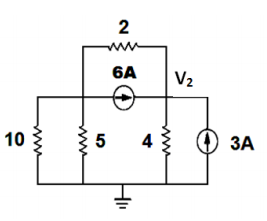
501. Determine the value of node voltage V2. All resistances are in ohms.
A. 14 V
B. 12 V
C. 0 V
D. 1 V
Answer: Option B
Solution:
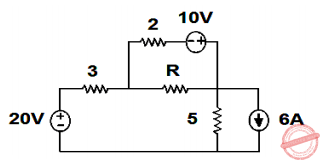
502. What should be the value of R so the resistor will receive the maximum power? All resistances are in ohms.
A. 10.0 ohms
B. 3.875 ohms
C. 0.968 ohms
D. 1.60 ohms
Answer: Option D
Solution:
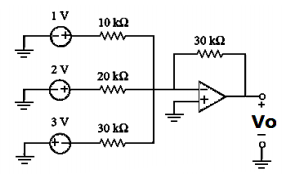
503. Determine the value VO in the ideal op-amp circuit below.
A. -8 V
B. -6 V
C. -4 V
D. -3 V
Answer: Option D
Solution:
504. Determine the value VO in the op-amp circuit below.
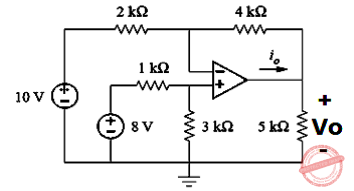
A. -4 V
B. -8 V
C. -2 V
D. -3 V
Answer: Option C
Solution:
505. If the voltage source (dependent or independent) is connected between two non-reference nodes, the two non-reference nodes form a ______.
A. Common Node
B. Supernode
C. Complex Node
D. Reference node
Answer: Option B
Solution:
506. The theorem that states that “the voltage across or current through an element in a linear circuit is the algebraic sum of the voltages across or current through that element due to each independent source acting alone”.
A. Superposition Theorem
B. Thevenin’s Theorem
C. Norton’s Theorem
D. Reciprocity Theorem
Answer: Option A
Solution:
507. Kirchhoff’s Current Law states that
A. the algebraic sum of the currents flowing into any point in a circuit must equal zero
B. the algebraic sum of the currents entering and leaving any point in a circuit must equal zero
C. the algebraic sum of the currents flowing away from any point in a circuit must equal zero
D. the algebraic sum of the currents around any closed path must equal zero
Answer: Option B
Solution:
508. When applying Kirchhoff’s Current Law,
A. consider all the currents flowing into a branch point positive and all currents directed away from that point negative
B. consider all the currents flowing into a branch point negative and all currents directed away from that point positive
C. remember that the total of all the currents entering a branch point must always be greater than the sum of the currents leaving that point
D. the algebraic sum of the currents entering and leaving a branch point does not necessarily have to be zero
Answer: Option A
Solution:
509. When applying Kirchhoff’s Voltage Law, a closed path is commonly referred to as a
A. node
B. principal node
C. loop
D. branch point
Answer: Option C
Solution:
510. Kirchhoff’s Voltage Law states that
A. the algebraic sum of the voltage sources and IR voltage drops in any closed path must total zero
B. the algebraic sum of the voltage sources and IR voltage drops around any closed path can never equal zero
C. the algebraic sum of all the currents flowing around any closed path must equal zero
D. none of these
Answer: Option A
Solution:
511. When applying Kirchhoff’s Voltage Law
A. consider any voltage whose positive terminal is reached first as negative and any voltage whose negative terminal is reached first as positive
B. always consider all voltage sources as positive and all resistor voltage drops as negative
C. consider any voltage whose negative terminal is reached first as negative and any voltage whose positive terminal is reached first as positive
D. always consider all resistor voltage drops as positive and all voltage sources as negative
Answer: Option C
Solution:
512. The algebraic sum of +40 V and -30 V is
A. -10 V
B. +10 V
C. +70 V
D. -70 V
Answer: Option B
Solution:
513. A principal node is
A. a closed path or loop where the algebraic sum of the voltages must equal zero
B. the simplest possible closed path around a circuit
C. a junction where branch current can combine or divide
D. none of these
Answer: Option C
Solution:
514. How many equations are necessary to solve a circuit with two principal nodes?
A. 3
B. 2
C. 4
D. 1
Answer: Option D
Solution:
515. The difference between a mesh current and a branch current is
A. a mesh current is an assumed current and a branch current is an actual current
B. the direction of the current themselves
C. a mesh current does not divide at a branch point
D. both A and B above
Answer: Option D
Solution:
516. Using the method of mesh currents, any resistance common to two meshes has
A. two opposing mesh currents
B. one common mesh current
C. zero current
D. none of these
Answer: Option A
Solution:
517. The fact that the sum of the resistor voltage drops equals the applied voltage in a series circuit is the basis for
A. Kirchhoff’s Current Law
B. node voltage analysis
C. Kirchhoff’s Voltage Law
D. the method of mesh currents
Answer: Option C
Solution:
518. The fact that the sum of the individual branch currents equals the total current in a parallel circuit is the basis for
A. Kirchhoff’s Current Law
B. node voltage analysis
C. Kirchhoff’s Voltage Law
D. the method of mesh currents
Answer: Option A
Solution:
519. If you do not go completely around the loop when applying Kirchhoff’s Voltage Law, then
A. the algebraic sum of the voltages will always be positive
B. the algebraic sum is the voltage between the start and finish points
C. the algebraic sum of the voltages will always be negative
D. the algebraic sum of the voltages cannot be determined
Answer: Option B
Solution:
520. A resistor is an example of a(n)
A. bilateral component
B. active component
C. passive component
D. both A and C
Answer: Option D
Solution:
521. To apply Superposition theorem, all components must be
A. the active type
B. both linear and bilateral
C. grounded
D. both nonlinear and unidirectional
Answer: Option B
Solution:
522. When converting from a Norton-equivalent circuit to a Thevenin equivalent circuit or vice versa
A. RN and RTH have the same value
B. RN will always be larger than RTH
C. IN is shorted-circuit to find VTH
D. VTH is short-circuited to find IN
Answer: Option A
Solution:
523. When solving for the Thevenin equivalent resistance, RTH,
A. all voltage sources must be opened
B. all voltage sources must be short-circuited
C. all voltage sources must be converted to current sources
D. none of these
Answer: Option B
Solution:
524. Thevenin’s Theorem states that an entire network connected to a pair of terminals can be replaced with
A. a single current source in parallel with a single resistance
B. a single voltage source in parallel with a single resistance
C. a single voltage source in series with a single resistance
D. a single current source in series with a single resistance
Answer: Option B
Solution:
525. Norton’s Theorem states that an entire network connected to a pair of terminals can be replaced with
A. a single current source in parallel with a single resistance
B. a single voltage source in parallel with a single resistance
C. a single voltage source in series with a single resistance
D. a single current source in series with a single resistance
Answer: Option A
Solution:
526. With respect to terminals A and B in a complex network, the Thevenin voltage, VTH, is
A. the voltage across terminals A and B when they are short-circuited
B. the open-circuit voltage across terminals A and B
C. the same as the voltage applied to the complex network
D. none of these
Answer: Option B
Solution:
527. With respect to terminals A and B in a complex network, the Norton current, IN, is
A. the current flowing between terminals A and B when they are open
B. the total current supplied by the applied voltage to the network
C. zero when terminals A and B are short-circuited
D. the current flowing terminals A and B when they are short-circuited
Answer: Option D
Solution:
528. Which theorem provides a shortcut for finding the common voltage across any number of parallel branches with different sources?
A. The Superposition Theorem
B. Thevenin’s Theorem
C. Norton’s Theorem
D. Millman’s Theorem
Answer: Option D
Solution:
529. A d.c. circuit usually has ____ as the load
A. Resistance
B. Capacitance
C. Inductance
D. both inductance and capacitance
Answer: Option A
Solution:
530. Electrical appliances are connected in parallel because it ____.
A. is a simple circuit
B. draws less current
C. results in reduce in power loss
D. makes the operation of appliances independent of each other
Answer: Option D
Solution:
531. The purpose of load in an electric circuit is to ____
A. increase the circuit current
B. utilize electrical energy
C. decrease the circuit current
D. none of these
Answer: Option B
Solution:
532. A passive network has
A. no emf source
B. no current source
C. neither emf nor current source
D. none of these
Answer: Option C
Solution:
533. The relationship between voltage and current is the same for two opposite directions of current in case of
A. bilateral network
B. active network
C. unilateral network
D. passive network
Answer: Option C
Solution:
534. Which of the following statement is not correct?
A. voltage source is an active element
B. current source is a passive element
C. resistance is a passive element
D. conductance is a passive element
Answer: Option B
Solution:
535. A resistance R is connected across two batteries, A and B connected in parallel. The open circuit emfs and internal resistances of the batteries are 12 V, 2 ohms and 8 V, 1 ohm respectively. Determine the ohmic value of R if the power absorbed by R is 7.656 watts.
A. 10 Ω
B. 12 Ω
C. 9 Ω
D. 8 Ω
Answer: Option A
Solution:
536. A network has 7 nodes and 5 independent loops. The number of branches in the network is
A. 13
B. 12
C. 11
D. 10
Answer: Option C
Solution:
537. The nodal method of circuit analysis is based on
A. Kirchhoff’s Voltage Law & Ohm’s law
B. Kirchhoff’s Current Law & Ohm‘s law
C. Kirchhoff’s Current Law & Kirchhoff’s Voltage Law
D. Kirchhoff’s Current Law & Kirchhoff’s Voltage Law & Ohm‘s law
Answer: Option B
Solution:
538. For a network of seven branches and four nodes, the number of independent loops will be
A. 11
B. 8
C. 7
D. 4
Answer: Option D
Solution:
539. A network has b branches and nodes. For this mesh analysis will be simpler then node analysis if n is greater then
A. b
B. b + 1
C. (b/2) + 1
D. b/2
Answer: Option C
Solution:
540. The number of independent loops for a network with n nodes and b branches is
A. n – 1
B. b – n
C. b – n + 1
D. independent no. of nodes
Answer: Option C
Solution:
541. The following constitutes a bilateral element
A. Resistor
B. FET
C. Vacuum Tube
D. metal rectifier
Answer: Option A
Solution:
542. Kirchhoff’s Laws fail in the case of
A. linear networks
B. non-linear networks
C. dual networks
D. distributed parameter networks
Answer: Option D
Solution:
543. Ohm’s law, Kirchhoff’s Current Law & Kirchhoff’s Voltage will fail at
A. Low frequency
B. high frequency
C. high power
D. none of these
Answer: Option B
Solution:
544. Total no, of mesh equations required is equal to
A. number of links
B. number of tree branches
C. number of nodes
D. none of these
Answer: Option A
Solution:
545. The minimum number of equations required to analyze the circuit
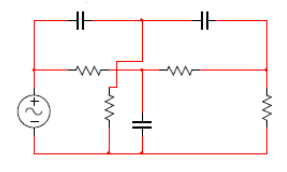
A. 3
B. 4
C. 6
D. 7
Answer: Option A
Solution:
546. Equivalent impedance seen across terminals a, b is
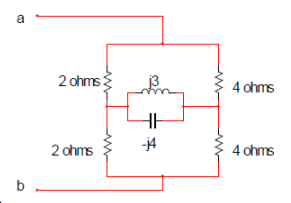
A. 16/3 Ω
B. 8/3 Ω
C. 8/3 + j12
D. none of these
Answer: Option B
Solution:
547. What is the Rab in the circuit when all resistors values are R?
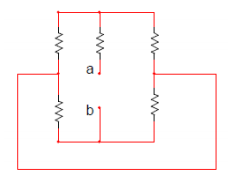
A. 2R
B. R
C. R/2
D. 3R
Answer: Option A
Solution:
548. Find Rab. All values are in ohms.
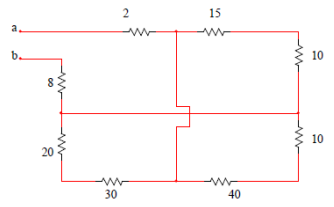
A. 22.5
B. 40
C. 30
D. none of these
Answer: Option A
Solution:
549. Find the equivalent resistance of the circuit in the figure.
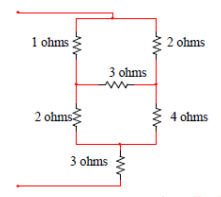
A. 3 ohms
B. 4 ohms
C. 5 ohms
D. 6 ohms
Answer: Option C
Solution:
550. Find the equivalent resistance of the circuit in this figure.
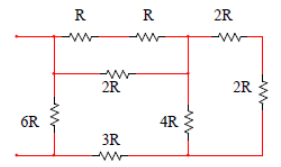
A. R
B. 2R
C. 3R
D. 4R
Answer: Option C
Solution:
⇒ MCQ in DC Circuits Part 12 | REE Board Exam
Questions and Answers in DC Circuits
Following is the list of practice exam test questions in this brand new series:
Related Content



P inoyBIX educates thousands of reviewers and students a day in preparation for their board examinations. Also provides professionals with materials for their lectures and practice exams. Help me go forward with the same spirit.
“Will you subscribe today via YOUTUBE?”
TIRED OF ADS?
- Become Premium Member and experienced complete ads-free content browsing.
- Full Content Access to Premium Solutions Exclusive for Premium members
- Access to PINOYBIX FREEBIES folder
- Download Reviewers and Learning Materials Free
- Download Content: You can see download/print button at the bottom of each post.
PINOYBIX FREEBIES FOR PREMIUM MEMBERSHIP:
- CIVIL ENGINEERING REVIEWER
- CIVIL SERVICE EXAM REVIEWER
- CRIMINOLOGY REVIEWER
- ELECTRONICS ENGINEERING REVIEWER (ECE/ECT)
- ELECTRICAL ENGINEERING & RME REVIEWER
- FIRE OFFICER EXAMINATION REVIEWER
- LET REVIEWER
- MASTER PLUMBER REVIEWER
- MECHANICAL ENGINEERING REVIEWER
- NAPOLCOM REVIEWER
- Additional upload reviewers and learning materials are also FREE
FOR A LIMITED TIME
If you subscribe for PREMIUM today!
You will receive an additional 1 month of Premium Membership FREE.
For Bronze Membership an additional 2 months of Premium Membership FREE.
For Silver Membership an additional 3 months of Premium Membership FREE.
For Gold Membership an additional 5 months of Premium Membership FREE.
Join the PinoyBIX community.